

You know the scene. You open your wardrobe and a sleeve falls out. Two hangers are tangled like they’re hugging. Your favorite top is somewhere in the pile, probably, maybe, and the shelf above looks like a soft mountain that’s one strong sneeze away from falling. You tell yourself, for the tenth time this month, I really need to organize my wardrobe. Then you close the doors and wear whatever’s clean.
Here’s the secret nobody tells you. A wardrobe doesn’t stay messy because you’re lazy. It stays messy because it has no system. Clothes land wherever there’s space. Clean laundry goes back wherever it fits. Within two weeks, even a freshly tidied closet slides back into chaos, because tidying once isn’t the same as building a home for each thing. When girls say they want to organize my wardrobe, what they usually mean is bigger: they want a wardrobe that stays organized on a normal, tired, busy week. That’s what this article builds. Not a pretty afternoon. A system.
It works for big wardrobes, tiny wardrobes, and the shared-with-a-sister kind where your half is really a third. You don’t need new furniture, matching boxes, or a free weekend. You need one honest reset, a few clear zones, and habits so small they feel almost silly. Let’s build it step by step.
The Short Answer

Here’s the short version. To organize my wardrobe in a way that lasts, you can’t just tidy the surface. You empty it fully, sort by your real life, and give every category a fixed home zone. Most worn pieces live at eye level, in easy reach. Off season pieces live up high or stored away. Then you keep it alive with tiny habits, like a ten minute weekly sweep, instead of one giant rescue mission every few months. That’s the whole method. When girls tell me they finally managed to organize my wardrobe for good, it’s never because they bought cute boxes. It’s because every single thing they own has a home, and putting it back takes seconds, not decisions.
Start With Everything Out: The Honest Reset
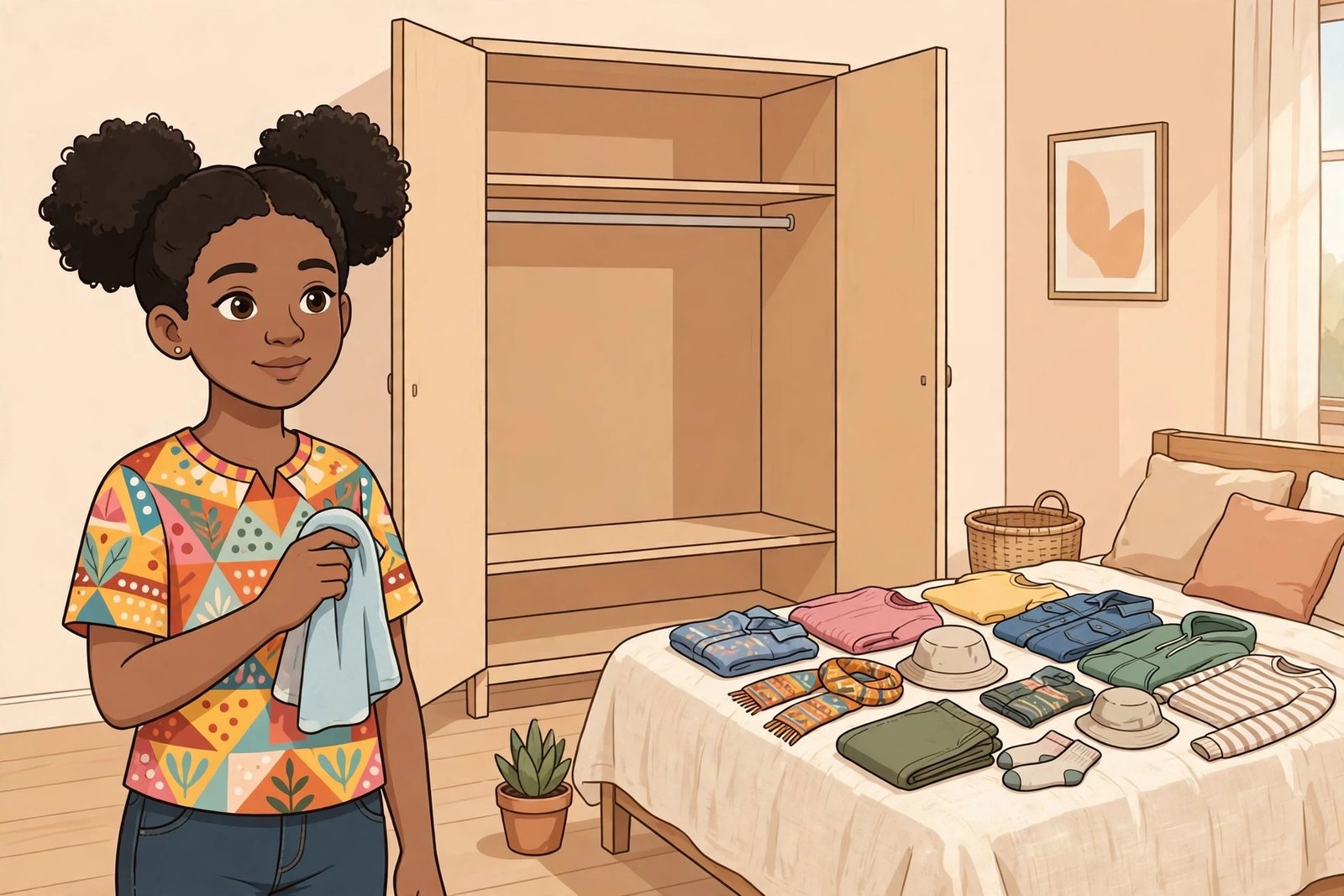
Every lasting system starts the same way: everything comes out. Not the one shelf that bothers you. Everything. Clothes on the bed, shoes in a row on the floor, the mystery items from the back corner too. It looks worse before it looks better, and that’s normal. You can’t organize my wardrobe by shuffling the same piles from one side to the other. The full emptying is what shows you the truth: how much you own, what you forgot you own, and why the space never worked.
While the wardrobe stands empty, give it a quick wipe. Shelves collect dust, and putting clean clothes back into a dusty box starts the whole cycle grumpy. This is also your one chance to look at the space itself. Where’s the rod? Which shelves exist? What’s the awkward corner where things go to disappear? A wardrobe is a small room with a floor plan, and you’re about to plan it properly.
Now, the honest part. As pieces come out, some of them tell on themselves. The top with the tag still on from last year. The jeans that haven’t fit since two summers ago. The dress you keep for a life you don’t live. You’re not doing a big emotional clear out today, and you don’t have to let anything go. But do make a small “not now” pile for pieces that aren’t part of your current life. They can live in a bag up high or under the bed. The working wardrobe, the one you dress from daily, should hold only clothes that are in the game.
That one move is half of what it means to organize my wardrobe for real: the daily space serves daily life, and everything else gets stored with the storage things, not mixed into your mornings.
Halfway through the emptying, a voice may pop up: why did I start this today? That’s the mess peak talking, and it passes. Take a quick photo of the empty wardrobe and the full bed. It sounds silly, but the photo helps twice. First, it proves to your brain that the space is smaller than the mountain of clothes suggests. Second, it’s the before picture you’ll want later, when the system has been running for a month and you’ve forgotten how bad it was. Every girl I know who’s said “fine, I’ll organize my wardrobe properly this time” has hit this messy middle. Push through it. The sorting is where it turns.
Sort by Your Real Life, Not Your Fantasy Life

With everything out, it’s time to sort. Most advice says sort by color or by type, and that comes later. First, sort by your actual week. Make piles that match your real days: school or work clothes, home and comfy clothes, going out pieces, sports or activity gear, and special occasion outfits. Your life has a shape. Your wardrobe should be sorted in that same shape, so the clothes you reach for most are grouped where your hand goes first.
Be honest about the numbers. If five days a week are school days, school clothes are your biggest pile and deserve the best space. The party pile, if it’s three pieces worn twice a year, doesn’t get prime shelf room just because it’s pretty. This sounds obvious, but most messy wardrobes are sorted the other way: fantasy pieces in front, daily pieces buried. Girls who organize my wardrobe by real life first are always shocked by how much easier mornings get, because the closet finally matches the calendar.
Inside each life pile, do a second, quicker sort by type: tops with tops, bottoms with bottoms, dresses together. And here’s where the fantasy check from the piles helps again. If your going out pile is huge but your going out life is small, that’s not a sorting problem. That’s information. You don’t have to act on it today. Just notice it. A wardrobe sorted by the life you have, rather than the life in your head, is a wardrobe that stops fighting you.
One more sorting trick that saves future you a lot of pain: make a small “repair and wash” pile as you go. The blouse missing a button, the top that needs a proper stain wash, the sweater that’s fine but smells like the back of the closet. These pieces aren’t part of the system until they’re usable again. Putting broken clothes back into the clean zones is how chaos sneaks back in through the side door.
Give Every Category a Home Zone

Now the empty wardrobe gets its map. This is the heart of the whole thing. When you organize my wardrobe by zones, every category gets one fixed home, and only one. Tops live here. Bottoms live there. The rule is so simple it sounds too simple: a thing has a place, and it always goes back to that place. Finding clothes becomes fast because you’re not searching. You’re visiting an address you know by heart.
Draw the map by reach. The golden zone is between your knees and your eyes: rods and shelves you can grab without stretching or crouching. That zone belongs to your most worn categories, the school or work pieces you touch five days a week. Higher shelves take the light, rare stuff: special occasion pieces, off season clothes in boxes, the not now bag. Low shelves and the floor zone take shoes and heavy things. If you hang clothes, keep the daily rod section at the front, where your hand lands when the doors open.
Inside each zone, a light order helps, but don’t overdo it. Within tops, you can group by sleeve length or by color, whatever your eyes like. The exact order matters far less than the zone itself. A rough system you follow beats a perfect system you abandon by Thursday. Organizers online love color rainbows, and they do look lovely. But if rainbow sorting makes laundry day slower, your brain will quietly stop doing it, and the rainbow will melt by the weekend. Choose the version of order that your tired self can keep.
Label if it helps, especially in drawers and boxes. A small piece of tape with a word on it feels silly for one afternoon and saves you for a year. When a friend or a sister shares the space, labels quietly end the “where does this go” debate before it starts. Zones plus labels turn putting laundry away from a thinking task into a matching task, and matching is fast even when you’re tired. That’s the real difference between a wardrobe that was tidied once and a wardrobe that stays tidy: the system does the remembering for you.
Here’s a tiny example of zones doing their quiet magic. Monday morning, half asleep, you reach for school tops. Your hand goes to one shelf, not a treasure hunt through the whole wardrobe. Home from school, you change into comfy clothes from their drawer, and the school top goes back to its shelf while you’re still in motion. Nothing was searched for. Nothing was decided. When you organize my wardrobe into zones, you remove dozens of tiny daily decisions, and that’s why the tidy feeling lasts past the first week. The zones remember, so your brain doesn’t have to.
Sorting by Season Without Losing Your Mind

Seasons are where good systems go to die, if you let them. The problem is simple: your wardrobe holds twelve months of weather in a space built for about three. Summer dresses crowd the rod in December. Bulky sweaters eat the shelf in July. The fix isn’t a bigger wardrobe. It’s rotation, and rotation is just giving the off season a waiting room somewhere else.
Twice a year, spring and autumn, do a swap. Off season clothes get washed, folded, and stored in a box, a suitcase, or a bag on the top shelf or under the bed. Current season clothes take over the golden zone. When you organize my wardrobe with rotation, the daily space only ever holds what the sky is actually doing, and suddenly the same closet feels twice as big. Girls are often stunned by this part. Nothing was bought, nothing was thrown away, and yet there’s air between the hangers.
The swap is also a natural honesty check, twice a year, for free. As winter pieces come out, you see what you never wore last winter. As summer pieces go in, you notice what never left the hanger. You don’t have to make big decisions on the spot. Just seeing it, season after season, teaches you what your real style is, better than any quiz. And pieces that fail the check three seasons in a row can move to the not now bag without drama.
A few practical details keep rotation painless. Wash everything before storing, because small stains grow in the dark. Use boxes you can see into, or label boxes clearly, so next season’s swap starts with finding instead of digging. Keep one in between layer, like a light jacket, in the daily zone all year, because weather loves surprises. And if your climate barely changes, rotate by school term or by sports season instead. The idea isn’t the calendar. It’s that not everything you own needs to live in arm’s reach at the same time.
The first time you organize my wardrobe by season, the swap will feel slow. That’s normal. You’re building the boxes, the labels, and the habit all at once. The second swap takes half the time, because the storage spots already exist and your hands know the routine. By the third, it’s a background task you do with music on, not a project. If a piece survives three swaps without ever being worn in its season, that’s your answer about it, given gently by the calendar instead of by a guilt trip. Rotation doesn’t just save space. It tells the truth, slowly and kindly.
Small Closet, Shared Closet: Tricks That Still Work

Maybe your wardrobe is tiny. Maybe it’s half a wardrobe, shared with a sister who has a different idea of tidy. Good news: a system matters even more in a small space, not less. In a big closet, chaos can hide. In a small one, zones are the only thing standing between you and a daily avalanche. When you organize my wardrobe in a tight space, every centimeter gets a job, and the rules below earn their keep fast.
Think vertical. The space above the rod and below the hanging clothes is usually wasted. A hanging shelf strip can turn dead air into folded zones for tees and leggings. Hooks on the inside of the doors hold belts, caps, or tomorrow’s outfit. The floor, if shoes live there, gets one row only, in pairs, toes out. A second row is how shoe swamps begin.
If the closet is shared, draw the border clearly and kindly. Her zones, your zones, maybe one shared zone for things like formal pieces. Trouble starts when clothes drift across the border and laundry day becomes an argument. A simple agreement helps: each person owns their zones, and putting things back takes under a minute because the map is obvious to both of you. If your sister won’t sort hers, sort yours anyway. Half a calm wardrobe still calms your mornings.
For very small spaces, the capsule idea can quietly help. Keeping a smaller set of pieces that all mix well means the daily zone stays light. Our guide on building a capsule wardrobe on a budget shows how a tight, well chosen set works in real life. You don’t need to go full capsule. Even trimming the daily zone to the pieces you truly rotate makes a tiny closet breathe.
Your half still counts, even if it’s really a third. When you organize my wardrobe on your side of the border, your clothes stop vanishing into the shared blur, and getting dressed stops depending on anyone else’s habits. There’s a second, sneakier win: a tidy half is contagious. Sisters who would never accept a lecture will quietly copy a system they see working every morning. Don’t preach it. Just let your zones do their calm, daily demo. And if space is truly shared down to the shelf, stack your folded piles with a divider between households, so laundry day has a border that eyes can see.
Drawers, Shelves and Hangers That Earn Their Place

Storage tools promise miracles, but the honest truth is smaller: a few basics, used well, beat a pile of gadgets. Start with hangers. Matching, slim hangers save more space than any fancy box, and they stop the wire tangle that makes mornings grumpy. Velvet style hangers grip slippery tops. Wooden ones carry heavy coats. Pick one main type for the rod so clothes hang at the same height and slide like they belong together.
Drawers work best one category deep. A drawer of all tops, folded so you can see each one, like files in a cabinet, means no more digging to the bottom for the one tee. If you fold in stacks, keep stacks short, five or six pieces, because the bottom of a tall stack is a place clothes go to be forgotten. Shelf dividers or small open boxes keep stacks from sliding into each other. That’s most of what organizers sell you, honestly: walls. Small walls between categories so piles stay piles.
Notice how every tool here serves the zone map from earlier. That’s on purpose. When you organize my wardrobe, tools come last, not first. Buying boxes before you have zones is decorating a mess. With zones set, you’ll see exactly which tools you need, and it’s usually two or three, not twelve. A clear box for off season scarves. A divider for the sweater shelf. Hooks for the door. Done.
One more piece of honesty: skip the tools that fight your habits. If you know you’ll never fold a tee the fancy way at 10 pm, use a basket for tees instead. A system built on your real habits survives. A system built on a stranger’s habits looks great in a photo and collapses by Sunday. Home keeping writers share the same advice in guides like this closet organization guide from Homemade Simple, which also puts usage and season first when deciding what lives where. The principle travels well: store by how you live, not by how a photo looks.
The Ten Minute Habits That Keep It Tidy

Here’s the part that decides everything. A system without habits is a photo. A system with tiny habits is a lifestyle. The girls who organize my wardrobe once and keep it that way aren’t doing monthly overhauls. They’re doing small things so often that mess never gets a chance to grow roots. Ten minutes a week is the whole maintenance budget. Ten. That’s less than one scroll session.
Habit one: the return rule. When you take something off and it’s still clean, it goes back to its zone the same day. Not on the chair. The chair is where systems go to die, because one shirt on a chair invites a second, and by Friday the chair is a second wardrobe with no zones at all. Hang it or fold it back while you’re changing. It takes twenty seconds, and it saves the Saturday rescue mission.
Habit two: laundry comes home. When clean clothes come back, they go straight to their zones before they touch a surface. The pile of clean laundry on the bed feels harmless, but it’s the mess seed. Sorted into zones, it’s done in five minutes. Left in a heap, it blends with the worn pile, and soon nobody knows what’s clean. This is also where knowing your own style helps quietly: girls who know their look own less filler, and our article on how to find your personal style is a kind place to start if your piles include a lot of “not really me” pieces.
Habit three: the weekly sweep. Pick a day, Sunday evening works well, and give the wardrobe ten minutes. Rehang the drifters. Fix one messy stack. Pull out anything that landed in the wrong zone. That’s it. And habit four rides along with shopping: one in, one out. A new piece earns a zone by taking the place of a tired one, so the total never quietly grows past what the space can serve. When you organize my wardrobe with these habits running, the big reset becomes a once or twice a year event, not a monthly emergency.
And the next time you say the words to yourself, organize my wardrobe, it’ll be about a quick seasonal swap, not a cry for help.
And here’s the quiet reward waiting a few months down the line. A friend opens your wardrobe to borrow a top and says the sentence you once said about other girls: “Your closet is so organized.” You’ll smile, because you know it isn’t talent and it isn’t the boxes. It’s zones plus ten small minutes a week. When she sighs that she needs to organize my wardrobe too, you’ll know exactly what to tell her: empty it all, sort by real life, give everything an address. The system that saved your mornings is simple enough to hand over in one conversation.
Frequently Asked Questions
How long does a full wardrobe reset take?
For a teen wardrobe, plan two to three hours, with music and a drink nearby. The emptying and sorting take the longest. The zone setup is quick once piles are clear. Small or shared closets can take less time, since there are fewer pieces, but the sorting honesty matters more. Don’t rush the sorting step. It’s where you decide what your daily life looks like, and every step stands on it. Most girls who organize my wardrobe this way say the time flies once the piles start making sense.
What if I have almost no storage space?
Then zones matter even more. Use door backs, under bed space, and high shelves for storage, and keep only the current season in arm’s reach. Fold vertically in drawers so you can see everything at once. A small wardrobe with a clear map beats a big one with none, every morning. The girls with the tiniest closets are often the most organized, because the space forces the system. If you can organize my wardrobe in a space the size of a fridge, you can do it anywhere.
How do I share a wardrobe with my sister without fights?
Draw the border and label it, kindly but clearly. Each person owns their zones and puts their own laundry back. Agree on one shared zone for rare pieces, like formal dresses. Most fights aren’t about mess at all. They’re about clothes drifting into the wrong half and borrowing without asking. A visible map ends the drift. If she won’t keep her side tidy, keep yours anyway. When you organize my wardrobe on your half only, your mornings still get calmer, and your example often spreads.
Should I sort by color or by type?
By type and by life first, by color second, if at all. Your hand looks for “a top for school,” not “something blue.” Grouping by category and by how often you wear each piece makes finding and returning fast. Color order inside a category is a nice finishing touch if you enjoy it, but it’s decoration, not structure. If color sorting slows down your laundry days, skip it without guilt. A system you’ll actually keep beats a pretty one you won’t.
How often should I redo the whole organization?
A full reset once or twice a year is plenty if your habits are running. The seasonal swap is the natural moment: as you rotate clothes, you recheck zones and catch drift early. Between swaps, the weekly sweep handles the rest. If you want a full redo every month, that’s a sign the daily habits slipped, not that you need a new system. Go back to the return rule for two weeks. When most girls organize my wardrobe with the habits in place, the dramatic reset stops being necessary.