

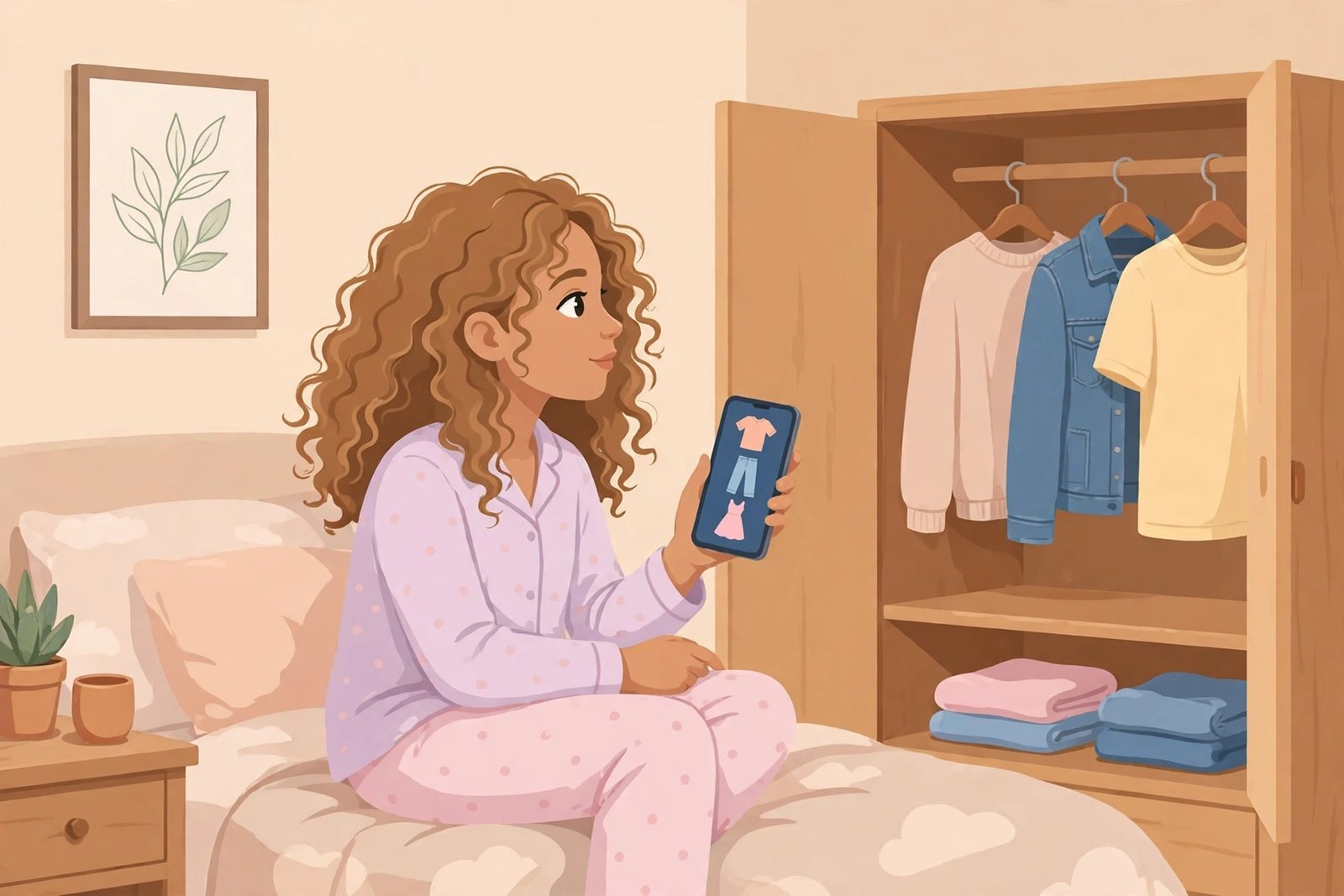
You’re standing in front of your closet in your pajamas. The doors are wide open. Clothes are hanging in a thick row, folded piles are stacked on the shelf, and one drawer is so full it barely closes. And still, the same sentence pops into your head, clear as a bell. I always feel like I have nothing to wear. Not today in particular. Always. It was there yesterday morning. It was there before the last family lunch. It will probably be there tomorrow too.
Here’s the strange part. If someone counted your clothes, the count wouldn’t be small. Twenty tops, easy. Six pairs of jeans or pants. Dresses from two summers ago. A skirt you forgot you owned. The closet isn’t empty, and you know it. So why does your brain keep telling you there’s nothing in there? Why does that one sentence, i always feel like i have nothing to wear, feel so true when the facts say the opposite?
This article isn’t here to hand you outfit ideas for this morning. If you need something to wear right now, our guide on what to wear when you feel like you’ve nothing to wear can rescue today’s outfit in five minutes. This page does something different. It looks at why the feeling shows up at all. Because once you understand the five or six quiet reasons behind it, the sentence loses its power. You stop hearing “my closet is broken” and start hearing something much more fixable. Let’s take the feeling apart, piece by piece, like the closet itself.
The Short Answer

The short version is this. When i always feel like i have nothing to wear runs through your head, your closet is rarely the real problem. Your brain is. Too many choices can freeze it. Some of your clothes were bought for a fantasy version of your life. Some can’t be worn because a basic piece is missing, or because they’re sitting in the laundry basket. And your eyes compare your real closet with perfect outfits online. The feeling is a signal, not a fact. Read it like a diagnosis, and it gets much quieter.
By the end of this article, you’ll know how to run a kind closet check, find which of the hidden reasons is yours, and fix that one thing. And on the mornings when i always feel like i have nothing to wear still shows up, you’ll know it’s just an old habit talking, not the truth about your clothes.
Your Closet Is Full, So Why Does It Feel Empty?

Let’s start with the part that feels almost unfair. Your closet can be full and still feel empty to you. Both things can be true at the same time, because “full” is about numbers and “feels empty” is about something else entirely. Your brain doesn’t count clothes. It scans them. In about three seconds, it looks for one thing: an outfit it can picture you wearing today, with your mood, your plans, and the weather outside. If it can’t picture one fast, it sends the alarm. I always feel like I have nothing to wear. The alarm is about outfits, not items.
Think of it like a fridge. A full fridge can still hold nothing you want to eat. Ten ingredients that don’t go together are not dinner. Clothes work the same way. A closet can hold forty single pieces and almost zero complete outfits that feel like you. The striped top needs the plain pants, but the plain pants are in the wash. The cute dress needs the cardigan, but the cardigan has a missing button. Every piece is almost an outfit, and almost isn’t enough at 7 in the morning.
There’s also the mood filter, and it’s stronger than you think. On a tired, flat morning, your brain quietly rejects anything that feels like effort. The dress that needs ironing? Rejected. The jeans that feel tight after breakfast? Rejected. The top that only works with the good bra, which is also in the wash? Rejected. Within seconds, your brain has crossed out half your closet without asking you. Then it looks at what’s left, shrugs, and reports: nothing. So when i always feel like i have nothing to wear, part of what you’re feeling is a tired brain doing fast, lazy math.
There’s one more test that proves the point. Ask yourself when the feeling is strongest. For most girls, it isn’t before a slow Sunday at home. It’s before school, before plans, before days when other people will see them. The closet didn’t change between Sunday and Monday. The pressure did. So when i always feel like i have nothing to wear on a Monday, you’re often hearing pressure, not fabric. And if i always feel like i have nothing to wear mostly on busy, watched, rushed days, that pattern itself is the first clue of your diagnosis.
One more quiet factor is sameness. If most of your clothes look alike, your eyes stop seeing them. Five black tops in a row read as one black top. Your brain gets bored, and bored feels a lot like empty. The clothes are there. They just stopped registering. This is why a friend can open your closet and say “you’ve so many cute things” while you see a grey blur. She sees the pieces fresh. You see the blur of a hundred mornings.
Too Many Choices Can Freeze Your Brain

Here’s a reason nobody suspects. Having more clothes can make choosing harder, not easier. Your brain loves a short list. Give it three options and it picks one, quick and calm. Give it forty options and it starts comparing, doubting, and second guessing. What if the other top was better? What if this skirt looks odd? What if I regret this by second period? The comparing drains you. Pretty soon, deciding feels like homework, and your brain takes the easiest exit it can find: it declares there’s nothing to wear and closes the case.
There’s a name for this drained feeling. A plain, helpful read on it’s this Psychology Today piece on decision fatigue, which explains how too many choices in a short time wear the brain down until even small picks feel hard. Getting dressed is one of the first decisions of your day. If your closet makes it a forty option exam, you start the day already tired. No wonder the words i always feel like i have nothing to wear show up so often in busy weeks and so rarely on slow holiday mornings, when your brain is rested.
Watch for the loop it creates. A frozen morning makes you late. Being late makes you rush. Rushing makes you grab the same safe outfit again. Wearing the same safe outfit again makes the rest of the closet feel even more unworn and useless. And unworn clothes make the next morning’s scan even bleaker. Round and round it goes. The loop is why the feeling says “always.” It’sn’t describing your closet. It’s describing a cycle.
The good news is that cycles can be interrupted at any point. Fewer visible choices help more than more clothes. Some girls hang only this week’s likely pieces at the front. Some keep a short mental list of three outfits that always work. If mornings are your hard moment, our article on what to wear when you don’t know how to dress walks through building that kind of go to list. The point isn’t rules. The point is giving your morning brain a short list, so it stops freezing in front of a long one.
When the scan takes ten seconds instead of ten minutes, the sentence i always feel like i have nothing to wear has nothing to feed on.
The Fantasy Clothes Hiding in Your Closet

Now we get to the sneakiest reason of all. Part of your closet doesn’t belong to your real life. It belongs to a fantasy one. You know these pieces. The dress bought for parties you never go to. The heels for a fancy dinner life you don’t live. The top that would be perfect if you were the kind of girl who goes to art galleries on Sundays. Fantasy clothes are bought for a mood, a trip, or a version of you that exists mostly in your head. They hang there, pretty and unworn, taking up space and hangers.
Here’s why they matter so much. Every morning, your brain scans your closet and counts what you can actually wear today. Fantasy pieces get counted by your eyes but rejected by your life. You own them, but you can’t use them. So your closet looks full on the outside and feels much smaller on the inside. A girl can own fifty pieces and still live in twelve. When that gap is big, the daily math is brutal: forty pieces she walks past, a handful she can wear. Of course she ends up saying i always feel like i have nothing to wear. By her real wardrobe count, she almost does.
How do fantasy clothes get in? Usually through happy moments. A sale on holiday. A shopping trip where you felt bold and new. A gift from someone who loves a fancier version of you. None of that makes you silly. It makes you human. We all buy for the girl we hope to be sometimes. The trouble is only that she doesn’t show up on school mornings, and her clothes wait for her like guests at a party she never attends.
Try this gentle test on any piece. Can I picture the exact day, place, and plan where I’ll wear this in the next two months? If a real picture comes fast, the piece belongs to your life. If you’ve to invent a whole new lifestyle first, it’s a fantasy piece. You don’t have to throw it out today. Just knowing which pieces are fantasy changes the morning scan. You stop counting them as options, the fake fullness drops away, and the real wardrobe, the wearable one, finally becomes visible. And honestly, on the day i always feel like i have nothing to wear, half the pain is staring at a closet full of someone else’s life.
The Pieces You Own but Cannot Actually Wear

Some reasons are less about your head and more about plain, boring logistics. A surprising share of any closet is made of pieces that are technically yours but practically out of service. The blouse with the loose button you keep meaning to sew. The jeans with the broken zipper pull. The white top with the faint stain that shows in bright light. The sweater that only works over one specific camisole, and the camisole is always missing. Each one is a tiny locked door in your closet.
There’s also the almost outfit problem. Many closets are heavy on fun tops and light on the quiet basics that hold outfits together. Ten interesting tops and one pair of pants that goes with all of them means you really own one outfit’s worth of bottom half. When that one pair is dirty, ten tops are suddenly useless. Your brain isn’t being dramatic when it says i always feel like i have nothing to wear. That morning, in a very real sense, the bottom half of your wardrobe is one pair of jeans deep.
Shoes can lock doors too. The dress you love needs the sandals that hurt by noon. The skirt looks right only with boots that are still muddy from last weekend. So both stay unworn, morning after morning, and your eyes learn to skip them. After a while you stop seeing whole sections of your own closet. They become decoration. And a closet that’s half decoration will always feel half empty, no matter how full the rail looks.
The fix here’s refreshingly unglamorous. A tiny repair pile, sewn and sorted on one quiet afternoon. One or two missing basics added to a list for the next shopping trip. A honest look at which shoes your real outfits actually need. None of it’s fun to shop for. Nobody dreams about buying the plain camisole. But these small, boring unlocks can double your wearable wardrobe without a single new statement piece. The next time you catch yourself thinking i always feel like i have nothing to wear, ask a plainer question first: how many of my pieces are actually unlocked and ready today?
The Outfits You See Online All Day
Let’s talk about the feed in your pocket. Every day, you scroll past girls in perfect outfits. The light is soft. The jeans fit like they were sewn on. The colors match in ways your closet never seems to manage. Those images are styled, filtered, and picked from dozens of tries. But your brain doesn’t file them under “advertising.” It files them under “normal.” And next to that standard, your real closet, with its mixed colors and lived in pieces, looks dull. Comparison quietly raises the bar until your own clothes can’t clear it.
This is why the feeling often hits harder after a long scroll. Ten minutes on a fashion feed before getting dressed is like studying a cooking show before making toast. Your toast didn’t change. Your standard did. The sentence i always feel like i have nothing to wear sometimes means something sneakier: nothing I own looks like what I just saw. Those are two very different problems, and only one of them is about your closet.
There’s a second comparison trap, and it lives closer to home. The friend who always looks put together. The classmate whose outfits seem to land every single day. What you don’t see is her own morning chaos, her own floor pile of rejected tops. Everyone’s closet feels disappointing from the inside. Hers too. She isn’t working with better clothes. She is working with the same human brain, and she has the same sentence in her head some mornings. She just doesn’t post that part.
You don’t have to quit the apps or unfollow anyone. Just move the timing. Get dressed first, scroll later. And when a feed makes your closet feel small, try naming what you actually liked in the photo. Often it’s one simple thing, like a belt, a tucked shirt, or a color pairing you already own the pieces for. Borrowing the trick is free. Borrowing the whole wardrobe is impossible, and your mornings calm down the moment you stop asking your closet to be someone else’s highlight reel. If you still whisper i always feel like i have nothing to wear after a scroll, that timing is your clue. It was never the closet. It was the comparison.
The Laundry Gap and Other Boring Practical Reasons

Time for the least glamorous reason of all: laundry. Your wearable wardrobe isn’t what you own. It’s what you own, minus what’s dirty, minus what’s in the wash, minus what’s drying, minus what’s in the pile on the chair that everyone pretends not to see. On a good week, that’s still plenty. On a chaotic week, your real wardrobe can shrink to a third of your closet. And it always seems to shrink right before the days that matter: picture day, the presentation, the party.
The laundry gap explains a pattern you may have noticed. The sentence i always feel like i have nothing to wear loves Mondays and the days right after busy weekends. That’sn’t your style failing. That’s your favorites sitting in a basket, waiting their turn. Your best jeans, your good top, your one bra that fits right: all out of service at the same time. A wardrobe can only take so many favorites being benched before the whole team looks weak.
There’s a cousin of the laundry gap, and it’s the seasons gap. A closet that’s half summer and half winter sounds balanced, until a strange weather week arrives. Too warm for the sweaters, too cold for the dresses, and the three pieces that fit the in between days get worn on repeat until you’re sick of them. Weather like that can make a perfectly fine closet feel broken for a week. It’sn’t broken. It’s just dressed for a different sky.
What helps is boring and it works. A rough laundry rhythm, so favorites come back before they all vanish at once. Washing the key pieces first when time is short. Keeping the chair pile on a short leash, because clothes on the chair are in a strange limbo: not dirty, not put away, and somehow never chosen. And when a morning still goes wrong, it can help to name the true reason out loud. Not “i always feel like i have nothing to wear,” but “my three favorites are in the wash.” One sentence is a judgment on you. The other is a scheduling problem, and scheduling problems have fixes.
A Gentle Closet Diagnosis You Can Do This Weekend

Now let’s turn all of this into one kind, doable check. You don’t need a free day, a trash bag, or a big emotional clear out. You need about forty minutes, your phone for a few notes, and honesty without self attack. The goal isn’t a perfect closet. The goal is finding which of the reasons in this article is your main one, because each reason has a different fix, and fixing the wrong one changes nothing.
Start by counting, roughly. How many pieces do you own, more or less? Then count how many you’ve worn in the last month. Most girls are surprised by the gap. If you own sixty and wore twenty, your problem isn’t quantity. Next, pull out the pieces you never wear and ask each one the fantasy question: can I picture the exact day I’ll wear this in the next two months? Sort them into a quiet maybe pile. You’re not throwing anything away today. You’re just learning your own numbers, maybe for the first time.
Then check the locked doors. Gather every piece that can’t be worn today: the broken zipper, the missing button, the stain, the top with no matching bottom. Count them. If that pile is big, your fix is repairs and one or two missing basics, not new clothes. After that, check your mornings. For one week, notice when the sentence shows up. Right after scrolling? On laundry days? On tired days? The pattern points at the cause more clearly than any single morning can.
One last part of the diagnosis is kindness, and it isn’t decoration. Beating yourself up in front of the mirror has never once produced a good outfit. It just adds shame to a problem that’s mostly logistics and brain habits. Talk to yourself the way you’d talk to a friend standing in the same spot: of course you’re stuck, half your favorites are in the wash and the rest don’t match. That’s a fixable week, not a failed style. The diagnosis works better, and faster, when the voice running it is on your side.
End with one small change, only one. Move your most worn, most loved pieces to the front, where your 7 am brain can find them without a search party. Make a short list of three outfits that work, and keep it in your phone. Do the tiny repair pile on a slow afternoon. Whatever you pick, let it match the cause you found. That’s the whole secret. The girls who stop saying i always feel like i have nothing to wear didn’t buy a new wardrobe. They found their one reason, fixed that, and let the feeling fade on its own.
And on the rare morning when i always feel like i have nothing to wear still pops up, treat it like an old song stuck in your head: familiar, a bit annoying, and not a fact you’ve to obey.
Frequently Asked Questions
Is it normal to feel like I have nothing to wear even with a full closet?
Yes, completely normal, and very common. Your brain doesn’t count pieces. It scans for a full outfit it can picture you in today, with your mood and your plans. If too many pieces are fantasy buys, locked by small problems, or stuck in the wash, the scan fails fast. That failed scan is exactly why i always feel like i have nothing to wear, even when the rail in front of you is packed tight.
Does buying more clothes fix the feeling?
Rarely, and often it makes things worse for a while. More pieces mean more choices for a tired morning brain, and new buys are often fantasy pieces that add to the unworn pile. If your real problem is a missing basic or a broken zipper, a new statement top can’t fix it. Buy the boring missing piece first. It unlocks outfits you already own, which is why i always feel like i have nothing to wear fades faster that way.
How many clothes do I actually need?
There’s no magic number, and anyone who gives you one is guessing. What matters is how many complete outfits you can build for your real life: school days, weekends, family events, your actual weather. A small wardrobe where everything matches and fits your days beats a huge one built for a fantasy life. Count outfits, not items. Ten pieces that combine well can give you weeks of calm mornings.
Why does the feeling hit harder on school mornings?
School mornings stack every trigger at once. You’re tired, so your brain rejects anything that feels like effort. You’re in a hurry, so the scan has to be fast. You saw classmates and feeds all week, so comparison is fresh. And favorites are often in midweek laundry limbo. Slow weekend mornings remove most of those pressures, which is why the same closet can feel fine on Saturday and broken on Tuesday.
What’s the fastest way to make mornings easier?
Give your morning brain a short list. Keep three outfits that always work written in your phone, with the pieces hung near the front of your closet. Decide the night before when you can. None of this needs new clothes or a big clear out. It just removes the forty option exam from your sleepiest hour. Most girls find that once the morning panic fades, i always feel like i have nothing to wear fades with it, because the sentence was never really about the clothes.