

You can own a full closet and still stand in front of it feeling like a stranger dressed you. The jeans were bought for a version of you that went out more. The blazer belongs to a job you left. The dress was perfect for someone else’s wedding, someone else’s body, someone else’s summer.
That mismatch is not a failure of taste. It is information. Learning how to find your personal style starts with reading that information honestly instead of buying your way out of it.
Most style advice begins with a shopping list. This guide begins somewhere quieter and far more useful: with your actual days, your actual body, your actual budget, and the clothes you already reach for when nobody is watching.
When women ask how to find your personal style, they rarely mean they want to look fashionable in a magazine sense. They mean they want getting dressed to stop feeling like a small daily argument. They want to open the closet and recognize themselves.
That is a learnable skill. It involves observation, a little psychology, some ruthless sorting, and a series of small experiments that cost little or nothing. It does not involve becoming a different person, following every trend, or waiting until your body, your income, or your life looks different.
This article walks through the whole process. You will learn how to find your personal style by studying your real life first, then your closet, then your body and your habits, and finally by building a small, working wardrobe that reflects all three. Along the way we will look at what research says about clothing and identity, the mistakes that keep women stuck, and the counter examples that prove there is no single right answer.
The short answer

The short answer is this: your personal style is not something you buy, copy, or declare in one afternoon. It is the pattern that emerges when you pay close attention to what you actually wear, what you feel good in, and what your life actually requires, then you repeat those things on purpose.
So how to find your personal style in practice? You audit your real week, you study the clothes you already love, you name the looks you are drawn to in plain words, you test small combinations at home, and you stop buying for a fantasy life that keeps not arriving.
That sounds simple, and the steps are simple. The hard part is honesty. Most closets are museums of other people’s expectations: a mother who said you looked better in dresses, a partner who liked a certain look, a workplace that rewarded blending in, an algorithm that showed you the same outfit forty times until it felt like your idea. None of it requires permission, a new body, or a new budget, which is exactly why how to find your personal style is a practice you can start today.
If you want a one sentence method for how to find your personal style, it is this: keep what you reach for, understand why you reach for it, and build everything else around that evidence. Your hands already know things your shopping cart does not.
Everything below is that sentence, expanded into a complete method you can work through in a weekend and refine over a season.
Why your wardrobe feels like someone else’s life

Before you change anything, it helps to understand how a closet drifts away from its owner. It rarely happens in one big mistake. It happens in dozens of small, reasonable decisions that added up to someone else’s wardrobe.
The first force is imitation without translation. You see a woman whose style you admire, and admiration is healthy. The problem starts when you buy her exact pieces without translating them into your climate, your job, your body, and your tolerance for maintenance. Her linen trousers work because she works from home in a warm city. In your rainy commute, they are a daily defeat.
The second force is the fantasy purchase. You buy for the life you plan to have: the gallery openings, the beach holiday, the promotion, the slimmer month. Psychologists who study self determination talk about the gap between the real self and the ideal self, and clothing is one of the most common places that gap gets stored, on hangers, with tags still on.
The third force is old rules that were never yours. Many women were dressed, directly or indirectly, by their mother’s fears, their school’s codes, or a culture that treated certain bodies as problems to solve. Those rules get internalized early and they run quietly for decades. You are not choosing against the black dress because you dislike it. You are choosing against it because at fourteen someone said black was too much on you, and the comment never left.
Naming these forces matters because it changes the task. You are not starting from zero and you are not broken. You are editing out layers of imitation, fantasy, old rules, and old lives. What remains, once those layers are named, is much closer to your style than anything a store can sell you. Once you see those layers clearly, how to find your personal style stops feeling like a mystery and starts feeling like an editing job you can actually finish.
There is also a social layer worth naming. Clothing is communication, and women know they are read through it at work, on dates, and in family photographs.
Start with your real life, not your fantasy life

Every reliable method for building a wardrobe begins with a calendar, not a catalogue. Your style has to serve the week you actually live, repeated roughly fifty times a year.
Start by writing down your real week in plain terms. How many days are spent at work, and what does work actually look like: office, shop floor, classroom, home desk, client meetings? How many evenings are at home, with friends, at family obligations? How much time is spent walking, driving, carrying children, sitting on trains?
Then note the physical facts. Your climate for most of the year. Whether you run warm or cold. Whether your feet can tolerate heels for a full day or only for a photograph. Whether you cook, clean, cycle, or kneel on the floor at work. These facts are not limitations on style. They are its raw material.
Next, divide your wardrobe needs by that reality. A woman who works five days in a smart office, walks her dog twice a day, and goes out once a week does not need equal amounts of office wear, dog walking clothes, and evening dresses. Yet many closets are divided almost randomly, heavy on the rare occasions and empty for the daily ones. That imbalance is why getting dressed feels hard on an ordinary Tuesday and strangely easy before a party.
A useful exercise is the seven day list. For one week, write down every outfit you wear, and give it a simple score out of ten for comfort and a score out of ten for feeling like yourself. Do not change your behavior for the exercise. You are collecting evidence, not performing.
Patterns appear fast. The same three combinations score high. The expensive piece scores low every time. The shoes that pinch get chosen and regretted on a loop. This small diary does more for your style than a month of saved images, because it describes you, not an audience. Keep the diary honest and unperformed, because honest data is what makes how to find your personal style possible at all.
How to find your personal style by reading your own closet

Your closet is the most honest style document you own. It records what you bought, what you kept, what you repaired, and what you quietly abandoned. Learning how to find your personal style means learning to read it like evidence.
Do a full audit, but do it in a kind order. Take everything out by category, not all at once, and sort into four groups: worn often and loved, worn often but not loved, rarely worn, and never worn. The second group is the most interesting. Those are your workhorses that almost work. They tell you exactly where your style is close but not right.
For each loved piece, ask four questions. What is the fabric and how does it feel at hour six, not minute one? What is the shape: fitted, loose, structured, flowing? What color family does it belong to? And what do you pair it with without thinking?
Write the answers down. After ten loved pieces, repetitions will jump out. Perhaps everything you love is high waisted, in navy, black, cream, or deep green, made of fabrics with some weight, and worn with the same two pairs of shoes. That repetition is not boring. That repetition is your style, photographed from the inside.
Now do the opposite pass. For the never worn pieces, name the real reason, out loud if you can. Not the polite reason. The real one: it needs a bra you do not own, it shows sweat, it rides up, it reminds you of the person who gave it to you, it fits a body you had in another decade, you feel costumed in it. Each real reason becomes a rule for future buying, written in your own words. Write each reason down in plain words, since a written rule is far easier to follow than a vague intention about how to find your personal style.
This is the heart of how to find your personal style without spending anything: convert your history into rules. Three or four honest rules, such as no sleeveless tops for work, no shoes I cannot walk twenty minutes in, no pale colors near my face, will protect you better than any trend report.
By the end of this audit you should have three lists: your repeat patterns, your buying rules, and your gaps. Gaps are specific and few, such as a warm layer that works with dresses, or shoes that survive rain and still look right at work. Specific gaps are the only shopping list you need from this whole process.
Body, fit and comfort: the parts no trend can decide for you
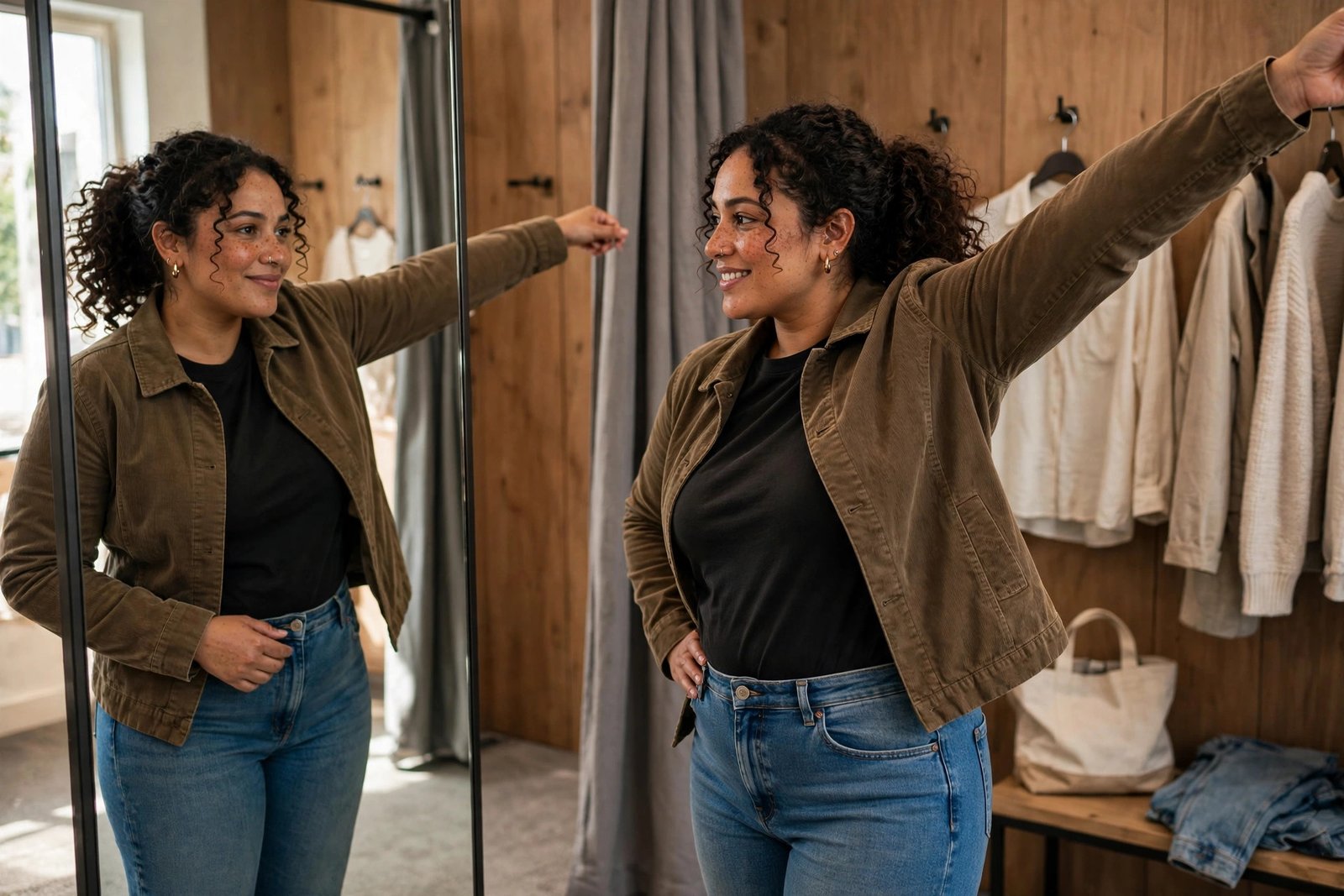
No guide to this subject is honest if it treats the body as a problem to dress around in shame. Your body is the constant in every outfit you will ever wear. Style that fights it loses every morning.
Start with fit, because fit does more work than fashion. Clothes that pull, gap, twist, or need adjusting every ten minutes will feel wrong no matter how current they are. Learn your key measurements and keep them in your phone: bust, waist, hips, inseam, and the shoulder width that decides whether jackets sit well. Sizes vary wildly between brands, and a number on a label is marketing, not information about you.
Learn, also, which lengths and shapes you stop adjusting. Some women feel best when a top ends at the hip bone, others when it is tucked, others in longer lines that skim. There is no correct answer, only your answer, and it is found by noticing, not by following charts drawn for an average woman who does not exist.
Comfort deserves a more serious definition than softness. Real comfort in clothing includes temperature, movement, skin feel, and psychological ease: not thinking about your clothes while you live your day. A dress can be physically soft and psychologically loud if you spend the evening monitoring it. Count that as uncomfortable, because it costs you attention, and attention is the whole day.
This is also where to be careful with advice about dressing for your shape that is really advice about hiding. You are allowed to emphasize what you like and downplay what you do not, that is ordinary dressing and every stylish person does it. But notice when a rule makes you feel like a suspect in your own clothes. Rules that produce ease are tools. Rules that produce vigilance are cages, whatever magazine printed them.
Bodies change, and a humane wardrobe expects it. Waistbands with a little give, wrap shapes, adjustable straps, and pieces that work across a small range of sizes are not compromises. They are engineering for a real life, in which bodies shift with cycles, seasons, health, and age. A wardrobe that only fits one exact version of you will punish you for being alive in a body. Dressing the body you have now, kindly and well, is not a detour from how to find your personal style. It is the road itself.
What research says about clothing, mood and identity

It is fair to ask whether any of this matters beyond vanity. Research in psychology suggests it does, in specific and limited ways that are worth understanding without exaggeration.
A concept often discussed in this area is enclothed cognition, the idea that what we wear can influence how we think and act, partly through the meaning we attach to the clothes and partly through the physical experience of wearing them. The original studies were small and later work has debated how strong the effect is, so treat it as a suggestion, not a law: clothes you associate with competence may help you feel and act a little more competent, especially when you also feel physically at ease in them.
Research on self determination offers a sturdier frame. People tend to feel better and persist longer at things they experience as self chosen rather than imposed. Applied to dress, outfits chosen to express your own values tend to support confidence in a way that outfits chosen purely to win approval often do not. The mechanism is not magic. It is the daily experience of seeing your own choices in the mirror and recognizing them as yours.
Fashion media can be a useful witness here rather than a judge. Browsing a recognized magazine such as Vogue with your three style words in hand is a different experience from browsing it hungry for a new identity. You stop asking, should I become this, and start asking, does this contain one element I can translate: a color pairing, a proportion, a way of layering.
The research, taken together, supports a modest and encouraging claim. How you dress will not fix your life, your mood, or your self worth. But a wardrobe aligned with your identity and your days removes a daily source of friction and adds a daily, visible act of self recognition. Small, repeated, and real: that is how most durable changes work.
Building a small wardrobe that actually works

Once you know your patterns and your gaps, building becomes surprisingly unglamorous, and that is a good sign. A working wardrobe is mostly repeats, near repeats, and pieces that agree with each other.
Begin with your core. For most women this is a small set of bottoms, tops, layers, dresses or alternatives, and shoes that cover her real week. The exact numbers depend on laundry habits and climate, but the principle is fixed: every core piece should combine with at least three others you own, in colors from the palette your audit revealed. A beautiful piece that combines with nothing is not core. It is a guest.
Choose your palette from evidence, not from a color chart someone sold you. Your loved pieces already voted. Most women find they live in three or four main colors and one or two accents. Let that stand. A limited palette is not a lack of imagination. It is what makes twenty pieces behave like sixty outfits, and it is how recognizable personal style is actually built: repetition that other people start to read as signature. A palette drawn from your own loved pieces is one of the most reliable shortcuts in how to find your personal style, because it was chosen by your life, not by a chart.
Then add your distinguishing elements, the things that make the core yours. These are usually small: a preference for gold over silver, a rolled sleeve, a particular boot, a red lip, a vintage bag, scarves, sharp collars, soft knits, always a blazer, never a blazer. Two or three repeated signatures do more for identity than a closet of one off statements. Think of the women whose style you can describe in one sentence. That sentence is made of repeats.
Travel is a surprisingly good teacher here. Packing for a week in a city like Montreal forces the same discipline: pieces that layer, combine, and survive walking. If you have ever lived happily out of a suitcase for ten days, you have proof that a small, coherent wardrobe works, and a guide like what to do in Montreal will remind you how much of a trip is spent on foot, in weather, living real days rather than posing for them.
Shopping, mistakes and counter examples

Even with good rules, shopping is where most wardrobes go back off course, because shops are designed to sell you a feeling quickly. Knowing the common traps in advance is the best protection, and it is a core part of how to find your personal style and keep it.
The first trap is the sale that changes the question. The question stops being, would I choose this at full price for my real week, and becomes, can I afford to miss this bargain. Pieces bought under that spell are disproportionately represented in every never worn pile ever audited.
The second trap is shopping for a single event with a whole new identity. A reunion, a wedding, a first date: the stakes feel high, so the purchase gets grand. You end up costumed as an exaggerated version of yourself at exactly the moment you wanted to feel most like yourself. For big events, the safer rule is your style, slightly elevated: your colors, your shapes, better fabric, more care with hair and details. For single events especially, remember that how to find your personal style is about repeating what is truly yours, slightly elevated, not inventing a stranger for one evening.
The third trap is buying the same almost right thing repeatedly. Three black tops that are each slightly wrong are more expensive, in money and morale, than one right one. When you notice a repeat purchase, stop and diagnose the original. The problem is specific: neckline, length, fabric weight, transparency. Name it and the loop usually breaks.
Now the counter examples, because they matter. Some women thrive with large, eclectic wardrobes and dress by mood, and their style is real even though it breaks every capsule rule. Some women wear a near uniform and are expressing themselves precisely through that refusal of variety. Some women find their style at twenty and keep it for life; others change completely at fifty after a divorce, a new country, or a new body, and the later style is not less authentic for arriving late.
There is a relationship angle here that is rarely said plainly. Dressing to keep a partner’s approval, or to compete with an image of who he might look at, quietly hands your wardrobe to someone else’s taste. It can help to read about independence inside relationships, such as why some men want an independent woman but cannot handle her, and notice how the same pattern applies to dress: autonomy that is welcomed in theory is sometimes resisted in practice. Your style is a reasonable place to practice keeping your own vote.
The test that survives all counter examples is simple. Does your wardrobe, as it stands, help you live your days feeling recognizable to yourself? If yes, protect it from advice, including parts of this article. If no, change it by evidence and experiment, not by overhaul and regret.
What to do next
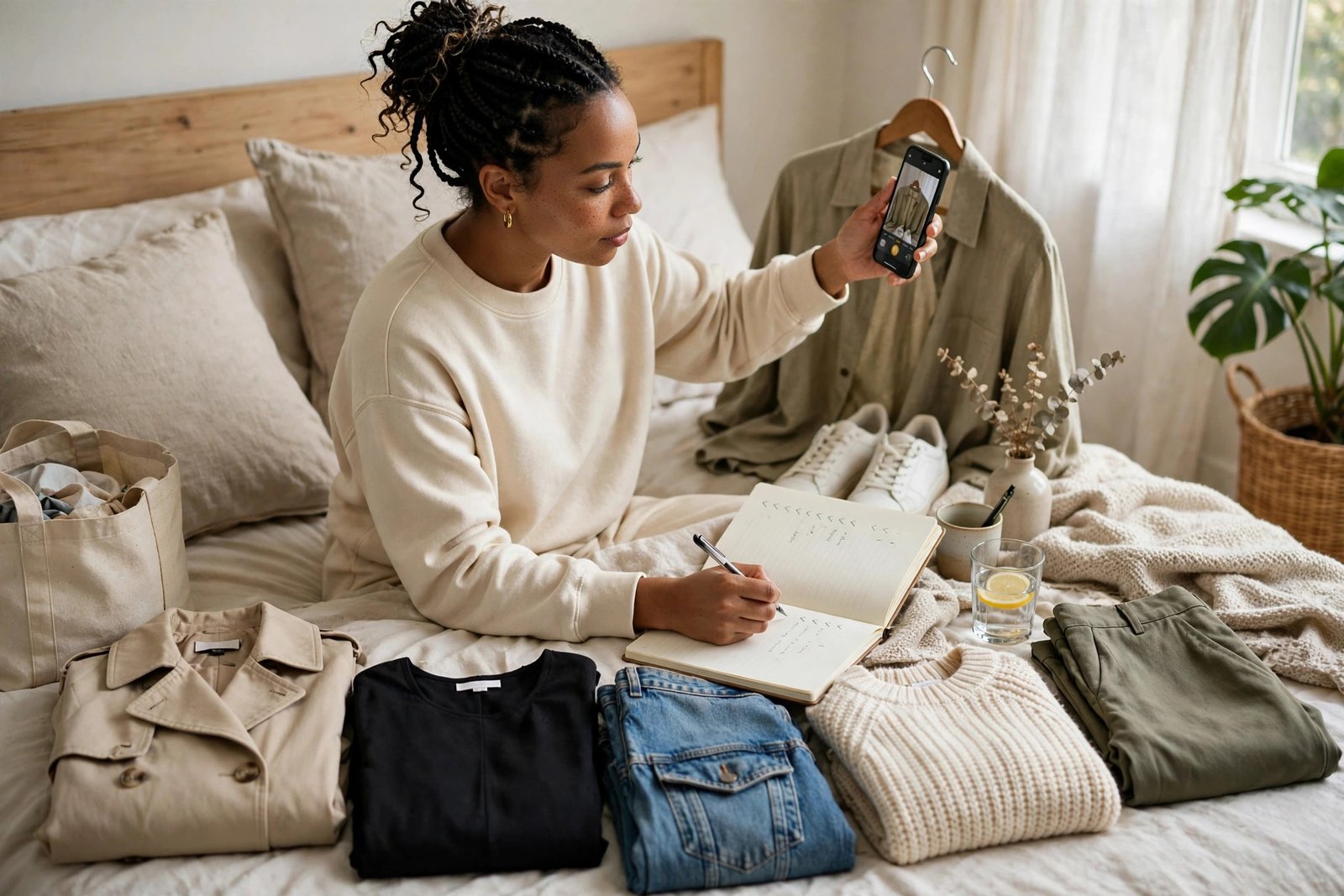
Here is a concrete plan for the next two weeks, designed to be finished rather than admired. Finishing matters, because an unfinished style project becomes one more source of morning guilt, and guilt was never a good stylist.
On day one, start your seven day outfit diary. Photograph each outfit, score it for comfort and for feeling like yourself, and write one line about why. No buying, no sorting yet. Observation only, the way any honest inquiry begins.
On day eight, do the closet audit by category. Make your four groups, list your repeat patterns, write your buying rules, and name your gaps in specific words. Bag the never worn pieces that carry bad reasons, and set them aside for donation or sale at the end of the month, not tonight, so the decision can be calm. Treat the audit as a conversation with yourself, since that conversation is the engine of how to find your personal style.
In the second week, build five outfits from your loved pieces only, including one for work, one for an ordinary day off, one for an evening, one for bad weather, and one for the day you feel worst about how you look. That last outfit is the most important one in this whole guide. Decide it in advance, on a good day, and let it carry you on the bad ones.
Then choose your three style words and write them where you shop: in your phone list, with your gaps and measurements. Test every future purchase against the words, your rules, and your real week. If a piece fails two of the three, it stays in the shop, however beautiful it is on the rail. Those three words will do quiet work every time you shop, which is why choosing them carefully matters so much in how to find your personal style.
Finally, remember what this process actually is. Working out how to find your personal style is not a makeover with a reveal at the end. It is the slower, better business of aligning an ordinary daily tool with the woman who uses it. Expect it to take a season to feel settled. Expect to keep adjusting as your life changes, because it will.
Start small, repeat what works, and trust the evidence of your own good days. Your style is not hiding in a store, a trend, or another woman’s photograph. It is already present in the outfits you loved this year. Your job, starting this week, is simply to give those outfits more company and fewer contradictions.
FAQ

Questions are a healthy sign at this stage, because they mean you are testing the method against your real life instead of just nodding at it. Here are the ones women ask most often when learning how to find your personal style for themselves.
How long does it take to find your personal style?
For most women, the audit and first experiments take two to three weeks, and the wardrobe feels settled after one full season of wearing, repeating, and adjusting. You will feel early wins within days, especially from your five prepared outfits, but deep ease comes from repetition across real weather, real work, and real moods.
Do I need to throw everything away and start again?
Almost never. Starting again is expensive, wasteful, and usually unnecessary, because your loved pieces already contain your style in embryo. Remove only what carries a clear bad reason, keep the workhorses while you improve them, and replace gradually as pieces wear out. Editing beats replacing, in cost and in learning. Editing what you own, piece by piece, is also how to find your personal style on any budget, because it teaches you your own patterns before you spend anything.
What if I like very different styles on different days?
Then range may be part of your style, and the task is to give the range a shared backbone: a consistent palette, similar fits, or repeated accessories that make different moods read as one woman. Many women are not one note. The goal is coherence you can recognize, not uniformity you have to obey.
How do I find my style on a small budget?
The core of this method costs nothing: the diary, the audit, the rules, the five outfits, and better care of what you own. After that, buy one gap at a time, consider second hand for better fabrics at lower cost, and spend first on the pieces you wear most often each week. Cost per wear, not the tag, is the honest measure.
Can my personal style change as I get older?
Yes, and it should be allowed to. Lives, bodies, work, and countries change, and style that cannot change becomes a costume of a former self. Keep the method and let the answers update: audit once a year, keep your rules current, and let each decade dress the woman who is actually living it.
Pingback: How to Find Your Own Clothing Style as a Teen - The Honest Truth