

The closet is full. The bed is covered in rejected clothes. You are already ten minutes late, you have tried on four outfits, and the honest sentence in your head is not about fashion at all. It is: I have nothing to wear, and something must be wrong with me.
Nothing is wrong with you. That morning, repeated in bedrooms everywhere, is one of the most common and least understood wardrobe problems there is. Deciding what to wear when you feel like you have nothing to wear is rarely a problem of quantity. It is a problem of fit, mood, weather, laundry, self image, and a closet organized for a life you no longer live.
This guide treats the problem seriously and practically. First you will get a calm method for the morning itself, usable in ten minutes while the feeling is still loud. Then you will get the deeper diagnosis: why the feeling keeps returning, what psychology says about choice and stress, and how to rebuild a closet in which the feeling has far fewer places to hide.
Keep one idea with you from the start. The question of what to wear when you feel like you have nothing to wear is not really asking for more clothes. It is asking for fewer, better decisions, made in advance, on a calm day, by the version of you who is not already late and upset.
By the end of this article you will have five outfit formulas that work on blank mornings, a ten minute rescue routine, a weekend closet reset, and specific plans for work, dates, bad body image days, and difficult weather. You will also know how to tell the difference between a wardrobe problem, which you can fix, and a mood problem wearing a wardrobe costume, which you fix differently.
The short answer

The short answer is: on that morning, do not try to invent an outfit. Choose a formula you have already tested, dress in the version of it that fits today, and add one familiar finishing detail. Invention is for calm afternoons. Rescue mornings run on rehearsal.
So what to wear when you feel like you have nothing to wear, in concrete terms? Wear the combination you have worn happily before in similar weather and a similar day: your most reliable bottoms, a top that needs no adjusting, shoes you can walk in, and one layer or accessory that makes it feel chosen rather than surrendered.
If even that feels impossible, change the order of operations. Shower, hair, and shoes first, clothes last, because a surprising amount of the nothing to wear feeling is actually a not ready yet feeling that clothing gets blamed for.
And if the feeling arrives most mornings, the answer stops being about mornings at all. Recurring panic in front of a full closet is a signal about the closet, your laundry system, your sleep, or your relationship with your body. The sections below take each of those seriously, because the honest version of what to wear when you feel like you have nothing to wear is sometimes: the outfit is fine, and something else needs your attention today.
Why a full closet can still feel empty
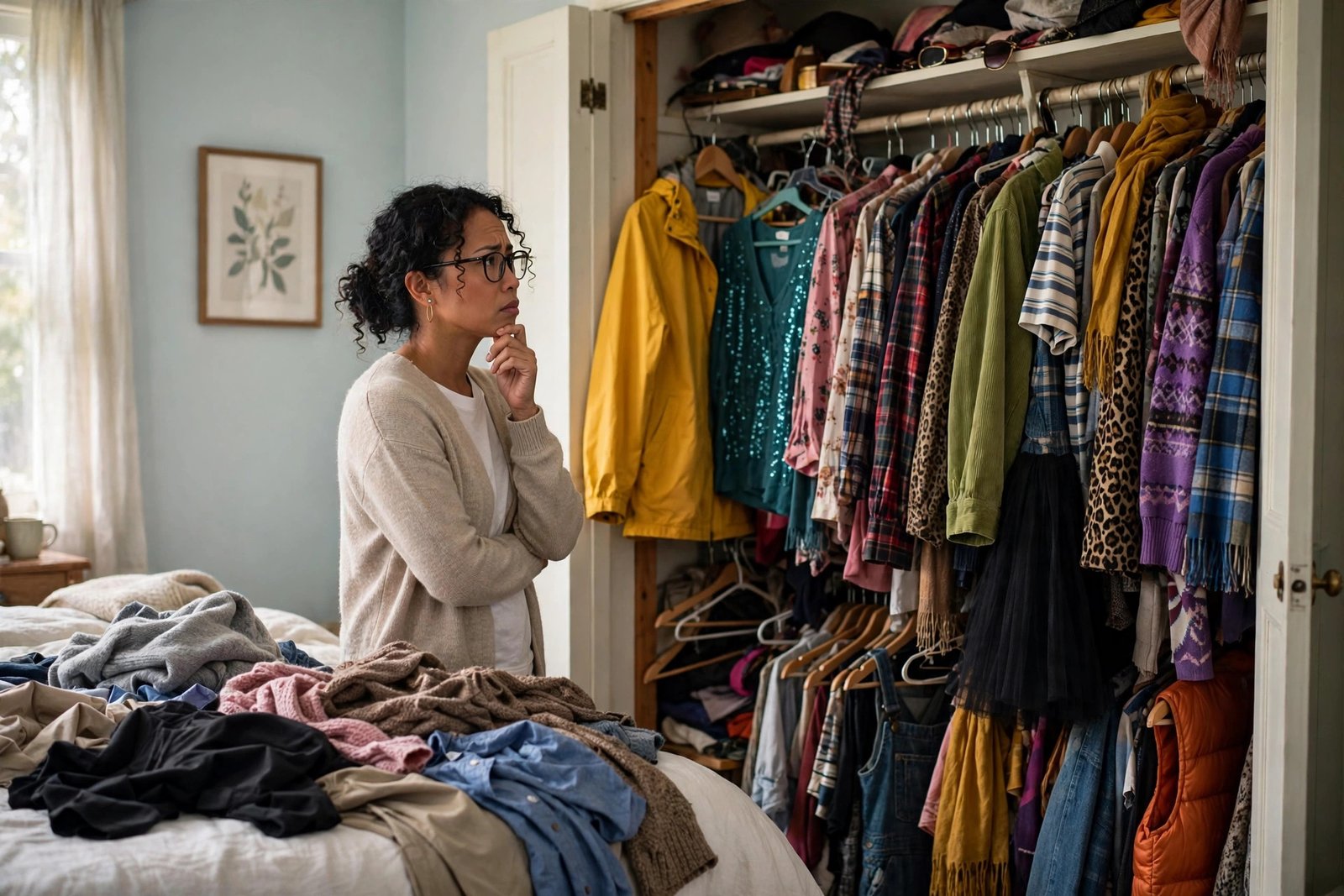
It helps to name the paradox plainly, because naming it removes the shame. A closet can be full of clothes and empty of outfits. Clothes are objects. Outfits are combinations that fit your body today, suit your day, match the weather, and are clean at the same time. It is entirely possible to own eighty clothes and, on a given rainy Tuesday, possess two outfits.
The first cause is fragmentation. Many closets are collections of single pieces bought one at a time, each admired alone, none checked against what already exists. A striking top that works with nothing you own is not an outfit waiting to happen. It is homework you gave yourself, and every morning it sits there making the closet look full and feel empty. Fragmentation alone explains most closets, and naming it is the first honest step in answering what to wear when you feel like you have nothing to wear.
Another major cause is laundry and maintenance debt. The right clothes exist, but they are in the wash, at the cleaner’s, missing a button, or waiting to be ironed by a person who does not exist. Wardrobes fail logistically far more often than they fail aesthetically. A style problem is often a systems problem in disguise.
A further cause is occasion imbalance. Plenty of pieces for weddings, holidays, and evenings out, almost nothing for the ordinary workday, the school run, the rainy errand. Since most of life is ordinary, the closet feels empty most of the time, even though the rail looks crowded. Naming these causes turns a shameful feeling into a short list of fixable conditions, which is a much better thing to meet before coffee.
What is really happening on a nothing to wear morning
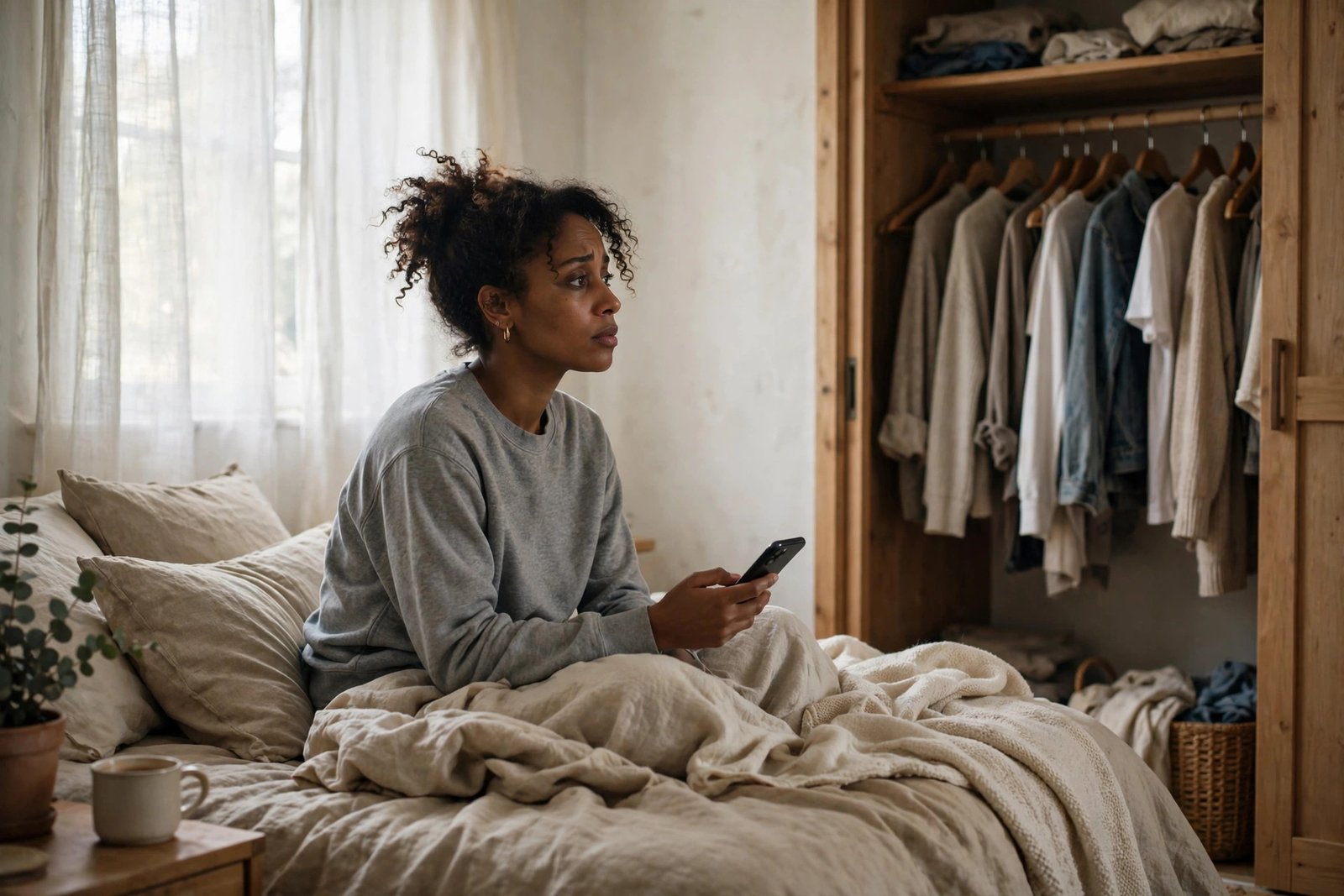
Underneath the logistics sits psychology, and it deserves honest treatment rather than jokes about indecision. Several ordinary mechanisms of the mind converge in front of an open closet.
The first is decision fatigue in its everyday, practical sense. You may already have made dozens of decisions before breakfast, and the closet demands twenty more micro decisions at once: color, fit, formality, weather, comfort, impression. A tired mind does not experience that as twenty small choices. It experiences it as a wall, and the wall gets a name: nothing to wear. Seen this way, what to wear when you feel like you have nothing to wear is a workload problem before it is a wardrobe problem, and workload problems have practical solutions.
The second mechanism is state dependent judgment. When you are tired, rushed, premenstrual, grieving, or simply low, your brain evaluates everything more harshly, including your reflection. The same outfit that felt fine on Saturday is rejected on Tuesday, not because it changed, but because the judge did. This is why arguing with the mirror on a low morning almost never works. You are not short of clothes. You are short of kindness and time at the same moment.
The third mechanism is comparison arriving early. For many women the morning now includes a phone, and a phone includes other women’s best outfits, best angles, and professional lighting before your own eyes have focused. Entering your closet straight from that feed is like entering an exam after reading only perfect scores. The standard in your head is not your life anymore.
The fourth is the internalized audience. Many women dress, without noticing, for an imagined panel: a critical mother, an ex, colleagues, strangers in the street. When the panel is in session, every outfit is cross examined, and cross examination produces paralysis far more reliably than it produces elegance. Part of learning what to wear when you feel like you have nothing to wear is learning to dismiss the panel and dress for the one person who will actually live in the clothes all day.
None of this means the feeling is imaginary or that you should simply think positive thoughts at your wardrobe. It means the fix has two floors: a practical floor, formulas and systems, and a psychological floor, rest, self talk, and a closet that stops arguing with your body. This guide builds both, in that order, because on the morning itself you need the practical floor first.
The first ten minutes: a calm reset that works

This routine is for the morning itself, when there is no time for philosophy. It has been kept deliberately small, because a rescue plan with fifteen steps rescues nobody.
Minute one: stop trying on complete outfits. Step back, close the closet if you can, and state the facts of the day out loud: weather, temperature, main activity, how long you will be out, and how your body actually feels today. Facts shrink the problem. Most days need an outfit that passes three tests, not thirty. Keep the facts in front of you the whole time, because facts are what decide what to wear when you feel like you have nothing to wear on a rushed morning.
Minutes two to three: choose the base category, not the piece. Trousers and a top, a dress, a skirt and knit, jeans and a shirt. Choosing a category first cuts the closet by three quarters in one decision, and what remains suddenly looks manageable.
Minutes four to six: pull your tested formula in that category. This is where preparation pays. A formula is a combination you have already worn and scored well on a calm day, photographed if possible. You are not creating today. You are repeating, the way a good cook repeats a dish on a busy night without apologizing for it.
Minutes seven to eight: fit check in motion. Sit down, raise your arms, walk to the door and back. If you are adjusting, tugging, or holding something in place, change that one piece only, not the whole outfit. Most failed outfits fail in one component. Replacing everything is how ten minutes become forty and a mood becomes a crisis.
Minutes nine to ten: one finishing detail and out. A belt, earrings, a watch, a scarf, lipstick, the good shoes. Finishing details matter out of proportion to their size because they convert an outfit from something that happened to you into something you chose. Then leave. The mirror gets no vote after minute ten.
Two supporting rules protect the routine. First, the night before rule: on evenings when tomorrow matters, lay out the formula then. Your night self is calmer and kinder than your morning self, and she should be trusted with the decision. Second, the photograph rule: every time an outfit works, take a quick picture. Your phone album becomes a personal catalogue of answers to what to wear when you feel like you have nothing to wear, written in your own clothes rather than in a stranger’s.
Five outfit formulas to use when your mind goes blank
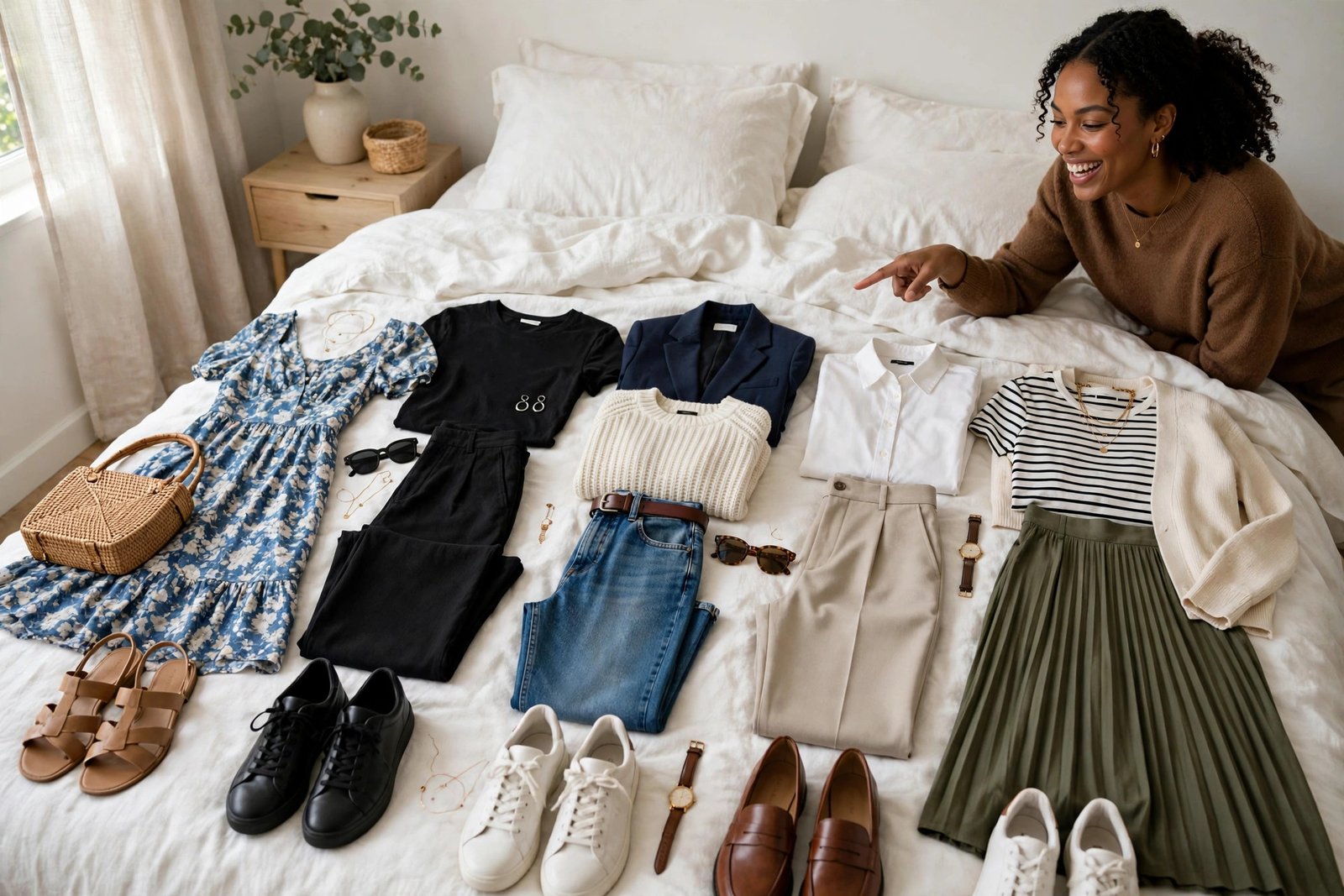
Formulas are not uniforms, and they are not an admission of defeat. They are tested combinations with interchangeable parts, and every woman whose style you admire relies on them more than she admits. Here are five that cover most lives, each to be adapted to your colors, your body, and your climate.
Formula one: dark bottoms, light top, structured layer. Trousers or dark jeans, a white or cream top, and a blazer, cardigan, or jacket over it. It reads as intentional in offices, restaurants, and family settings, and it tolerates almost any shoe. When women ask what to wear when you feel like you have nothing to wear for a day that includes other people and their opinions, this is the most reliable first answer.
Formula two: the one piece answer. A dress or jumpsuit you can move in, plus shoes and one accessory. One piece dressing removes the matching problem entirely, which is why it rescues low energy mornings. Keep at least two such pieces in your current size, clean and ready, the way you keep a spare key. On the lowest energy mornings of all, this single piece logic is often the truest answer to what to wear when you feel like you have nothing to wear.
Formula three: monochrome with one break. Head to toe in one color family, navy, black, grey, beige, or deep green, with a single contrasting element: shoes, bag, belt, or lipstick. Monochrome looks deliberate even when each piece is simple, and it flatters by creating one long line rather than several competing ones. Monochrome is also forgiving of tired eyes, which is why stylists quietly recommend it for what to wear when you feel like you have nothing to wear.
Formula four: soft top, hard bottom, or the reverse. Pair something structured, denim, leather, a crisp shirt, tailored trousers, with something soft, a knit, a flowing blouse, worn in jeans. The contrast is what makes it an outfit rather than clothing. Most beloved casual outfits in your own history probably follow this pattern without your having named it. Once you spot the contrast pattern in your own past outfits, you will start seeing answers to what to wear when you feel like you have nothing to wear everywhere in your closet.
Formula five: the repeat with a twist. Take yesterday’s working outfit, or last week’s, and change exactly one element: different shoes, a layer added or removed, jewelry instead of a scarf. Repetition is not a failure of imagination. It is the mechanism by which real style exists at all. Nobody whose style you can describe got there by never repeating herself.
What research says about choice, stress and getting dressed

It is worth pausing on what is actually known, because this small daily problem sits inside some well studied territory, and honest evidence is more steadying than slogans.
Research on choice overload, developed over several decades, found that while people are drawn to large assortments, very large choice sets often reduce satisfaction and increase the chance of making no decision at all. The size of the effect varies by situation and later studies have refined the picture, but the practical reading for a wardrobe is hard to argue with: beyond a point, more options make choosing harder, not easier, and make the chosen option feel worse.
Research on self perception adds a further piece. People tend to feel more coherent and capable when their appearance matches their own sense of identity, a feeling sometimes discussed under enclothed cognition and related ideas. The findings in this area are debated and the effects are modest, but they align with ordinary experience: clothes that feel like you cost less attention all day, and attention is a real resource.
Fashion journalism, read well, supports the same modest conclusions. Browsing a recognized magazine such as Elle on a calm Sunday to steal one proportion, one color pairing, one way of wearing a shirt, is research. Scrolling it at 7 in the morning while half dressed is self sabotage. The source is the same. The timing decides whether it helps.
The research verdict, in one paragraph, is this: reduce options in the moment, decide in advance where you can, keep familiar proven combinations ready, and be suspicious of any standard imported from images made by professionals. That is not glamorous, but it is what the evidence and the experience of well dressed ordinary women agree on.
Fix the closet, not yourself: the weekend reset

Mornings improve most when the closet itself changes. This reset takes a few hours on one weekend day and it is designed to remove causes, not to create a perfect wardrobe in an afternoon.
First, remove everything that does not fit today. Not forever, not in anger: out of the daily closet, into a box, a spare rail, or a bag with a date on it. You can revisit the box in six months with calm eyes. What matters is that tomorrow morning, every single thing in front of you is a genuine candidate. A closet where everything fits is a closet that stops insulting you before breakfast. A closet where everything fits changes the emotional math of what to wear when you feel like you have nothing to wear before the day has even started.
Second, reunite outfits physically. Hang or fold your proven formulas together for two weeks: the trousers with their tops, the dress with its layer and shoes nearby. Most closets are organized by category, which is logical for storage and terrible for dressing. During the reset, organize a visible section by outfit and notice how much faster mornings become.
Third, fix the maintenance debt in one pass. Buttons, loose hems, shoes to the repair shop, the stain treated today, the knit depilled. Then set a laundry rhythm that matches your formulas: if formula one is your workday backbone, its pieces must cycle back to ready within your week, which usually means owning the backbone pieces in twos or washing midweek. Boring, decisive, effective. Maintenance is unglamorous, yet it quietly decides what to wear when you feel like you have nothing to wear more often than taste ever does.
Fourth, fill only listed gaps. After the first three steps, real gaps announce themselves precisely: nothing warm that works with the dresses, no shoes for rainy workdays, every top needing a layer you do not own. Write those gaps as a short list, and let that list, and only that list, guide any shopping for the next season. Precision here is what turns what to wear when you feel like you have nothing to wear from a daily emergency into an occasional, solvable question.
Fifth, create the rescue rail. One small section, at the front, holding two complete outfits in your current size, clean, season appropriate, and proven. On the worst mornings you do not browse. You go to the rail the way you go to a fire extinguisher, without debate, and you get dressed. Women who adopt a rescue rail consistently report that its main benefit is not speed. It is the end of the morning argument with themselves.
Travel teaches the same lesson in miniature, if you let it. A week in a city like Montreal, living out of a small case of pieces that all combine, often feels easier than a month at home with a full closet, which is why packing lists in guides like what to do in Montreal quietly demonstrate the principle: limited, coherent, weather aware beats abundant and random. Your weekday wardrobe deserves the same respect as your suitcase gets.
Special cases: work, dates, bad days and weather

The general method holds everywhere, but four situations deserve their own notes, because each one adds a specific pressure that distorts judgment in a predictable way.
Work mornings add the pressure of being read professionally. The fix is the narrowest wardrobe of all: two or three tested work formulas in rotation, decided at the level of the week rather than the morning. Many women who dress well at work are not more creative than you. They are more repetitive, on purpose, and they save their creativity for where it costs less. Repetition at work is not laziness. It is a deliberate answer to what to wear when you feel like you have nothing to wear under professional eyes.
Dates add the pressure of being desired, and with it the temptation to dress as someone else entirely: tighter, newer, less comfortable, less you. Resist it with a rule: first dates get your most proven outfit, slightly elevated, never a debut. There is a deeper point here, explored in our article on whether you can love someone but not want them: attraction and ease are not enemies. A person who will love being with you will meet the real you sooner or later, and your clothes may as well introduce her honestly on day one.
Bad body image days add the cruelest pressure, because the judge is not the outfit at all. On those days, choose by touch and movement rather than by mirror: fabrics that feel kind, waistbands that do not argue, shapes you have felt safe in before. Do not try on the demanding clothes. Do not conduct a referendum on your body before work. Some days the goal is simply to be dressed, comfortable, and free to think about something else, and meeting that goal is a complete success.
Bad weather adds a practical pressure that ruins more outfits than taste ever does. Rain, heat, and serious cold each deserve one pre built outfit, tested in that weather, including footwear and layer. The morning the storm arrives is not the morning to discover that your only rain appropriate shoes are the ones that hurt. Build the weather outfits on dry days, photograph them, and file them with the others. Build those weather outfits on a dry, calm day, and the storm morning question of what to wear when you feel like you have nothing to wear is already answered.
What to do next

Start tonight, not on some future organized Sunday that may never come. Lay out tomorrow’s outfit using a formula, any formula, from clothes you already own. Photograph it on you in the morning if it works, or note the one piece that failed if it does not. That single act begins your answer book.
This week, do the fit pass. Move everything that does not fit today out of the daily closet, without commentary and without a farewell speech. Give yourself one morning in front of a closet where everything is a candidate, and notice what that quiet feels like. Most women are surprised by how emotional that quiet is, and how much of the old noise was never about clothes. Notice, too, how much kinder the morning feels when what to wear when you feel like you have nothing to wear stops beginning with clothes that cannot be worn at all.
This weekend, do the reset: outfits reunited, maintenance debt cleared, gaps listed, rescue rail built. Keep it to a few hours and stop when the list is written. The list is the deliverable, not a transformed life.
Over the next month, photograph every outfit that works, build your five formulas in your own colors, and add one weather outfit and one bad day outfit to the album. By the end of the month, the question of what to wear when you feel like you have nothing to wear will still visit occasionally, because you are a person and not a system. But it will find a house with answers ready: a rail, an album, and a woman who has stopped expecting a hard morning to also be a creative one.
FAQ

The questions below are the ones women actually ask at the closet door and in the weeks after they start fixing it. Short answers here, because by now you have the full reasoning above, and because deciding what to wear when you feel like you have nothing to wear should end with getting dressed, not with more reading.
Why do I feel like I have nothing to wear even with a full closet?
Because outfits, not clothes, are what a morning needs, and outfits require pieces that fit today, combine with each other, suit the weather and the day, and are clean at the same time. Fragmented buying, size spreads, laundry debt, and occasion imbalance can each empty a full closet of usable outfits. All four are fixable, and the weekend reset above addresses each one directly.
What is the fastest thing to wear on a panic morning?
Your most repeated proven combination: reliable bottoms, a top that needs no adjusting, walkable shoes, and one finishing detail. If you have built a rescue rail, use it without browsing. If you have not yet, formula one from this article, dark bottoms, light top, structured layer, is the most widely reliable place to start.
Should I buy new clothes to solve this?
Not first. First fit, reunite, repair, and list the gaps, because most nothing to wear closets already contain the needed outfits, buried. Buy only what the gap list names, in your current size, checked against three pieces you already own. Buying before the reset usually adds volume to the problem and calls it a solution.
How do I stop comparing my outfits to what I see online?
Move the feed out of the dressing hour. Decide the night before, or from your own album of photographed outfits, which contains your body, your light, and your real days. Use images of other women as occasional research on a calm afternoon, stealing single elements, never as a morning standard. Comparison thrives on timing more than on content, so change the timing.
What if this feeling is really about my body, not my clothes?
Then treat it as information, not as a dressing failure. Use the bad day protocol: kind fabrics, no demanding try ons, no referendum before the day begins. If distress about your body is frequent and heavy, consider speaking with a trusted professional, because that conversation deserves more than a wardrobe can give. Your closet should support your life, and on the hardest days its whole job is to get out of the way.