
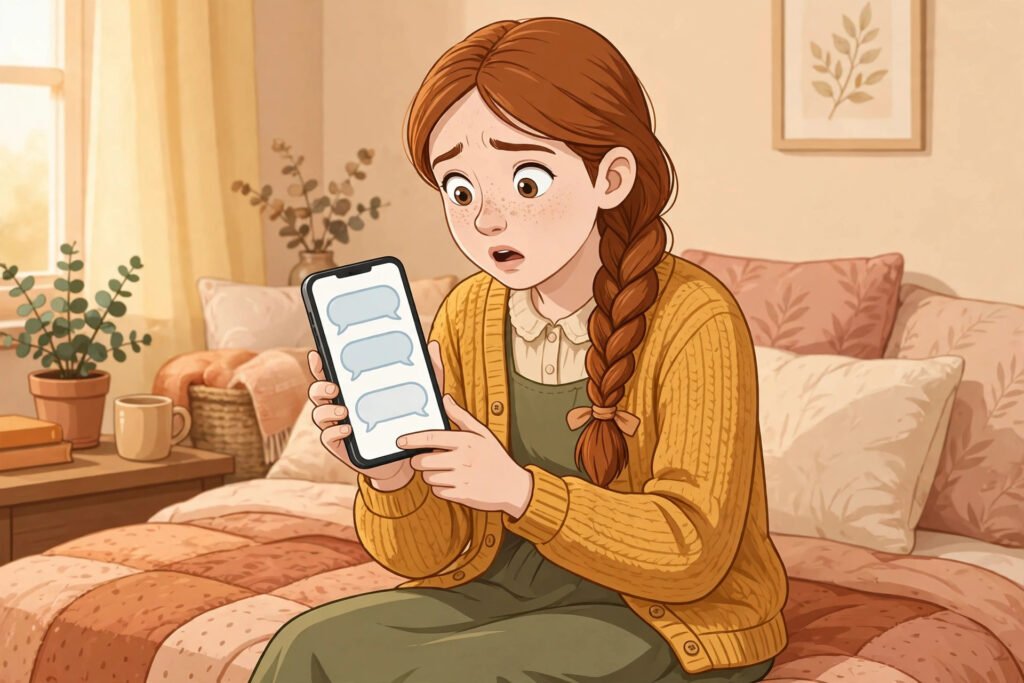
You pick up your phone from the kitchen counter. The chat with your best friend is open. You didn’t leave it open. Your stomach drops, your hands go hot, and one thought screams in your head. They read it. They read all of it. And right behind the shock comes the big question. How should I react when my parents read my messages, when I feel this angry and this exposed?
Take a breath before anything else. What you feel right now is real. Your messages are your private thoughts, your jokes, your venting, your whole inner world in text form. Having someone read them without asking can feel like someone walked into your room and read your diary out loud. You’re not overreacting for feeling shaken.
This guide will help you handle the whole thing, step by step. You will learn what to do in the first hot moment. You will learn why parents read messages in the first place. You will learn how to talk about privacy and trust without the talk turning into a war. And you’ll learn how to land on fair rules that you can all live with. By the end, you’ll have a clear, calm answer to how should I react when my parents read my messages, one you can use tonight.
The Short Answer

Here’s the short answer. The best first move is almost always the boring one. Pause. Don’t launch the biggest fight of your life in the first five minutes. When girls ask how should I react when my parents read my messages, the honest answer starts with this. React after the first wave of anger, not during it. Timing is the whole trick behind how should I react when my parents read my messages, and timing is something you can control.
A calm reaction isn’t a weak reaction. You can be fully serious and fully calm at the same time. In fact, calm is what gets you heard. Parents tend to listen to a daughter who talks like this matters to her. They tend to shut down when every sentence is a shout.
So the short version of how should I react when my parents read my messages goes like this. Feel your feelings first, somewhere private. Then ask for a real talk. Say clearly that your messages are private and that reading them hurt your trust. Ask why they did it. Listen to their side, even if you hate it. Then agree together on rules for the future.
One thing is worth saying out loud. Reading your messages was a real thing that happened, and your feelings about it count. You don’t have to pretend it was fine. But the goal isn’t to win a battle. The goal is a home where you feel respected and they feel less scared. That goal is reachable, and this guide shows you the way there.
The First Moment: Breathe Before You React

The first moment is the hardest one. Your heart is pounding. Your face feels hot. Part of you wants to scream. Part of you wants to grab your phone and delete everything you’ve ever typed. Both urges are normal. Neither one helps you much. So how should I react when my parents read my messages in the very first minute? Smaller than you feel. One calm sentence, then space.
So if you’re standing there wondering how should I react when my parents read my messages, start small. Say one calm sentence. Something like, I need a little time before we talk about this. Then go to your room, or take a walk, or splash cold water on your face. Give your body ten minutes to come down from the shock.
There’s a real reason for this pause. Words said in the first wave of anger tend to be the words you regret. You might say things about your parents that you don’t truly mean. They might fire back in the same heat. Then the talk stops being about your messages. It becomes about who shouted the loudest, and nobody wins that game.
Use the pause to sort your own head. What exactly did they read? Was it one chat or many? Did they tell you themselves, or did you catch it? What scares you most about it? Is it one secret you’re terrified they saw? Or is it the simple fact that they looked at all? Knowing your own answer makes the later talk ten times clearer.
Also use the pause to protect your friendships. If your best friend’s private words were in that chat, she deserves a heads up. A short text is enough. My parents saw our chat. I’m sorry. I’m handling it. Friends forgive fast when you’re honest fast. Silence is what lets a friend feel exposed and alone.
And here’s a small thing that matters. Don’t start a revenge spiral. Don’t read their messages back. Don’t slam doors for a week to punish them. Cold wars feel powerful for a day. Then they just make home heavy for everyone, including you. A clear talk beats a cold war every single time.
When you feel your voice could stay steady, you’re ready for the next step. Not happy. Not calm like a monk. Just steady enough to say what you mean. That’s the real answer to how should I react when my parents read my messages in the first hour. Steady first, strong second.
Why Parents Read Messages in the First Place
This part may sting a little, but it helps to know. Most parents who read messages aren’t trying to be villains. They’re scared. They have seen scary headlines. They have heard stories from other parents. Fear makes people do sneaky things, even kind people who love you a lot.
Some parents check because they noticed a change. You got quiet. Your grades slipped. You cried after school twice in one week. They couldn’t get you to talk, so they went looking for answers in the only place that talks back. It’s not fair to you. But it often comes from worry, not from cruelty.
Other parents read because the phone rules were never clear. They pay for the phone. They think of it as their device on loan. In their head, checking it’s like checking your homework. They may truly not know that your chats feel like private letters to you. Two people can see the same phone in two very different ways.
The tech world plays a part too. Parents get sold apps and tools that promise to keep kids safe. The Common Sense Media guide to parental controls shows how many of these tools exist and why experts say they work best when families talk about them openly. A tool bought in fear, with no talk, lands very differently in real life.
None of this means the reading was okay. A kind motive doesn’t erase a hurt feeling. But knowing the motive changes your plan. If they read from fear, your talk can answer the fear. If they read because rules were fuzzy, your talk can make the rules clear. You can’t fix a problem you haven’t named yet.
So part of how should I react when my parents read my messages is detective work. In the talk, ask one plain question. Why did you look? Then actually listen to the answer. You may learn about a fear you can calm. You may learn about a worry that has nothing to do with you at all. Either way, you’ll know what you’re really solving.
And if their answer is simply, because I can, that tells you something too. It tells you the talk needs to be about respect, not about safety. That’s a different talk, and we will get to it. Either way, you walk in knowing more than you did. Knowledge is power in a family talk. It keeps you from arguing with a shadow.
What Privacy Really Means at Your Age

Let’s talk about the word at the center of this whole thing. Privacy. Privacy doesn’t mean hiding bad things. Privacy means having a space where your thoughts can be messy, silly, and unfinished. Every person needs that space. Teens need it even more, because you’re still building who you’re.
Think about how you talk to your best friend. You try out opinions. You vent about a bad day. You say things in a big dramatic way, then laugh at yourself a minute later. Those chats are a workshop, not a final product. Having them read without warning is like someone publishing your rough draft to the whole class.
This is also why learning how to tell my parents I want more privacy in everyday life helps so much here. A closed door, a knock before entering, a journal that stays yours. Those small things and your messages are all one subject. Your family can build one clear privacy rule that covers all of it.
Privacy has limits, and honest girls admit that. If someone is in danger, privacy steps aside. If a stranger is pressuring you, or someone threatens to share your pictures, adults need to know. That kind of secret is heavy and unsafe. We even have a guide on what to do if someone shares a screenshot of your private conversation, because private words being spread is a real harm. But everyday chats with friends aren’t danger. They’re just your life.
So when you wonder how should I react when my parents read my messages, remember the core point you’re defending. You’re not defending secrets. You’re defending a normal human need. That’s a strong, fair position. You can hold it with a clear head and a steady voice. You’re not asking for anything strange. Every adult in your life has private conversations too. Ask them, gently, if they would like theirs read out loud at dinner. The answer writes your argument for you. Hold on to that picture the next time you ask how should I react when my parents read my messages and feel the anger rising again.
One more angle that helps in the talk. Privacy and trust hold each other up. When parents respect privacy, teens tend to share more, not less. When teens feel watched at all times, they share less and hide more. That’s the opposite of what scared parents want. Saying this calmly, in your own words, can land hard. It shows them that trust isn’t the enemy of safety. Trust is the road to it.
Pick the Right Moment to Talk About It

Timing can make or break this talk. A talk launched at midnight, or in the car, or in front of your little brother, starts with a handicap. You want a moment when everyone is fed, awake, and not rushing out the door. Boring moments are the best moments for big talks.
So ask for the talk like it matters. You can say, I want to talk about my phone and my messages. Can we sit down after dinner tonight? Asking ahead does two things. It shows them you’re serious and grown up about this. And it gives them time to cool down too, because being caught reading can make a parent defensive and jumpy. It also quietly answers how should I react when my parents read my messages: like a grown up about it, before anyone can treat you like a child about it.
Pick your place with care. The kitchen table works. A walk works even better for some families, because side by side feels less like a courtroom than face to face. Avoid your bedroom door as the stage. Avoid texting the whole talk. Big talks deserve voices, not thumbs.
If you’re still asking yourself how should I react when my parents read my messages, think of the talk as the reaction. The reaction isn’t the shout in the hallway. The reaction is this planned, clear conversation. Everything before it’s just you getting ready to do it well.
Prepare two or three points, no more. Point one: what happened, in plain words. Point two: how it felt, in plain words. Point three: what you want to change. A short list keeps you from wandering into old fights about chores, grades, and that one party. Stay on this one topic. You can fight about the dishes some other day.
Also decide, before the talk, what a good ending looks like. Maybe you want them to promise not to read without telling you. Maybe you want one check in a week that you agree on together. Maybe you want your group chats fully private, with safety talks instead. A clear wish gives the talk a target. Without one, it can spin in circles and end in tears.
And if the first talk goes badly? That happens. People get defensive. Doors get slammed. Let it rest for a day or two. Then try again, shorter and calmer. Many families need two tries for a talk like this. A bad first round doesn’t mean you lost. It means the topic is big, and big topics take more than one sitting.
Words That Open Doors Instead of Slamming Them

Now for the words themselves. The trick is simple to say and hard to do. Talk about your feelings and your needs, not about their character. There’s a wide gap between you broke my trust and I felt sick when I saw my chat open. Both are true. Only one of them can be heard without a fight.
Here are some lines you can borrow. When I saw my messages open, I felt panicked and embarrassed. My chats are where I think out loud with my friends. I need them to stay mine. I want us to agree on rules we both follow. Lines like these are firm. They’re also clean. Nobody has to defend their whole soul against them.
Ask questions instead of firing charges. Try, what were you worried about when you looked? Or, what would you need to see from me to feel calmer? Questions turn a fight into a puzzle you solve together. Charges turn it into a court case, and in court cases, everybody loses something.
Expect a few hard lines back. They may say, we pay for that phone. Or, you live under our roof. Or the classic, if you’ve nothing to hide, why do you care? Stay steady. This is the exact moment where how should I react when my parents read my messages gets tested, right at the line you least wanted to hear. You can answer, I get that the phone is yours on paper. My words in it still feel like mine. Hiding and privacy aren’t the same thing. You don’t read my diary because it sits in your house.
That last point deserves a slow repeat, because it’s your strongest card. Privacy isn’t hiding. Hiding means covering up something wrong. Privacy means keeping normal things personal. Your parents lock the bathroom door. They lower their voices on some calls. They’re not hiding. They’re being people. You’re asking for the same basic thing, at your scale.
This is the heart of how should I react when my parents read my messages. You react like a person with a fair point, said in fair words. Not a suspect begging for mercy. Not a lawyer hunting for a win. A daughter who respects herself and still respects them. That mix is very hard to argue with for long.
If tears come mid talk, let them. Crying isn’t losing. It shows the topic is real to you. Take a breath, sip some water, and finish your sentence. Many parents soften the moment they see real tears instead of a performance. And if you feel anger rising, say so. I’m getting too upset to talk well. Can we pause and finish after dinner tomorrow? A planned pause is strength, not surrender.
Agree on Fair Rules Together

A good talk should end in something you can point to. Rules. Not their rules dropped on your head, and not your rules with no safety at all. Rules you built together, in words you both said out loud. That’s what fair means here.
What can fair rules look like? Here are shapes that work in many homes. Parents don’t open chats without telling you first, except in a true emergency. You keep no locked second accounts that hide your whole online life. You agree on a weekly or monthly check in where you talk about your online world together, with the phone staying in your hands. You tell them fast if a stranger contacts you or something scares you online.
Notice the pattern. Each rule gives something and asks something. They give privacy and warning. You give honesty and a window into your world. That balance is what makes rules last. One sided rules crack the first week. Balanced rules can hold for years.
Write the rules down if your family likes paper. A note on the fridge sounds silly. It also ends the he said, she said game later. When everyone can point to the same words, small slips get fixed fast. And a written rule protects you too. If a rule is broken, you can point to it calmly instead of starting from zero.
So when friends ask you how should I react when my parents read my messages, this is the part you’ll be proudest of. You didn’t just get angry. You built something. A set of rules that respects your privacy and answers their fear. That’s grown up work, and you did it at the kitchen table.
One more rule shape worth offering. A sunset clause. Rules can be revisited every few months as you get older and prove yourself. Parents love hearing that good behavior earns more freedom over time. It gives them a reason to loosen their grip. And it gives you a clear road to walk. Trust, given in steps, tends to keep growing. It also gives you a living answer to how should I react when my parents read my messages as you get older: the rules grow up as you do.
And be honest about your side of the deal. If you agree to tell them when something scary happens online, then actually tell them. The first time you keep your word on a hard thing, their fear drops a lot. Trust is built in those moments, not in speeches. Your side of the rules isn’t a tax you pay. It’s the fuel that makes your privacy grow.
If It Happens Again After Your Talk

Let’s be real. Sometimes you do everything right, and it still happens again. You find the chat open. Or a parent quotes a line from a message they swore they wouldn’t read. That second time hurts more than the first. You kept your side. They broke theirs. It’s fair to feel that fully.
So how should I react when my parents read my messages a second time? Start by naming it plainly. We talked about this. We agreed on rules. The rules were broken. Naming it calmly is stronger than any explosion. It shows you remember the deal, and you expect deals to mean something in your house.
Then ask for the reason, and listen. Maybe there was a real scare. Maybe a teacher called, or a rumor reached them, and fear won over the promise. A real emergency can bend a rule. But bending needs honesty after. If they hid it and you caught it, that hiding is part of the problem now, and it’s fair to say so.
If there was no emergency, you may need a bigger stage for the talk. Another adult can help. A grandparent, an aunt, an older sibling, a school counsellor. A calm third person can lower the heat and witness the promises. Asking for a witness isn’t drama. It’s what people do when private talks keep failing.
Protect your own peace in the meantime. You can change your passwords and lock your apps. That’s your right, and it’s not a crime. Just know that locks alone don’t fix trust. Some parents see a new lock and panic harder. Pair the lock with words. I locked my phone because the rule was broken. I still want us to fix this. Lock plus honesty beats lock plus silence.
And take care of your heart through it. A home where you feel watched can wear you down. Talk to your friends. Write in a journal that lives somewhere safe. If the stress starts to eat your sleep or your mood for weeks, tell a trusted adult or a school counsellor. Feeling watched at home is a heavy thing to carry alone, and you don’t have to carry it alone.
Will every family fix this perfectly? No. Some parents hold on tight until you’re older. If that’s your house, take the long view. Each calm talk still plants a seed. Each promise you keep still counts. You’re building the adult relationship you’ll have with them one day. That work is slow, and it’s worth doing well, even when it’s unfairly slow.
Frequently Asked Questions
Should I confront them the moment I find out?
Not in the first hot minutes, no. Give yourself a short pause to cool down and sort your thoughts. You can say one calm line, like I need some time before we talk about this. Then have the real talk later that day or the next. A planned talk almost always lands better than a hallway explosion. This is the first step in how should I react when my parents read my messages in a way that actually changes things.
Is it ever okay for parents to read my messages?
Most families agree there’s one exception: a true safety emergency. If a parent has a real reason to think you’re in danger, many people accept a check. Everyday curiosity, boredom, or control aren’t emergencies. That’s why clear family rules matter so much. They draw the line before fear blurs it, and they protect both your safety and your privacy at the same time.
What if I had something in my chats I am ashamed of?
First, breathe. Almost every teen has typed something dramatic, mean, or silly in a private chat. Venting in a workshop of words is normal. If your parents bring up one line, answer honestly and briefly. Most parents calm down fast when a line turns out to be a joke or a vent. If it was something bigger, owning it calmly still beats lying about it. Shame fades. Trust takes longer to rebuild, but it does rebuild.
Can I just lock everything and say nothing?
You can lock your phone, and it’s your right to do so. But locks alone rarely fix the real problem, which is trust. A locked phone with total silence often makes scared parents even more scared. The stronger move pairs privacy with honesty. Lock what you need, and keep talking about fair rules. Privacy plus a working talk will protect your chats far better in the long run than any password can. That pairing is the honest core of how should I react when my parents read my messages.
What if my parents say the phone is theirs, so the messages are too?
This is the hardest line to hear, and many girls hear it. Separate the object from the words. The phone may be theirs on paper. The thoughts and jokes inside your chats are yours. You can say, you own my diary and my bedroom door. Owning them doesn’t make reading or barging in kind. If you’re still asking how should I react when my parents read my messages after that line, stay calm, repeat the owning and respecting difference, and ask for rules you can both name.