

Eight hours of sleep. A full glass of water. And still, the mirror hands you the same verdict at 7 a.m.: you look tired. The shadows under your eyes have become the most annoying part of your face, not because they’re dramatic, but because they lie. They tell every colleague, every client, every video call that you’re exhausted, even on the good weeks when you’re actually fine.
Let’s be honest about the goal from the start. You want to reduce the appearance of dark circles, not delete a normal human feature. Under eye skin is meant to be thin. Faces have hollows and shadows. Filters have taught us to see a natural part of being human as a defect, and the beauty industry happily sells that worry back to us in small expensive jars.
Video calls made it worse for a lot of us. A laptop camera sits low, the light in most rooms falls from above, and both of those facts dig shadows under the eyes that a bathroom mirror barely shows. You can end a call feeling fine and looking, on that small square of screen, like you have not slept since spring. It stings more than it should. It also explains a lot. Part of what you are fighting is light and angles, not your face. No cream fixes a ceiling light. But care, sleep, and a few smart tricks still do a great deal, and this article keeps them in the right order.
The honest route to reduce the appearance of dark circles starts with sleep and skin, not with a miracle cream. Some of what sits under your eyes is pigment. Some is shadow and light. Some is thin skin showing what’s underneath. Each kind answers to a different kind of care, which is why this guide goes in order: what circles actually are, what sleep really does, gentle daily care, what skincare can and cannot do, the habits that quietly deepen them, honest concealer steps for work mornings, and the signs that deserve a doctor instead of a product.
This guide will show you how to reduce the appearance of dark circles with that calm, layered approach. No diagnosis, because nobody can diagnose your face from an article, and no miracle promises, because your intelligence deserves better. By the end, you’ll have a realistic plan to reduce the appearance of dark circles on good weeks and tired ones alike, and you’ll know which changes are cosmetic and which ones deserve a professional’s eyes.
The Short Answer

The short answer is this: you reduce the appearance of dark circles in layers. Sleep first, because rested skin shows shadows less. Gentle care second, because the skin there is the thinnest on your face and hates being rubbed. Sunscreen always, because sun deepens pigment quietly. Concealer last, as the finishing touch, not the whole strategy.
Most women who manage to reduce the appearance of dark circles for good stop chasing one magic product. They fix the two or three habits that apply to them, give a simple routine a few weeks to work, and keep concealer in its proper place: a good tool for mornings, not a daily battle. That’s the realistic way to reduce the appearance of dark circles. Softer, lighter, less noticeable. And on your best weeks, barely there at all.
What Dark Circles Actually Are

Understanding what they are is the first step to reduce the appearance of dark circles sensibly, because “dark circles” is one name for several different things. For some women, the darkness is mostly pigment, extra color in the under eye skin itself. In many families, deeper under eye color simply runs in the family, the way eye color does. For others, the darkness is shadow: the natural hollow between the lower eyelid and the cheek catches light in a way that reads as a dark arc, especially in bathroom lighting, which seems designed by enemies.
There’s also the thin skin effect. The skin under your eyes is the thinnest on your whole face, thin enough that the tiny blood vessels beneath it can tint the surface, giving a blue or purple cast on tired or pale days. And there’s simple contrast: when the rest of your face is pale from a short night or a long winter, the under eye area looks darker by comparison, even if it changed very little. This is why one woman’s circles vanish with sleep and another’s barely move. They’re not the same circles.
General factors play their part too, in general terms, never as a verdict on you personally. Short sleep makes skin look paler and duller, which shows shadows more. For some people, allergies and the eye rubbing that comes with them deepen the look. Sun exposure can deepen pigment over the years. Age thins the skin a little more each decade. Naming these is not a diagnosis of your face. It’s a map of the usual suspects, so you can notice which ones live in your life.
One more honest word about skin tone, because most advice skips it. On deeper skin, the under eye color is more often pigment, and it can be strong even in women who sleep well and live gently. On fair skin, the thin skin and shadow side tends to show more, with blue and purple tones on pale days. Both are normal. Both are common. And both get sold the same tiny jar as if one product could read your face. It cannot. Knowing which side your own circles lean toward, color or shadow, calm and tired days compared side by side, tells you where to put your effort first.
Why does this matter so much? Because each kind answers to different care, which is why no single cream can reduce the appearance of dark circles for everyone. Pigment answers to sun protection and patience. Shadow answers to light, sleep, and clever concealer placement. Thin skin answers to gentleness and moisture. Once you stop treating your circles as one enemy, the plan gets much simpler, and much cheaper.
Start With Sleep, the Unsexy Truth

Sleep is the cheapest tool you own to reduce the appearance of dark circles, and the least glamorous, which is why it’s always listed last in ads for eye cream. Here’s the honest version. A short night rarely creates circles out of nothing. What it does is drain color and plumpness from your face, so the shadows and tint you already have show up louder. Sleep won’t rebuild your under eye area. It will stop turning up its volume.
The target isn’t perfection. It’s regularity. A fairly steady wake time, enough hours for your body, and a wind down that doesn’t end with a bright phone six inches from your face. If you often wake up wondering why do I feel tired even after sleeping, that article is worth your evening, because tired looking eyes and unrefreshing sleep usually travel together. And if your evenings have no off ramp, building a simple night routine for better sleep does more for your face than any jar in the bathroom cabinet.
Sleep position gets one small mention. Sleeping with your head very slightly raised can help if you wake up with puffiness that makes shadows look deeper in the morning. It’s a minor tweak, not a treatment, and it won’t suit everyone. The morning cold splash, or a cool compress while the coffee brews, also takes down puffiness for a while, which softens the shadow it casts. Small, free, unglamorous. That’s the theme of this whole section, and honestly, of everything that works here.
The weekend lie in deserves a word too. Sleeping until noon on Saturday feels like a refund, but a wild swing in your sleep times can leave you groggy, pale, and oddly more shadowed by Monday. Bodies like rhythm more than drama. A wake time that stays within about an hour, even on weekends, keeps your face on a steadier setting. You can still rest. You can still have slow mornings. Just let them start at a time your weekdays would recognize. Your under eyes will vote in favor, quietly, within a couple of weeks.
Give sleep two honest weeks before you judge it. Faces change slowly, and one heroic early night won’t undo a month of midnight scrolling. A steady wind down, repeated, makes it far easier to reduce the appearance of dark circles than any cream applied at midnight in a small panic. Your under eyes are keeping the score of your evenings. Let the score improve.
Gentle Care for Thin Under Eye Skin

The under eye area is not the place for enthusiasm. It’s the thinnest, softest skin you own, and it keeps a record of every rough year. Gentle handling is free, and it quietly helps reduce the appearance of dark circles over time, because skin that isn’t irritated, tugged, or inflamed simply looks calmer and reflects light better.
Start with makeup removal, the nightly crime scene. Dragging a cotton pad back and forth over mascara, scrubbing until the last trace gives up, tugs at this delicate skin every single night. Switch to patience instead: soak the pad, hold it gently on the closed eye for twenty or thirty seconds, then slide the makeup away with almost no pressure. Cleanser and water should do the work, not friction. Your future face is watching, and she approves.
Apply products with your ring finger, the weakest one, and pat rather than rub. Whatever you use, eye cream or your normal moisturizer carefully brought up to the bone, goes on with taps, not strokes. Skip the harsh scrubs and strong peels in this zone entirely, and be careful with very active products near the eye: if something stings or makes you water, it doesn’t belong there, whatever the label promises. Patch test new products, one at a time, the way you’d test anything near your eyes.
Sun protection belongs in this section too, because gentle care includes not letting the sun quietly deepen pigment day after day. Sunglasses help more than people think: they shield the thin skin and stop the squinting that creases it. Treat the area like silk every day, and you remove one of the daily habits that works against every effort to reduce the appearance of dark circles. Gentleness is slow. It’s also cumulative, in the best direction.
What Skincare Can and Cannot Do

Now the section the beauty industry wishes didn’t exist. Good skincare supports the skin so it reflects light more evenly, which is a real, modest way to reduce the appearance of dark circles. A well moisturized under eye looks smoother, and smoother skin scatters light instead of pooling it in shadows. That’s a genuine effect. It’s also a modest one, and keeping it modest in your head protects your wallet.
What can products reasonably do? A simple moisturizer can plump fine dry lines so they catch less shadow. Ingredients like vitamin C are used in products that aim to brighten the look of skin over time. Caffeine based eye products are popular for morning puffiness, since puffiness deepens the shadow beneath it. Sunscreen, as said, guards the pigment side. Used patiently, one product at a time, these can soften the look of circles over weeks. What they cannot do is rebuild a hollow, erase family pigment in a fortnight, or replace sleep. Any product promising that is selling you a story, not a result.
Keep the shelf small and the trial honest. One new product, used for four to six weeks, while everything else stays the same: that’s how you learn if it does anything for you. Five new products at once teaches you nothing and irritates everything. And if your skin is sensitive, the gentlest routine wins. Red, stinging under eyes look worse than the circles you started with, every single time.
Learn to read the loud words on jars with a calm eye. Words like instant, erase, and miracle are not facts. They are ads. A product can be good and still be sold with silly claims, so judge by the plain parts: what is in it, how it feels on your skin, and what your own photos show after a month. Take those photos, by the same window, at the same hour, once a week. Your memory will lie to you in both ways, some days too kind, some days cruel. The photos will not. They are the cheapest honest lab your face will ever get.
Consistency with simple products beats a rotating shelf of miracles when your goal is to reduce the appearance of dark circles. Boring routine, patient timeline, honest expectations. Your skin will do what skin can do, which turns out to be a fair amount, just never on the schedule the ads promised.
Daily Habits That Quietly Make Circles Worse

Some evenings quietly undo your mornings. Knowing them helps you reduce the appearance of dark circles without buying anything at all, which makes this the most profitable section in the article. Read it like a checklist of suspects, and just notice which ones live at your address.
Rubbing your eyes is suspect number one. Allergies, tiredness, the habit of rubbing while you think: all of it irritates the thinnest skin you own and can deepen its color over time. If your eyes itch often, that’s worth mentioning to a doctor or pharmacist in general terms, and in the meantime, a cool compress soothes without the friction. Next, sun without protection, which deepens pigment a little every summer and never sends you a bill until years later. Then the late night combo: very salty food and alcohol in the evening can leave the whole face puffier at dawn, and puffiness turns soft shadows into obvious ones. You don’t need a lecture on either.
You just need the connection named once, kindly.
Screen strain plays a smaller part. Long hours of close screen work tire the eyes and invite squinting and rubbing, and dry office air doesn’t help. The classic fixes are unglamorous and free: blink on purpose, look far away regularly, keep your screen at a kind distance, and don’t do your closest screen time in bed in the dark. Smoking deserves a plain line too, since it roughs up skin quality everywhere, this area included. If you smoke, that’s one more quiet reason on the list your future self keeps.
Sleeping in your makeup earns a place on the list too. It happens after long days and late nights, and no one here is judging. But mascara and liner left on overnight get rubbed into the thin skin as you sleep, and you wake to a grey shadow that is half product, half irritation. It reads as deeper circles and it is the easiest kind to fix. Ninety seconds with a soaked pad before bed, however tired you are, pays you back at the mirror. Keep wipes by the bed for the truly wrecked nights. Imperfect removal beats none, every time.
Cut two habits from that list, the two that actually match your life, and you’ll often reduce the appearance of dark circles more than a new serum would. Habits compound in both directions. That’s the bad news when they’re working against you, and the very good news once you flip just a couple of them.
Concealer That Looks Like Skin, Not a Mask
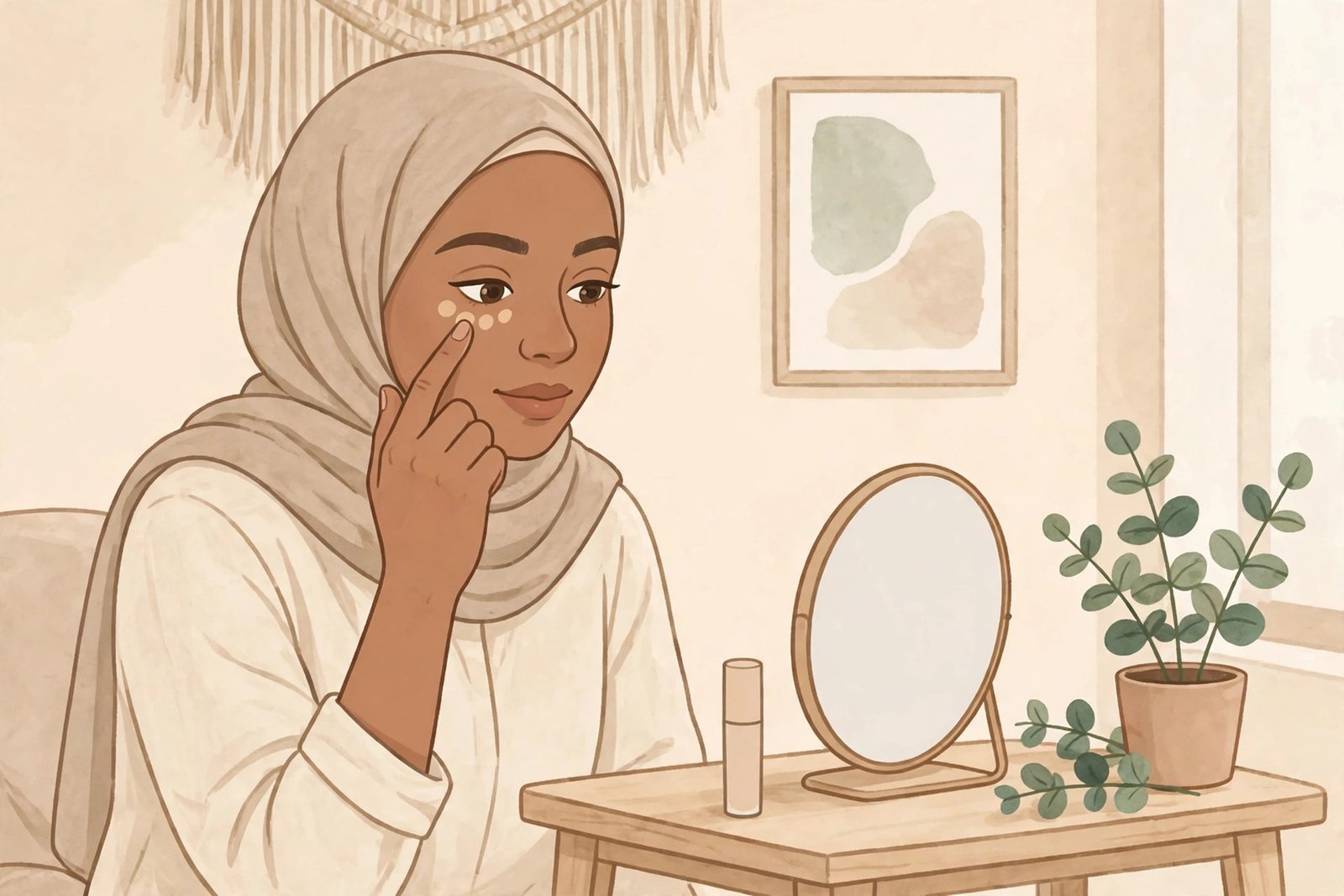
Now, and only now, the makeup. Used well, concealer is the fastest way to reduce the appearance of dark circles on a work morning, and there’s no shame in it. It’s paint, used with skill, for eight hours. The secret is that good concealer work is mostly about using less than you think, in the right place, in a shade chosen for the color you’re covering, not just your skin tone.
Look at the color first. Blue or purple toned shadows are softened by a peachy or warm corrector tone under your concealer; on deeper skin, a richer orange toned corrector does that neutralizing job. Brown toned darkness usually needs less correcting and more brightening with a concealer a touch lighter than your foundation. If color theory feels like homework, start simple: a concealer that’s warm toned and half a shade lighter than your skin will improve most circles without a separate corrector step.
Placement is the second secret. Don’t paint the whole under eye in a thick triangle, the way old tutorials taught. Put small dots only where the shadow actually lives, usually the inner half and the deepest line, then blend the edges with a fingertip or a damp sponge until the product disappears into your skin. Two thin layers, blended at the edges, will reduce the appearance of dark circles more naturally than one thick one ever will. Thick layers settle into fine lines by 10 a.m. and end up announcing exactly what they were hired to hide.
Check your work in the right light before you trust it. Bathroom light is bright, close, and cruel, and it tempts you to add more and more. Step to a window instead. Daylight shows what the world will see. If it looks soft there, you are done, even if the bathroom mirror still argues. And one small habit saves many mornings: do the under eye step after your eyeshadow and mascara, not before. Fallen specks of dark shadow love to land on fresh concealer and fake a circle that is not even yours.
Set it lightly, or not at all. A whisper of fine powder on a small brush stops creasing; a heavy bake makes thin skin look dry and older. Cream products suit dry under eyes better than matte ones. And moisturize first, always: concealer over dry, flaky skin clings to every flake and looks worse than bare skin by lunch. Done this way, the whole job takes ninety seconds, and what people see is your face, just rested. Which was the entire point.
When Dark Circles Deserve a Doctor Visit

Most dark circles are a cosmetic topic, not a medical one, and that’s reassuring. Knowing the line between cosmetic and medical is part of learning to reduce the appearance of dark circles safely, so let’s draw it clearly. Mayo Clinic notes that dark circles under the eyes usually are not a medical problem, and lists the same calm self care this guide does: more sleep, a cold compress, sun protection, and treating skin kindly. That’s the normal case, and it’s probably yours.
But some changes deserve a professional’s eyes, promptly. Circles that appear suddenly, or change fast. Darkness or swelling under one eye only, especially if it keeps getting worse over time; Mayo Clinic specifically advises discussing one sided changes that worsen with a healthcare professional. Swelling that’s new and stays. Pain, itching that’s intense, or skin that becomes scaly, broken, or weepy. Anything after an injury. None of this is said to frighten you. It’s said so that the rare case that matters doesn’t get managed with concealer while it waits.
If yours change suddenly on one side, the goal stops being to reduce the appearance of dark circles and becomes getting checked. A doctor can look at the whole picture, your health, your medications, your skin, in a way no article can. Sometimes the answer is a simple skin condition that has proper care. Sometimes it’s just reassurance, which is also a real result: you’ll stop worrying every morning, and the mirror gets quieter.
For everything else, the everyday case, hold the calm line from this guide. Circles are common in adult women, across every skin tone, in every demanding job and young family. They are not a verdict on your health or your habits. Care for the skin, guard your sleep, use your ninety seconds of concealer without guilt, and let the rare warning signs, not daily anxiety, decide when a doctor joins the story.
Frequently Asked Questions
Do eye creams actually work, or are they just small moisturizers?
Mostly, they’re moisturizers in smaller jars, and that’s not an insult. Moisturized under eye skin looks smoother and reflects light better, so circles read softer. Some formulas add brightening or depuffing ingredients that can help the look a little over weeks. What no cream can do is rebuild a hollow or erase deep family pigment. Buy one if you enjoy it, keep expectations adult sized, and judge it after a month of honest use.
How long until I see a real difference?
Slower than ads say, faster than you fear. Puffiness driven mornings can improve within days of better sleep and gentler evenings. Skin texture and dryness usually shift in two to four weeks of kind, steady care. Most habits that reduce the appearance of dark circles need four to six weeks before the mirror gives a clear verdict, because skin renews on its own schedule. Judge by monthly photos in the same light, not by daily mirror moods.
Why do my circles look worse some days than others?
Because several of their ingredients are daily variables. A short night pales your skin and deepens contrast. A salty dinner or a late drink adds morning puffiness, and puffiness casts a shadow. Dry air, allergies acting up, a weekend of sun without protection: each one turns the volume up or down. That’s actually good news. It means your worst mornings are weather, not your face’s permanent state, and weather can be dressed for.
Can I stop wearing concealer one day?
Plenty of women do, once the sleep, care, and habit layers are in place and their circles soften to a level they no longer think about. Others keep a ninety second concealer habit for workdays and bare skin on weekends, happily. Both are fine. The goal was never a product free face. The goal is mornings where the mirror doesn’t set your mood, and where covering up feels like a choice, not a duty.
What is the simplest plan for a very tired week?
Strip it to the floor. Protect your sleep like an appointment, even if it’s shorter than you want. Cold water or a cool compress in the morning. Moisturizer, sunscreen, and ninety seconds of concealer placed only on the shadow. Sunglasses outside. No rubbing, however itchy the day gets. That’s how you reduce the appearance of dark circles without letting them run your mornings: a small plan you can actually keep, even in the weeks when life is loud.