

You did everything right. You have your own life, your own money, your own opinions, and a full calendar that does not revolve around a man. And at first, he loved exactly that about you. So why do some men want an independent woman but can’t handle her once they actually have her? Why does the same strength that attracted him slowly become the thing he complains about?
If you are asking why do some men want an independent woman but can’t handle her, you have probably lived the whiplash yourself. In the beginning he admired you. He told his friends you were different, refreshing, not needy like the others. Then, little by little, your business trips became a problem, your opinions became arguments, your busy weekends became proof that you “don’t need anyone.” Nothing about you changed. What changed is that the fantasy ended and the reality of you stayed.
This pattern is so common that it deserves a real explanation, not a shrug. Below is a full breakdown of why do some men want an independent woman but can’t handle her, what relationship research says about it, the signs that separate a man who is adjusting from a man who is shrinking you, and what to do with that information.
The short answer

The short answer to why do some men want an independent woman but can’t handle her is this: many men are attracted to what an independent woman represents, but not all of them are prepared for what she requires. She requires a partner who is secure enough not to need control, needed enough not to feel useless, and mature enough to see her strength as something to join, not something to defeat. A man who only loved the idea of you will start fighting the reality of you, and that fight is about his insecurity, never about your worth.
Put more simply, attraction and capacity are two different things. Attraction is what he feels when he watches you live your life. Capacity is what he can sustain when your life keeps moving at full speed next to his. Plenty of men have the attraction. Far fewer have done the inner work that capacity requires, and the gap between the two is where most of the confusion lives.
He fell in love with what your independence said about him

For some men, an independent woman is a trophy before she is a partner. Being chosen by a woman who clearly does not need a man feels like proof of his value. If she has her own money, her own life, and a line of options, and she still picks him, that must mean he is special. Her independence flatters him.
That is a pleasant feeling for him, but notice where you are in it. You are not a person in that story. You are evidence. And evidence only has to exist, not have needs, moods, deadlines, or a voice of its own.
This shows up in small, revealing ways. He introduces you by your job title. He repeats your accomplishments to his friends like they are partly his. What he describes is a status, not a relationship. The problem is that a status does not talk back, does not get tired, does not disagree at dinner, and does not have a bad week where she needs comfort instead of admiration.
Listen to how it sounds in real life. Early on, he says, “I love that you have your own thing going on. My ex wanted to be together every second.” Three months later, the same man says, “You booked the trip without even asking me?” Same independence. Same woman. The only thing that changed is that the independence stopped being a compliment to him and started being a fact he has to live with.
This is often why do some men want an independent woman but can’t handle her voice most of all. A woman who thinks for herself will eventually disagree with him, in public, calmly, with reasons. A woman who earns her own money will not ask permission for her choices. A woman with her own life will not cancel it every time he is bored. The trophy was supposed to be silent. The woman never agreed to that.
It is worth being fair here, because the counter example matters. Some men are drawn to independent women for the healthiest reason there is: they want a partner, not a project and not an audience. They find self sufficiency attractive because it means the relationship is a choice renewed daily, not a dependency dressed up as love. These men stay relaxed when your independence has practical consequences. The trophy hunter only loved it while it was decorative. That distinction explains a large part of why do some men want an independent woman but can’t handle her once the honeymoon stage ends.
Why do some men want an independent woman but can’t handle her? The honest reasons

Once the first admiration fades, a few very human things can surface. None of them are your fault, but all of them help explain the sudden tension in a relationship that started out so promising.
The first reason is the fear of not being needed. Many men were raised to believe that their value in a relationship comes from being necessary: the provider, the fixer, the protector, the one she cannot do without. With an independent woman, that script breaks. You can change your own tire, pay your own bills, and solve your own problems, so he quietly wonders what he is for. Instead of finding a new answer, some men try to make themselves necessary again, by criticizing your choices, creating small crises of loyalty, or sulking until you lean on them for things you never needed.
Notice how specific this fear is. It is rarely spoken out loud, because “I feel useless next to you” is a hard sentence for a man raised on the provider script to say. So it comes out sideways. He mocks the consultant you hired instead of admitting he wishes you had asked him. He goes quiet when you handle a crisis well. He insists on doing tasks you never assigned him, then resents you for not being grateful enough. The need to be needed is not weakness by itself. It becomes a problem when the only way he can feel it is by reducing what you do alone.
The second reason is control dressed up as preference. He does not say “I want to control you.” He says he prefers you with less makeup, prefers you home on Fridays, prefers that you check with him first, prefers friends of his choosing. Each preference is small. Together they redraw the borders of your life, moving them inward, month after month.
Preferences have a sound, and it is worth learning it. A genuine preference is offered once and dropped when you decide otherwise. Control disguised as preference repeats, escalates, and charges interest: the sigh when you wear the outfit anyway, the cold evening after you saw the friend anyway, the argument that is officially about something else. If every “preference” of his requires a concession from you and none ever requires one from him, you are not looking at taste. You are looking at a border being moved.
The third reason is plain insecurity. Your competence can feel, to a man who doubts his own, like a permanent comparison he is losing. Your promotion becomes a mood. Your confident evening with friends becomes an interrogation. He is not angry at your success. He is angry at what he believes it says about him, and you are simply the closest target.
Insecurity also explains the strange timing many women notice. He is warmest when you are tired, sad, or struggling, and coldest right after your wins. That is not a coincidence. Your low moments resolve his comparison problem, and your high moments reopen it.
The fourth reason is that some men genuinely never met an equal before. Their past relationships ran on a familiar structure where one person led and the other followed. Your equality is not an attack on that structure, but without it, they do not know how the dance goes. Some learn. Some spend the whole relationship trying to restore the only version they understand.
Underneath all four reasons sits something he probably never chose: the rules he absorbed growing up about what a man is for and what a woman is for. Psychologists call these internalized gender roles, the quiet instructions people carry from family and culture about who provides, who decides, and who yields. He may sincerely believe he wants an equal partner, because part of him does. But the older instructions run underneath the belief, and they fire automatically whenever your independence touches one of them. That is why his reactions can surprise even him. It does not excuse the behavior, but together these reasons explain why do some men want an independent woman but can’t handle her in daily life while insisting, quite honestly, that he is “fine with it.”
What research says about autonomy and attraction

It helps to know that none of this is just opinion. Relationship science has spent decades studying exactly this tension, and its findings line up closely with what women in these relationships describe.
Start with self determination theory, developed by psychologists Edward Deci and Richard Ryan. Their work identifies three basic human needs: autonomy, the feeling that your life is your own; competence, the feeling that you are capable; and relatedness, the feeling of being genuinely close to others. The important point for this topic is that autonomy and closeness are not opposites in the research. Studies on self determination in couples suggest that partners who support each other’s autonomy, offering choice instead of pressure and respecting independent goals, tend to report higher satisfaction and more stable relationships. In other words, a relationship does not become stronger when a woman becomes less autonomous. It becomes stronger when both people feel free and chosen at the same time.
Attachment research points in the same direction. Adults with a secure attachment style are generally comfortable with both closeness and independence, their own and their partner’s. Adults with an anxious attachment style, by contrast, often read a partner’s independence as distance or rejection, and may respond with protest behavior: extra texting, sulking, accusations, or sudden tests of loyalty. Adults with an avoidant style sometimes praise independence loudly at first, because it promises closeness without demands, then struggle when a real relationship asks for steady emotional presence. None of these styles is a life sentence, and attachment patterns can shift with experience and effort. But they help explain why do some men want an independent woman but can’t handle her consistency: the same behavior that looks like strength to a secure man registers as a threat to an anxious one.
Research on gender roles adds a third piece. Studies on what psychologists call precarious manhood suggest that in many cultures, manhood is treated as a status that must be publicly earned and can be publicly lost, unlike womanhood, which is usually treated as a given. A man carrying that belief experiences a partner’s visible competence as a status risk, especially in front of other men. It is one reason the same man can admire your success in private and undermine it at a dinner party. His audience changed, so his fear changed.
The honest summary of the research is this: attraction to independence is common and healthy, and the difficulty some men have with it usually traces back to unmet needs, attachment habits, and inherited scripts, not to anything excessive in the woman. Which is why do some men want an independent woman but can’t handle her is often less a mystery than a map. Once you can name the mechanism, his behavior becomes predictable, and predictable behavior is something you can make decisions about.
The signs he wants the title of your partner, not the reality of you

How do you tell the difference between a man who is adjusting and a man who is quietly trying to shrink you? Look at the pattern of his complaints. A man who is adjusting struggles with specific situations and works through them. A man who cannot handle you struggles with your independence itself, wherever it appears. The pattern behind why do some men want an independent woman but can’t handle her is rarely one dramatic event. It is the same small reaction, repeated across different areas of your life.
Watch for these signs. He praises your strength to other people and punishes it at home. He calls you intimidating, dramatic, or too much whenever you set a boundary, but never when you agree with him. He competes with your work, your friends, or your family for first place, as if your full life were a threat instead of the very thing that drew him in. He goes cold after your good news and warms up again when you are sad, small, or in need of rescue. He loves you most in the moments when you are least yourself.
The signs become easier to read when you make them concrete. Your promotion dinner ends with him picking a fight about something unrelated in the car. Your work trip produces three days of one word replies, then a speech about how distant you have become. You help a friend move and hear, that evening, that you have energy for everyone except him. You disagree with him in front of friends, mildly and reasonably, and the temperature drops for the rest of the night. Any one of these can happen in a good relationship. All of them, on repeat, form a sentence. Read it.
Pay attention to language, too, because it leaks the truth early. “You don’t need anyone, do you?” said with an edge. “Miss Independent,” used as a nickname that is not quite a compliment. “You’re not like other girls,” at the start, quietly replaced by “you’ve changed” later. And watch the compliment that is actually a leash: “I love how driven you are,” followed, whenever the drive costs him attention, by “but the relationship should come first,” where the relationship always seems to mean his comfort, on his terms.
There is also a subtler sign, and it is worth naming because so many women miss it. He is endlessly supportive of your independence in theory and strangely unavailable for it in practice. He applauds your career and never asks about the presentation. He respects your girls’ trip and texts accusations through all of it. The theory costs him nothing. The practice is where his true answer to why do some men want an independent woman but can’t handle her shows itself.
It is related to a bigger question about love and wanting

Sometimes what looks like a problem with your independence is actually a problem with what he wants from you. A man can enjoy your company, admire you, even feel something real for you, while wanting a version of the relationship where he stays comfortable and unchanged. This is the same confusing territory as wondering whether someone can care about you and still not choose the life you are offering. If that question feels familiar, it is worth exploring whether a man can love someone but not want them anymore, because the pattern of mixed wanting shows up in many forms.
Your independence simply makes the mismatch impossible to hide. A woman with fewer options might rearrange herself around his comfort for years. You will notice within months that you are being asked to trade pieces of yourself for peace, and you will feel the cost of every trade. That awareness is not the problem in the relationship. It is the alarm system working exactly as it should.
It also helps to separate two things he may keep blending together: loving you and wanting the life that loving you involves. Loving you, in his mind, may be entirely sincere. But the life that comes with you includes a partner who earns, decides, travels, and disagrees. If he wants the feeling of you without the facts of you, the relationship will keep producing the same argument in different costumes. That mismatch sits underneath why do some men want an independent woman but can’t handle her, and no conversation about tone, timing, or wording will fix it, because it was never about how you said anything. It is about what he is actually willing to live with.
The difference between a man who is adjusting and a man who is shrinking you
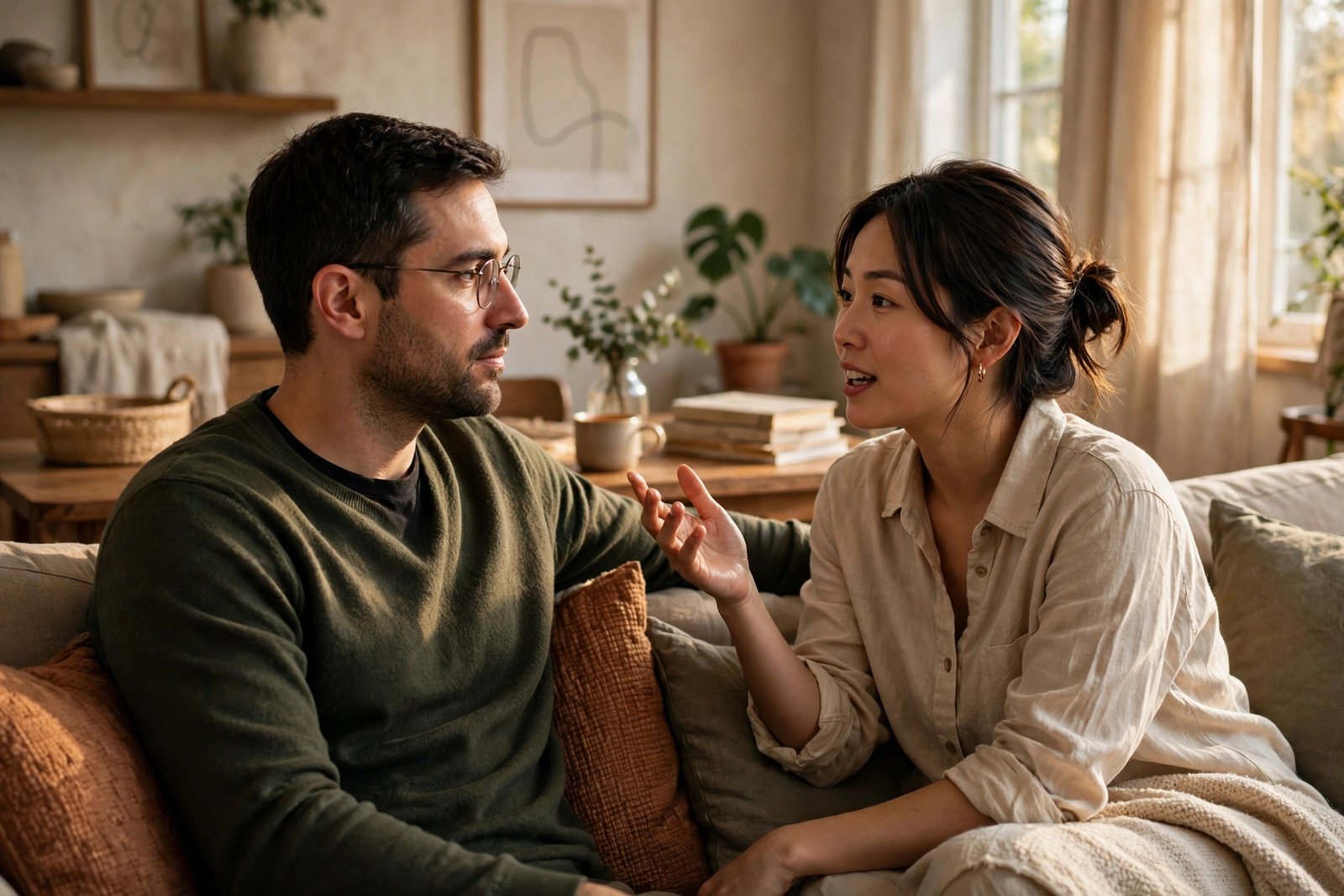
Every relationship asks both people to adjust. He will sometimes need to get used to your pace, your ambition, your calendar, your way of deciding things for yourself. Adjustment is normal, and it is not the enemy here. The difference is in the direction of the effort. Understanding why do some men want an independent woman but can’t handle her starts with watching direction, not incidents.
When a man is adjusting, the effort points at himself. He notices his own discomfort, he talks about it like an adult, he asks questions about your world instead of issuing verdicts about it, and over time the same situations get easier. He is expanding. When a man is shrinking you, the effort points entirely at you. Nothing about his behavior is ever the topic. Every conversation ends with something you should do less of, say more softly, want more quietly, or achieve more privately.
Put the two side by side in the same situation and the difference becomes obvious. You get offered a project that means two weeks of travel. The adjusting man says, “I will miss you and I am weirdly jealous of how much you wanted this. Tell me about it,” and then he actually asks, that week and the week after. The shrinking man says, “Do what you want, you always do,” and then makes the two weeks so cold and the homecoming so punishing that the next opportunity feels expensive before you have even decided. Both men had feelings about the trip. Only one of them took responsibility for his.
Here is the test that settles it. Think about who you were when you met him and who you are becoming inside this relationship. If you are growing steadier, prouder, more yourself, with a partner who treats your independence as one of the reasons he is there, you are watching a man adjust, and adjustment is a beautiful thing. If you are editing yourself a little more each month, apologizing for rooms you used to walk into confidently, the question of why do some men want an independent woman but can’t handle her has already been answered in your own life. He is one of them, and no amount of shrinking has ever turned one of them into the other kind of man.
What to do next

Start by refusing the most common trap: do not become smaller to see if he becomes happier. Women try this experiment constantly, in small ways. They downplay the win, decline the opportunity, ask permission they do not need, soften the opinion into a question. It never fixes anything, because his discomfort was never really about the size of your life. It was about his place in it, and only he can renegotiate that.
Instead, name what you see, once, clearly and calmly. Tell him that the woman he was drawn to and the woman he keeps correcting are the same person, and that you are not available for a relationship that requires you to edit her down. Then watch what he does with that information over the following weeks. A man who can handle you will get uncomfortable, honest, and better. A man who cannot will get louder about your tone and quieter about his behavior.
If you want a model for that conversation, keep it short, specific, and free of labels. Not “you are insecure and controlling,” which hands him an argument about words. Try: “When I got the promotion, you barely spoke to me for two days. When I told you about the conference, you said I care more about work than us. I am not willing to feel guilty for things that are good in my life. If something about my schedule actually hurts you, tell me directly and we will solve that problem. The guilt is not a solution I accept.” Then stop talking. What he does in the silence, and in the month after it, is the data you actually need.
Pay close attention to whether his support survives your success. Celebrate something in front of him and notice if the room gets warmer or colder. Share a plan and notice if he builds on it or dismantles it. These small moments are the real answer to why do some men want an independent woman but can’t handle her, delivered in his own handwriting.
And if, after honest conversation and real time, you are still shrinking, still apologizing for your own life, still wondering whether you should leave a relationship where you are no longer happy, trust what your days are telling you. The right partner does not need you to be less. He is proud that you are more, and he rises to meet you there. If you want to understand more about how secure attachment and independence support each other, the relationship basics at Psychology Today are a solid place to keep reading.
The question why do some men want an independent woman but can’t handle her stops hurting once you see it clearly, because it stops being a question about your value. Your independence was never the problem in these relationships. It was the test, the one that quietly separates men who want a partner from men who want proof. You do not have to become less to be loved by the first kind. You only have to stop contorting yourself for the second.
FAQ

Is it my fault for being too independent in a relationship?
No. Independence means you have a functioning life, not that you refuse closeness, help, or love. A partner can feel unneeded and say so honestly, and the two of you can build a bond where he matters deeply without you becoming helpless. If his only solution is for you to become less capable, the problem is his insecurity, not your strength.
Why do some men want an independent woman but can’t handle her only after months together?
Because the beginning of a relationship runs on admiration, and admiration is easy at a distance. Daily life is where independence has opinions, schedules, money decisions, and a voice. Men who loved the idea discover the practice, and the practice requires an equality that some of them have never actually lived with a partner before.
Can a man who struggles with my independence change?
Yes, if he sees the struggle as his to work on. Change looks like curiosity about his own reactions, honesty instead of sulking, and support for your life even on the days it makes him insecure. It does not look like you managing his feelings by editing yours. If the work is always yours, the change is not coming.
Do independent women intimidate men?
Some men, yes, but intimidation is worth defining carefully. An independent woman does not usually frighten a man by doing anything aggressive. She unsettles the ones who measure their worth by being needed, compared, or obeyed, because she offers none of those measuring sticks. Secure men generally read the same qualities as attractive and restful: a partner who is with them by choice. This pattern is at the heart of why do some men want an independent woman but can’t handle her. The woman is constant. What varies is what the man needs her to be.
How do I bring this up without starting a fight?
Choose a calm moment that is not the middle of an incident, and describe behavior and impact rather than character. Say what happened, what it felt like, and what you are asking for, in that order, and keep it to one or two examples instead of a full history. Then give him room to respond and, more importantly, time to show you his answer through behavior over the following weeks. If every attempt to discuss it becomes a fight about your tone, that reaction is itself information about whether he can handle an equal conversation, let alone an equal partner.
Pingback: Why Do Friends Disappear When You Start Succeeding? — The Honest Truth
Pingback: Can a Woman Be Happy Without a Man? - The Honest Truth
Pingback: Is It Normal to Hate Your Job Even If the Pay Is Good - The Honest Truth
Pingback: Is It Selfish to Want to Live Alone? - The Honest Truth
Pingback: Why Am I Afraid of Success? - The Honest Truth
Pingback: Why Do I Need Other People to Find Me Pretty? - The Honest Truth
Pingback: Is It a Problem to Never Have Had a Real Orgasm? - The Honest Truth
Pingback: Should a Woman Accept Earning More Than Her Partner? - The Honest Truth
Pingback: Should I Choose Love or My Career? - The Honest Truth