

Ask the question out loud at a family dinner and watch the room react. Can a woman be happy without a man? Someone will laugh a little too quickly. Someone will say of course, with a firmness that sounds like a defense. Someone older may go quiet, because for her generation the question was never really allowed to be asked.
Neither fear is necessary. This article takes can a woman be happy without a man seriously as an honest question, not as a slogan for either side. It is not an argument against men, against love, or against partnership. Plenty of women are deeply happy with a man. The real question is narrower and more interesting: is a man a requirement for a woman’s happiness, the way air is a requirement? Or is he one possible part of a happy life, wonderful for some, absent in others, and not the foundation either way?
That distinction matters, because millions of women are quietly building their answer right now, in apartments they chose, at jobs they worked for, around tables full of friends, sometimes with a partner and sometimes without one.
The short answer
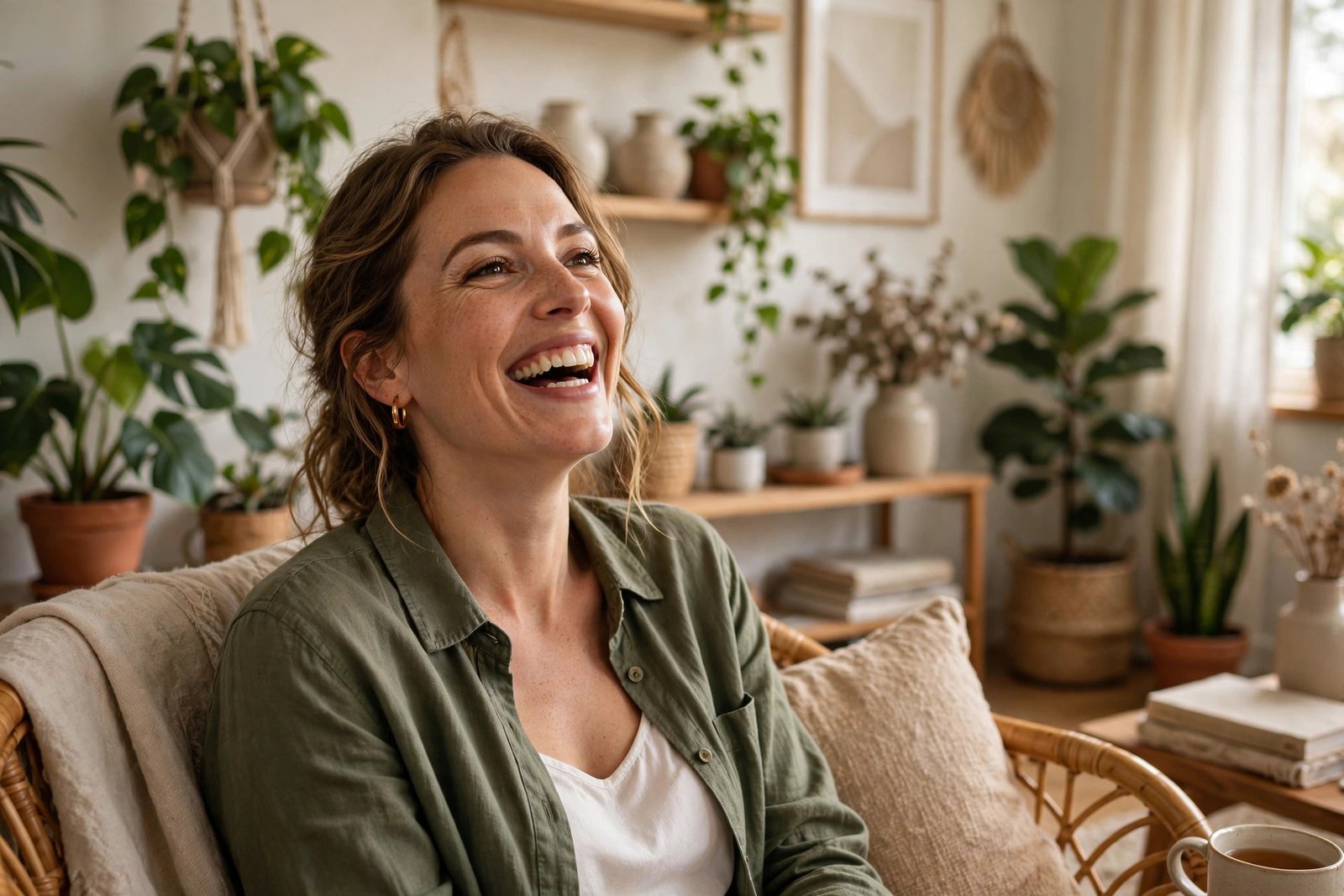
Yes. A woman can be happy without a man, and many women are, not as a performance and not as a consolation prize. Their happiness is not a waiting room. It is a life, with work, friendship, pleasure, difficulty, meaning, and love in several forms, and it does not become real only when a partner arrives to validate it.
At the same time, the honest short answer has a second half. Yes, can a woman be happy without a man, and yes, she can also be unhappy without one, just as she can be either of those things with one. Relationship status turns out to be a surprisingly weak predictor of happiness on its own. What predicts far more is the quality of a woman’s connections, her autonomy, her health, her work, and whether her daily life actually fits the person she is.
If you remember one sentence from this article, make it this one. Happiness does not require a man. It requires a life that is genuinely yours, and different women will build that life with different ingredients.
Can a woman be happy without a man, and what does happy actually mean?

Before going further, the word happy needs unpacking, because the debate often fails right here. When critics picture a woman without a man, they often picture a specific moment: coming home to a quiet apartment, eating alone, growing old alone. The picture is a moment, usually a lonely one, presented as if it were a whole life.
But happiness, as psychologists describe it, is not a moment and not a mood. It has at least two layers. The first is everyday wellbeing: how your ordinary days feel, your energy, your stress, your pleasures, your sense of calm. The second is meaning: whether your life feels like it is about something, whether you are growing, contributing, and using your capacities. A life can be short on romantic love and rich on both layers. A life can also have a partner in every photograph and be thin on both.
Notice, too, who gets asked this question. Nobody sits a man down, looks at his full and busy life, and asks whether he can possibly be happy without a woman, as a serious test of his legitimacy. Men without partners are called bachelors, focused, unlucky, or simply single. Women without partners get a diagnosis vocabulary: picky, bitter, afraid, incomplete. When people ask can a woman be happy without a man, part of what they are really asking is whether she is legitimate yet.
What research says about single women and happiness

Research cannot tell an individual woman how she will feel, but it can correct the folklore, and the folklore on this subject is strong.
Psychologist Bella DePaulo has spent much of her career studying single life, and one of her central observations is that many single people, women included, do not experience their lives as a deficit. They report valuing their friendships highly, savoring their autonomy, and using their time for work, learning, and community in ways that surveys of single adults consistently document. Her work also names the bias that distorts this debate: the assumption that partnered people are automatically doing better, which she calls singlism when it becomes discrimination.
Self determination theory, developed by Edward Deci and Richard Ryan, helps explain why. It identifies three basic psychological needs: autonomy, feeling your life is your own; competence, feeling capable and effective; and relatedness, feeling connected to others. Notice what is not on the list: a romantic partner. Relatedness matters enormously, but it can be met through friendship, family, community, and work, as well as through romance. A woman whose three needs are well met has the raw materials of happiness, whatever her relationship status. You can explore the theory in more depth through Psychology Today’s overview of happiness and wellbeing.
Large surveys of life satisfaction tend to support this balanced picture. Being in a good relationship is associated with higher reported happiness, and researchers are honest about that. But the comparison that matters is rarely made. A good relationship beats a lonely single life, while a bad relationship tends to score worse than a contented single one. The variable doing the work is quality, not the mere presence of a man.
None of this proves that every woman will thrive alone, and research should never be used as a weapon in either direction. What it does show is that when we ask can a woman be happy without a man, the empirical answer is not a brave exception. It is a common, documented outcome. And can a woman be happy without a man according to her own report, rather than according to what onlookers assume? Again, very often, yes. The gap between how single women’s lives look from outside and how they feel from inside is one of the most consistent findings in this whole area.
What a happy life is actually built from

The first block is autonomy: a life that feels chosen. This is where single life can be genuinely strong, and where the pattern explored in why do some men want an independent woman but can’t handle her becomes relevant, because a woman’s independence is often praised in theory and negotiated away in practice. A woman on her own answers for her time, her money, her home, and her plans to herself. That control is not a consolation. For many women it is the single most satisfying feature of their lives, the thing they would be most reluctant to give up.
If a partner is not the foundation, what is? It helps to name the building blocks plainly, because a woman wondering about her own future needs something more concrete than reassurance.
The second block is connection, and it deserves emphasis, because this is where critics of single life accidentally make a true point. Humans need close bonds. A life without intimacy of any kind will not be happy, with or without a partner on paper. But intimacy is wider than romance. A friend who has known you for twenty years, a sister who shows up, a community that expects you on Thursdays: these are not substitutes for real connection. They are real connection, in its most durable forms.
The third block is purpose. Work that matters to you, projects that absorb you, people you help, things you are building: purpose carries people through seasons when pleasure is scarce. Women without partners often invest heavily here, not because they are compensating, but because their time is theirs to invest. The resulting lives frequently look, from inside, less like a gap and more like a structure.
The fourth block is pleasure and rest, the unglamorous daily texture of a life: food you enjoy, movement that suits your body, a home that feels like yours, laughter, touch, beauty, sleep. None of these requires a man. Some are easier to arrange alone, some take more deliberate effort, but all of them are available, and a surprising amount of everyday happiness is decided at exactly this level.
The fifth block is security: enough money, a safe home, a plan for hard times. Here honesty is required. A two income household has real advantages, and pretending otherwise insults women who are doing the math alone. Security is the block where single women most often have to build more deliberately, through income, savings, housing choices, and mutual support networks. Harder does not mean impossible. It means the building is intentional rather than automatic.
Now stand back and look at the list. Autonomy, connection, purpose, pleasure, security. When someone asks can a woman be happy without a man, this list is the practical reply, because not one block has a man as a structural requirement. A good partner can contribute to several of them. So can good friends, good work, and good choices. And when women ask can a woman be happy without a man in the middle of a lonely season, what they usually discover is that one block, often connection or security, needs building. That is a solvable problem, and it is much more solvable than the vague verdict that their whole life is missing its main ingredient.
The honest case for partnership

Balanced means giving the other side its full strength, so here it is, without irony.
A good partnership is one of the great goods of a human life. To be known deeply by one person, to build a shared history, to have a witness to your days and a teammate in your crises, to touch and be touched, to laugh at jokes nobody else would understand: these are not cultural inventions. They answer real needs, and for many women a life without them would genuinely be smaller, however rich its other parts.
Partnership also distributes weight. Illness, grief, money shocks, and aging arrive more gently when someone shares them by default rather than by arrangement. The partnered woman does not have to organize all her support. Some of it is simply there, in the next room. Single women can build equivalent support, and many do, but it takes ongoing effort that coupled life provides automatically. That difference is real and it is fair to admit it. None of that changes the answer to can a woman be happy without a man. It only shows what a good partner can add to a life that could also stand without him.
So this article is not arguing that men add nothing, or that wanting a partner is a weakness installed by the culture. Wanting love is human. The argument is only about the word without. A woman can want a man, enjoy a man, and build a joyful life with a man, while the answer to can a woman be happy without a man remains yes. Desire and requirement are different things. Confusing them is what turns a preference into a panic.
Notice what follows from keeping them separate. If a partner is a choice rather than a requirement, then a woman can choose well. She can wait for a good one. She can leave a bad one without believing she is leaving happiness itself behind, which is precisely the fear at work when women ask should you leave your boyfriend if you are not happy. Believing happiness is possible without a man does not weaken relationships. It improves the ones that form, because they are entered freely rather than clutched at.
Loneliness and solitude are not the same thing
The strongest argument thrown at single women is loneliness, so it deserves a careful, honest answer rather than a dismissal.
Loneliness is real, it is painful, and it is not distributed by relationship status the way people assume. Loneliness is the feeling that your connections are not meeting your needs. It happens in marriages, in families, and in crowded cities, and researchers who study it are clear that being alone and feeling lonely are related but separate experiences. A partnered woman can be profoundly lonely at her own kitchen table. A single woman can come home to her quiet apartment and feel, simply, at peace.
Solitude is the other experience, and our culture barely has a positive word for it, which is part of the problem. Solitude is chosen aloneness that restores: time to think, to rest, to hear your own mind, to do things at your own pace without negotiating. Many women describe discovering, sometimes to their own surprise, that they are good at being alone, that the quiet they were warned about feels less like an absence and more like a room of their own.
The honest picture includes hard evenings. Most single women will tell you there are moments: a Sunday that stretches, an illness managed alone, a piece of good news with no obvious first person to call. Those moments are real, and a balanced article should not wave them away. But notice that partnered life has its own hard moments, different in kind, not in weight. Every life shape has a tax. The question is which tax you would rather pay, and that is a personal calculation, not a universal law.
So when the loneliness argument is used to answer can a woman be happy without a man with a flat no, it proves too much. If loneliness were caused by the absence of a man, no married woman would feel it. She does, often. Which means the cause lives elsewhere, and so does the cure.
Where the pressure comes from

If the evidence is this balanced, why does the question still carry so much weight? Because the pressure behind it was never really about evidence.
Part of it is history. For most of recorded history, a woman without a man was not merely pitied. She was economically exposed. Marriage was her pension, her protection, and often her only legal route to property, credit, and social standing. That world is gone in most places, but its emotional furniture remains. Grandmothers who survived that world pass its warnings down with love, not understanding that the warning has expired. When an older relative asks can a woman be happy without a man with real anxiety in her voice, she may be asking whether you will be safe, in the only language she was given.
And part, honestly, is that a woman who is content without a man is inconvenient to several arrangements. She is harder to shame into settling. She negotiates differently, at work and in love, because her alternative to a bad deal is a life she already likes. Cultures rarely celebrate the person who does not need what the culture is selling, and the mild suspicion aimed at contented single women says more about the sellers than about her. Suspicion, in any case, is not evidence, and it should not decide can a woman be happy without a man for anyone else.
Signs a woman is genuinely thriving on her own

Since outside observers are unreliable judges, here are better indicators, the kind you can check in your own life or in the life of a woman you care about.
Her friendships are deep and current, not leftovers. She invests in them the way couples are told to invest in a marriage: time, honesty, repair after conflict, showing up in crises. Her calendar and her heart are both populated.
Her days have a texture she chose. There is work she respects, rest she does not apologize for, and at least one pursuit that is hers alone. Ask her what she is looking forward to and she has an answer that does not involve another person’s arrival.
Her finances and her future have her attention. She may not be wealthy, but she is building: savings, skills, plans for housing and aging that assume her competence rather than a rescue. This practical self trust is one of the least discussed and most stabilizing forms of happiness.
She speaks about men and relationships without bitterness and without desperation. She can enjoy a date, decline a second one, celebrate a friend’s engagement sincerely, and describe her own status as a fact rather than a wound. That evenness is hard to fake, and it is usually the surest outward sign that the inward answer, for her, is yes. She has, in effect, answered can a woman be happy without a man by living the answer, one ordinary contented week at a time.
When wanting a partner is the honest answer
Balance also means protecting the opposite truth. For some women, in some seasons, the honest answer to this debate is personal: I would be happier with a partner, and I am tired of being told that wanting one makes me weak or brainwashed.
That position deserves respect, not correction. A woman can have a full life, strong friendships, real autonomy, and still feel the specific absence of romantic partnership as a genuine loss. Human beings differ. Attachment needs differ. The wish to share life with one particular person, to be chosen and to choose, in that specific way, is not a cultural implant for everyone. For many it is a central desire, and a culture that shames it in the name of empowerment is just the old pressure wearing new clothes.
Seasons matter too. A woman may thrive alone at thirty, long for partnership at forty, thrive inside one at fifty, and build a contented solo life again at seventy after loss. None of those chapters cancels the others, and none needs to be explained as the moment she finally admitted the truth. Lives are long. The answer to can a woman be happy without a man can be yes for two decades and incomplete in a third, and both reports can be honest.
There is also a difference between wanting a partner and needing rescue. Wanting is specific and warm: I would like to share this life with someone good. Needing rescue is frantic: anyone, quickly, before my worth expires. The first leads to good choices and can wait for them. The second leads to the kind of settling that gives single life its best advertising. If you recognize the frantic version in yourself, the work is not to abandon the wish. It is to lower the panic until the wish can breathe, because a calm wish chooses far better than a frightened one.
What to do next

Whether you are single and defending your life, single and quietly unsure, or partnered and thinking about all of this, here are moves that help more than debating the question in the abstract.
First, audit your life by blocks, not by status. Take the five building blocks from earlier, autonomy, connection, purpose, pleasure, and security, and rate each one honestly. Most women who do this discover that their unease lives in one or two blocks, not in the absence of a man as such. A thin connection block needs friends and community work. A thin security block needs a money plan. Naming the actual gap turns a vague dread into a project.
Second, build the block that is thinnest, starting this month, with one concrete action. Join the thing. Book the recurring dinner. Start the savings transfer. Small, repeated investments in friendship and security do more for real happiness than another year of arguing with the question can a woman be happy without a man inside your own head.
Third, examine the voices you are answering. When the doubt rises, ask whose sentence it actually is. Your mother’s fear, an old school friend’s pity, a film’s ending, an influencer’s certainty? Sentences you did not write should not get to grade your life. Keep the concerns that are truly yours. Return the rest, politely, to their owners.
Fourth, if you want a partner, want one from fullness. Date as a person choosing, not as a person auditioning for rescue. This is not a slogan. It changes practical behavior: you leave bad dates sooner, you state needs earlier, and you evaluate a man by whether he adds to a life you like, which is the only standard that reliably produces good partnerships anyway.
Fifth, if you do not want a partner, or not now, practice saying so plainly and kindly, without a speech. “My life is full, and I am not looking” is a complete answer. You do not owe the room your history, your reasons, or your five year plan. Plainness, practiced a few times, becomes ease, and ease is contagious. Other women in the room are usually listening harder than you think.
And finally, revisit the question less often. A well built life answers can a woman be happy without a man the way a well built house answers questions about the weather: not by arguing, but by standing there, warm and occupied, while the seasons do what they do.
FAQ

Can a woman be happy without a man for her whole life?
Yes, she can, and many women report exactly that across long lives, provided the building blocks are in place: close connections, autonomy, purpose, pleasure, and enough security. A whole life is a long project, and like any life it will contain grief and lonely seasons. But those seasons also visit partnered lives. What predicts a happy whole life is not a partner’s presence from start to finish. It is whether the life keeps being built, deliberately, by the woman living it.
Does being happy alone mean I will never want a partner?
No. Contentment and openness coexist easily. Many women who are genuinely happy on their own later choose a partner, and choose better, because they are selecting for addition rather than rescue. Others never do, and their contentment continues. Being happy alone does not lock any door. It simply means no door needs to be rushed through out of fear, which is a position of strength in every direction.
Is it normal to feel lonely sometimes even if I chose this life?
Completely normal, and it does not invalidate the choice. Chosen lives still contain hard evenings, illnesses, and Sundays that stretch. Partnered people feel lonely too, sometimes inside the relationship itself. Treat occasional loneliness as weather and as information: it may point to a friendship that needs feeding or a community you have been meaning to join. It becomes a problem to act on only when it is constant, and even then the action is building connection, not necessarily finding a man.
What does research actually say about can a woman be happy without a man?
Research generally supports a balanced conclusion. Good relationships are associated with higher life satisfaction, single people are far more content than stereotypes suggest, and the quality of a person’s connections, autonomy, and daily life predicts happiness better than relationship status alone. Researchers who study single life also document a bias in how single women’s happiness gets judged by others. In short, the science does not treat a partner as a requirement. It treats him as one possible contributor among several.
How do I answer people who insist I cannot be happy without a man?
Keep it short, warm, and final. “I understand it looks different from outside, but my life is full and I am well” answers most cases. You are not obliged to litigate your happiness in the manner of a court case, with evidence and witnesses. People who love you will usually accept a contented answer from a contented woman, eventually. People who cannot accept it are telling you about their own fears or their own choices, and that information, while interesting, is not a verdict on your life.
Happiness was never a prize awarded for completing the correct sequence of steps. It is the felt quality of a life built from real ingredients, by a person paying attention. Some of those lives will center on a beloved man. Some will center on work, friendship, family, faith, art, or quiet mornings in a home that is wholly hers. The honest answer to the question that started this article is yes, fully and without an asterisk. A woman can be happy without a man, because a man was never the ingredient. A life that is truly hers was, and that life is available to build, starting from wherever she stands today.