
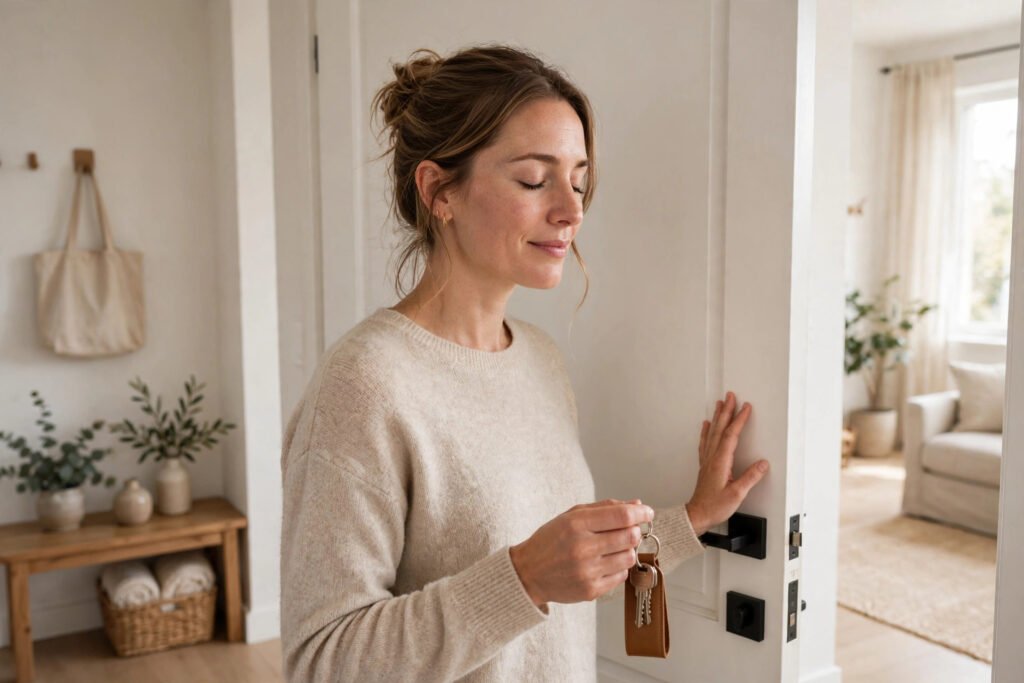
You have had the thought more than once. Maybe it came in a quiet apartment you visited, in a hotel room on a work trip, or in the middle of a loud family kitchen. A whole place of your own. Your books, your silence, your schedule, your door that locks behind you and answers to nobody.
And almost immediately, the second thought arrived to arrest the first one: what kind of woman wants that? So you ask yourself, quietly and with some shame, is it selfish to want to live alone?
This article takes that question seriously, because the answer matters more than it seems. Underneath the question is it selfish to want to live alone sits a much older accusation, and a much more interesting truth about what you actually need.
The short answer

No. It is not selfish to want to live alone. Selfishness means taking what you need at other people’s expense, without regard for the harm. Wanting your own front door harms no one. It is a preference about the shape of your daily life, and a preference is not a crime against the people who love you.
Notice something important: the question is it selfish to want to live alone is almost never asked about men. A man who wants his own space is called independent. A woman who wants the same thing is asked to explain herself, to her family, to her partner, and apparently to her own conscience at two in the morning.
That double standard is worth remembering, because it tells you where the guilt came from. It did not come from your character. It was installed, piece by piece, long before you ever pictured your own apartment.
Wanting to live alone is not a rejection of love, family, or company. Most people who ask is it selfish to want to live alone are not dreaming of a cabin in the woods with no visitors. They are dreaming of a home where their nervous system can finally stand down, where nobody needs anything from them for a few hours a day. That is not selfishness. That is a need, and needs are allowed to exist even when they inconvenience other people’s plans for you.
Where the guilt comes from: what you were taught a good woman does

Guilt this specific is never an accident. It is taught, and it helps to see the curriculum.
From childhood, most girls absorb a quiet job description: be available, be warm, be the one who notices, remembers, soothes, and stays. The good daughter lives close and calls often. The good partner merges her life smoothly into someone else’s. The good mother has no door she closes. None of these messages arrive as orders. They arrive as praise, and praise is a very effective teacher.
Psychologists have a term for the beliefs we swallow whole from our culture and families: internalized roles. They operate like background software. You do not argue with them consciously. You simply feel a pang of guilt when you violate them, and most women who wonder is it selfish to want to live alone are feeling exactly that pang, the discomfort of breaking a rule they never agreed to.
There is also a social function to the guilt. A woman who is happily self-contained is harder to recruit. She is less available for unpaid emotional labor, less dependent on approval, and less willing to organize her entire life around being needed. Cultures that run on women’s availability tend to label that availability’s opposite as a character flaw. Selfish is simply the word the system uses when a woman keeps something for herself.
Families add their own layer. In many households, a daughter moving out on her own, not for a husband, not for a job in another city, just because she wants to, reads as a verdict on the family itself. Parents ask what they did wrong. Relatives predict loneliness with an enthusiasm that sounds suspiciously like hope. Their reaction is about their story, not about your selfishness.
And if you have a partner, the guilt doubles. Wanting your own place gets translated, by him or by you, into wanting to leave him. Sometimes that translation is accurate, and we will be honest about that below. But often it is simply wrong: you can find the answer to can you love someone but not want them complicated enough without adding living arrangements to it. Love and shared housing are two separate decisions that we have been trained to treat as one.
History makes the pattern easier to see. A woman who lived alone used to be pitied: the spinster, the leftover, the cautionary tale. Pity has gone out of fashion, so the culture updated its tool. Now she is not pitied, she is diagnosed as selfish, avoidant, or afraid of commitment, as if a preference for her own address required a medical or moral explanation. That history sits quietly behind the modern question is it selfish to want to live alone: the wording changed, the conclusion did not. A woman contentedly on her own still has to be explained, because her contentment was never part of the original plan.
Once you see the guilt as installed rather than earned, the question changes. It stops being “what is wrong with me” and becomes “what do I actually need, and why was I taught to be ashamed of it?” That is a far better question, and the rest of this article works through it.
What research says about living alone and wellbeing

Psychology is surprisingly clear on the underlying need here. Self-determination theory, developed by Edward Deci and Richard Ryan, identifies autonomy as one of the basic psychological needs of human beings, alongside competence and connection. Autonomy does not mean isolation. It means experiencing your life as your own, chosen rather than assigned. A home of your own is one of the most concrete forms that autonomy can take.
Research on solitude tells a similar story. Psychologists distinguish between loneliness, which is painful and unwanted, and chosen solitude, which is restorative. Studies of everyday solitude have found that time alone, when freely chosen, is associated with calm, lower stress, and a renewed capacity to connect with others afterward. You can explore this distinction further in Psychology Today’s overview of solitude.
The sociologist Eric Klinenberg, in his book Going Solo, examined the rapid rise of one-person households across developed countries. One of his most striking observations was that people who live alone are often more socially engaged, not less: they see friends more, eat out more, and participate more in community life than many people in shared homes. Living alone, in other words, does not produce hermits. It frequently produces people with the energy to show up for others, precisely because they are not depleted at home.
Researchers who study couples have also documented a growing arrangement called living apart together, in which committed partners keep separate homes by choice. Far from being a failed relationship, these arrangements are often described by the people in them as the reason the relationship survived. Distance, chosen honestly, can protect affection rather than end it.
The psychologist Bella DePaulo has spent years studying single life, and her work is useful here precisely because it refuses the premise hidden inside is it selfish to want to live alone, namely that a life only becomes legitimate when it is shared and witnessed full time. Her research describes many single people as savoring their solitude and their autonomy, using time alone to grow rather than merely enduring it. You do not have to agree with every claim she makes to use the central insight: the wish for a home of one’s own shows up in study after study as a wish for a fuller life, not a smaller one.
None of this means living alone is a cure for anything. It means the honest answer to is it selfish to want to live alone is that the wish is normal, well documented, and frequently healthy. The guilt attached to it is a cultural artifact, not a psychological finding.
The difference between wanting space and avoiding people

There is one distinction that decides everything, and it is this: are you moving toward a life, or away from people?
Wanting space is an approach desire. Your imagination fills with specifics: mornings that start slowly, a desk nobody rearranges, silence after a long day of being needed, a kitchen where the dishes are only yours. The feeling underneath is appetite. You want something, and the something happens to be a home of your own.
Avoiding people is a protective desire. The fantasy is thinner, mostly about absence: no questions, no demands, no one witnessing you, no risk of disappointing anyone or being disappointed. The feeling underneath is relief, and relief is not the same as desire. It often means something hurts and you want the hurting to stop.
Both desires can live in the same person, and neither makes you a bad person. But they ask for different responses. If you are moving toward a life, arranging to live alone will likely satisfy you deeply. If you are mainly escaping pain, a new apartment will help less than you hope, because the pain tends to know your new address.
A useful test: imagine you have the apartment, exactly as you pictured it. Are you imagining what you will do there, or only what will no longer be done to you? When women honestly ask themselves is it selfish to want to live alone, what they usually discover underneath is one of these two engines. Name yours before you make any decisions, because the same front door can mean liberation or hiding, depending on which engine is driving.
Signs your wish to live alone is healthy

If most of these are true, your wish is probably exactly what it looks like: a healthy need asking to be taken seriously.
You still enjoy people. You see friends, you laugh at dinners, you show up for your family. You are not withdrawing from the world. You are asking for a base to return to, not a bunker to disappear into.
You feel more generous after time alone, not less. Solitude refills you, and the people around you can tell. You are kinder after a quiet weekend, more patient, more present. A need that makes you better company is a strange kind of selfishness.
Your wish is stable, not a spike. It does not appear only after fights or bad weeks. It has been there in calm weather too, for a long time, like a fact about you that you keep politely ignoring.
You can picture a full life in the space, not an empty one. The fantasy includes cooking for friends sometimes, working, resting, celebrating. The apartment in your mind is a home, not an escape pod.
You are willing to do the unglamorous work. Wanting to live alone, healthily, includes thinking about money, safety, logistics, and the effect on people you love. It is a plan forming, not a door slamming.
You think about other people’s feelings without surrendering to them. You would not vanish without a word. You would plan the move, honor your commitments, and stay present in the lives of the people who count on you. Thoughtfulness about the impact is built into the wish itself, which sits very strangely next to the word selfish.
When the wish is protecting a wound instead

Honesty requires the other side. Sometimes the answer to is it selfish to want to live alone is no, but the more useful answer is that the wish is a bandage, and the wound underneath deserves attention first.
Consider whether your desire for total solitude arrived suddenly, right after a loss, a betrayal, or a burnout. Wishes that arrive with crisis often soften when the crisis does. That does not make them fake. It means they may be measuring your pain level rather than your permanent needs.
Consider, too, whether being known by anyone has started to feel unbearable. If even your closest friend’s concern feels like an invasion, and every invitation feels like a threat, the issue may be less about housing and more about a season of depression, grief, or exhaustion. Those are real, common, and treatable, and a good professional can help you sort out which wish is which. There is no shame in checking.
And consider the bolting pattern. If every hard relationship chapter of your life has ended with you disappearing rather than speaking, living alone may be the latest chapter of an old strategy. The strategy protected you once. It may now be costing you the closeness you also genuinely want.
None of this disqualifies you from living alone. Plenty of people heal beautifully in their own space. It simply means the wisest order is wound first, lease second, so that the new home becomes a place to live rather than a place to hide.
One more test is worth doing: say the wish out loud to someone safe and watch your own reaction. If describing your own quiet home brings a wave of tears that feels more like grief than excitement, pay attention. Women in that position are often not really asking is it selfish to want to live alone. They are asking whether they are allowed to stop coping for a while. The answer to that question is yes, absolutely, but the stopping may need support, rest, and company of a chosen kind, not just a change of address.
Is it selfish to want to live alone when you have a partner?

This is the version of the question that keeps women up at night, because now the wish has a face attached to it. If you want your own place while someone loves you and expects a shared one, are you rejecting him?
Not necessarily. You might be rejecting a living arrangement, which is a different thing. It is worth saying plainly, because this exact confusion sits at the heart of the pattern in why do some men want an independent woman but can’t handle her: a woman’s autonomy gets read as a lack of love, when it is usually just autonomy.
Three honest possibilities exist. First, you love him and you also need your own home; the arrangement called living apart together exists precisely for this. Second, you are not sure about the relationship, and the apartment is your honest half-step while you figure it out; that deserves honesty, with him and with yourself. Third, you want to leave, and the apartment is the exit you keep picturing because the word leaving feels too heavy to say. Only you know which one is yours, and the question is it selfish to want to live alone cannot be answered honestly until you do.
Notice that in only one of the three is anyone being misled. Selfishness, if it appears anywhere here, lives in dishonesty, not in square footage. A woman who says clearly what she wants and why is not selfish, even if the answer disappoints someone. A woman who secretly plans an exit for a year while accepting a ring is in different territory, and it is territory that has nothing to do with apartments.
Practical fairness matters too. If you live apart, costs, holidays, emergencies, and time together need real agreements, not assumptions. Chosen distance works when both people design it. It corrodes when one person designs it and the other person is simply informed.
Couples who make it work tend to describe a rhythm rather than a rejection: weeknights in their own spaces, weekends together, keys exchanged, plants watered, a standing dinner that nobody cancels. When partners in these arrangements are asked is it selfish to want to live alone, the ones who thrive often give the same answer. It would be selfish, they say, to demand a life shape that slowly empties the other person just because the shape is traditional. The apartment is not the threat to the relationship. The resentment of a forced shape is.
How to say it without blowing up your life

The words are easier than the fear around them. Here are honest ways to open the conversation, depending on who is listening.
To your partner. “I love our life, and I have learned something about myself: I come back to you better when I have real space of my own. I want us to talk about what that could look like for us, because I am raising it to protect us, not to leave you.” Expect the first reaction to be hurt, and do not treat hurt as a verdict. Give the idea time to be heard in full before either of you decides anything.
To your parents. “This is not about getting away from you. It is about building the base my life needs. I will be five minutes away, I will be at Sunday lunch, and I will probably be nicer company than I am now.” Parents often soften when they see the ongoing place they hold in the plan. What alarms them is disappearance. Most daughters asking is it selfish to want to live alone are not planning to disappear at all, and saying so, concretely, changes the temperature of the whole conversation.
To the friend who says you will end up lonely. “Maybe. Or maybe I will end up rested, and you will get the best version of me instead of the depleted one. Come for dinner when I am settled and judge for yourself.” You do not owe anyone a defense beyond this. Grown adults are allowed to arrange their housing without a public trial.
Underneath all three scripts is the same move: you present the wish as information about your needs, not as a complaint about them. Needs can be discussed. Complaints start wars.
What to do next

If the wish has been with you for a while, treat it as data and start testing it against reality, gently and concretely.
First, define what exactly you are craving. Is it silence, control over your space, a shorter list of daily negotiations, or distance from a specific situation? Sometimes a lock on a door, a room of your own, or renegotiated routines inside your current home deliver most of what you want. Sometimes only your own address will do. Know which.
Second, run the practical numbers privately. What would it cost, what would you change, what would a realistic timeline look like? A wish with a spreadsheet attached stops being a guilty secret and becomes a plan you can evaluate calmly.
Third, take one small, real step. Visit a neighborhood. Spend a solo weekend somewhere and pay attention to how you feel on the last day: sad to return, or ready? Your body will hand you information your guilt has been editing.
Fourth, tell one person. Saying the wish out loud to a trusted friend breaks the shame loop faster than months of private reasoning, because shame needs secrecy the way fire needs air. You will know by the relief you feel whether this wish is a scandal or simply a plan that had not been spoken yet.
And finally, stop asking the question in its rigged form. Ask instead: is it selfish to want to live alone, or have I simply been taught that my needs need permission? The second version has an answer you can act on.
FAQ

Is it selfish to want to live alone while in a relationship?
No, wanting your own space while loving someone is neither rare nor selfish. Couples who live apart together report that the arrangement protects their affection by removing the daily friction that grinds it down. What a relationship cannot survive is not distance; it is dishonesty about distance. If the wish is real, saying it early and kindly is the opposite of selfish.
Does wanting to live alone mean I do not love my partner?
Not on its own. Love is measured by care, honesty, and how you treat someone, not by whether you share a bathroom. Wanting solitude says something about your nervous system and your history, not automatically about your heart. It is worth checking the three possibilities honestly: arrangement, uncertainty, or exit. But the wish alone is not proof of anything except that you need space.
Will living alone make me lonely?
Living alone and being lonely are different conditions, and research on single-person households suggests they often do not even travel together. Loneliness depends on the quality of your connections, not on your address. People in crowded homes can be profoundly lonely, and people in quiet studio apartments can be richly connected. The question to ask is not where you will sleep, but who will be in your life, and the answer to that one is yours to build. It is also worth noticing how rarely anyone asks a man signing his own lease is it selfish to want to live alone. The loneliness warning, like the selfishness accusation, seems to be distributed by gender.
How do I tell my family I want to live alone without hurting them?
Lead with the ongoing relationship, not the exit. Tell them what will continue: the calls, the lunches, the holidays, your presence in their lives. Explain the need in terms of what it gives you, rest, focus, steadiness, rather than what it takes you away from. Some hurt may happen anyway, and hurt feelings are not the same as harm done. Adults you love are allowed to feel disappointed and still love you on the other side of it.
Is it selfish to want to live alone, or is it just a phase?
It can be either, and time is the test. A phase spikes after conflict or exhaustion and fades when life calms down. A real need stays quiet and constant across good seasons too. If you have wanted this in your happiest months as well as your hardest ones, believe yourself. The most reliable sign that is it selfish to want to live alone is the wrong question entirely is this: the wish is not greedy, dramatic, or loud. It is steady. Steady wishes are usually the truth.
You are allowed to build a life that fits the person you actually are. If that life has your name alone on the door, it does not make you selfish. It makes you honest, and honesty, offered kindly and early, is one of the least selfish things a person can practice.