
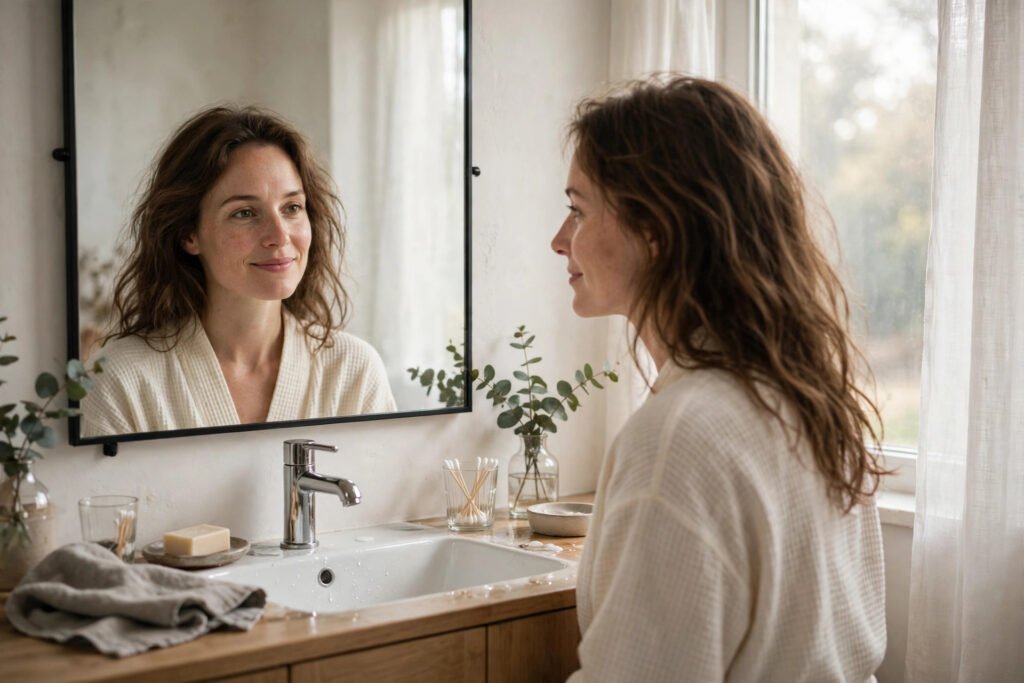
Same mirror. Same face. Same you. On Monday you catch your reflection while getting ready and think, honestly, that you look good. Your skin is cooperating, your hair falls the way you wanted, and you walk out the door feeling like yourself on a good setting. On Thursday you stand in front of that exact mirror and everything is wrong. Your face looks swollen, your skin looks dull, your features seem slightly off in a way you cannot name but cannot unsee either. So why do I feel beautiful some days and terrible on others, when almost nothing about your face has actually changed?
If you are asking why do i feel beautiful some days and terrible on others, you are not imagining the swing, and you are not vain for noticing it. Nearly every woman knows this whiplash. What most women do not know is that the swing is rarely about the face in the mirror. Understanding why do i feel beautiful some days and terrible on others means looking at the judge instead of the judged, because the thing that changes from day to day is not your bone structure. It is the state of the person doing the looking.
Below is a full breakdown of why do i feel beautiful some days and terrible on others: the biology underneath it, the psychology that amplifies it, what research on body image actually says, the role of the people around you, and what you can do on the days when the mirror feels like an enemy. The answer will not make the bad mirror days vanish. It will make them stop meaning what you think they mean.
The short answer

The short answer to why do i feel beautiful some days and terrible on others is this: your perception of your own face is state dependent. Your brain does not evaluate your appearance with a fixed measuring tool. It evaluates your appearance through the filter of how you slept, where you are in your cycle, how stressed you are, what you have been looking at for the last hour, and how safe and valued you feel in your life right now. Change the filter and the same face gets a different verdict.
On a rested, calm, well fed day, the filter is generous. Your brain registers your face as a whole, the way other people see it, and the whole is usually kind. On a depleted day, the filter turns forensic. Your attention zooms into pores, asymmetry, the one tooth, the forehead line, and the audit feels objective even though it is mostly chemistry and mood wearing the costume of fact.
Once you see that clearly, why do i feel beautiful some days and terrible on others stops being a question about your face and becomes a question about your state. That is genuinely good news. Faces are hard to change. States change constantly, and many of the levers that move them are partly in your hands.
Your face barely changes. Your state changes constantly.

Start with the objective facts, because they are more reassuring than you expect. Between your best mirror day and your worst, your actual face changes very little. A little water retention can soften your jawline. A short night can deepen the shadows under your eyes. Your skin can be slightly more reactive before your period. Hormones can add a small amount of puffiness. These are real, but they are marginal, the kind of differences a friend would not notice if her life depended on it.
What changes dramatically is the machinery of perception itself. You never see your face directly. You see a reconstruction your brain builds from light, memory, expectation, and mood. When you are anxious or exhausted, the brain’s threat systems are more active, and a brain on threat duty scans for problems. Pointed at a spreadsheet, that scanning finds errors. Pointed at your face in a bathroom mirror, it finds flaws, with the same dutiful energy.
There is also the simple matter of familiarity. You have seen your face ten thousand times, including at angles and in lighting no one else ever sees. Other people meet the animated, three dimensional, expressive version of you. You meet the frozen, reversed, fluorescent lit version, often first thing in the morning, at your least rested and least forgiving. It is not a fair comparison, and your brain rarely discounts for it.
That gap between the stable face and the unstable feeling is the entire puzzle of why do i feel beautiful some days and terrible on others. The feeling is real. The conclusion you draw from it, that something about you is wrong today, almost never is.
Why do I feel beautiful some days and terrible on others? The honest reasons

Underneath the swing there are a handful of honest forces, and they are more ordinary than the beauty industry would like you to believe. Here are the forces behind why do i feel beautiful some days and terrible on others in an ordinary week.
The first reason is sleep, and it is not close. A short or broken night changes both how you look and how you judge. Tired skin is slightly paler and less even, tired eyes are more noticeable, and a tired brain is measurably harsher in its evaluations, of your face and of everything else. If your worst mirror days reliably follow your worst nights, you already know your biggest lever.
The second reason is hormonal. Across the menstrual cycle, and again in perimenopause, shifting estrogen changes water retention, skin oiliness, sensitivity, and mood, all at once. Many women feel least attractive in the late luteal phase, the days right before a period, when breakouts, bloating, and irritability peak together. Nothing about that cluster is a personal failure. It is endocrinology, and it passes on a schedule you can learn to predict.
The third reason is mood itself. Low mood does not just accompany a bad mirror day, it manufactures one. When you are sad, anxious, or ashamed about something unrelated, your attention narrows toward the negative and your interpretations darken. Psychologists call this mood congruent perception: the feeling comes first, and the evidence is recruited afterward. Your face is simply the nearest available evidence.
The fourth reason is comparison, which gets its own section below because it has become the loudest voice in the room. The fifth reason is context and feedback. A compliment in the morning, a partner who looks at you with obvious warmth, clothes that fit the body you have today: these small signals tune the filter up. Silence, criticism, or an old pair of jeans tunes it down. Together, these five forces explain most of why do i feel beautiful some days and terrible on others, most of the time, for most women.
What research says about body image and self perception

None of this is just folk wisdom. Psychologists have studied body image for decades, and their work maps closely onto the experience women describe at the mirror. Researchers who study body image would recognize the question why do i feel beautiful some days and terrible on others immediately, because it describes something they measure under a specific name: state body image, the moment to moment version of how you feel about your appearance, as opposed to your general, long term satisfaction with your body.
The distinction matters. Your overall body image might be reasonably healthy while your state body image swings wildly across a single week. Studies using daily diaries and repeated check ins have found that women’s satisfaction with their appearance fluctuates from day to day and even within a day, and that the fluctuations track mood, stress, sleep, social feedback, and comparison far more closely than they track any physical change. The research answer to why do i feel beautiful some days and terrible on others is, in large part, that self perception is a state, not a snapshot, and states are weather, not climate.
Psychologist Thomas Cash, one of the central figures in body image research, described body image as having several layers: a perceptual layer (how you estimate what you look like), an emotional layer (how you feel about it), a thinking layer (the beliefs and importance you attach to appearance), and a behavioral layer (what you do because of it, from mirror checking to avoiding photos). On a bad mirror day, all four layers can tilt at once. Your perception literally sharpens on flaws, your emotions follow, your beliefs about how much appearance matters get louder, and your behavior, checking, fixing, hiding, confirms the whole loop by treating it as real.
Objectification theory, developed by psychologists Barbara Fredrickson and Tomi-Ann Roberts, adds a cultural layer. It proposes that women in many societies learn early to view themselves partly from the outside, as if through an observer’s eyes, a habit called self objectification. A woman running that internal camera is never just living in her face and body. She is also monitoring how they appear. Monitoring is exhausting, it spikes under stress and fatigue, and it turns an ordinary tired morning into a full appearance audit. If you want the broader picture of how body image works, the overview at Psychology Today is a solid place to keep reading.
One more finding is worth carrying with you. Research on attention and body image suggests that dissatisfied moments involve a specific pattern: longer staring at the features you dislike and less time taking in the whole. In plain language, on good days you see a person. On bad days you see a collection of parts, and parts, examined one by one under bright light, almost always lose. The swing is in the seeing, not in the seen.
The comparison trap: mirrors, cameras, and other people’s faces

Few things influence why do i feel beautiful some days and terrible on others more quietly and more constantly than comparison, because comparison has moved into your pocket. A generation ago, you compared yourself with the women in your street, your office, and a handful of magazine covers. Today your brain benchmarks your unfiltered morning face against a feed of faces that are lit, angled, edited, filtered, and selected from hundreds of discarded attempts, including, on heavy scrolling days, your own.
Social media comparison is mostly upward comparison, comparing yourself to people presented at their peak, and it reliably drags state body image down in the short term. The effect is strongest exactly when you are already tired, hormonal, or low, which means the days you most need kindness from the mirror are the days you are most likely to open the app that makes the mirror cruel. It is a stacked deck, and knowing it is stacked is the beginning of playing it better.
Then there is the camera problem, which is more mechanical than you think. You are used to your mirror image, your reversed face, and psychologists have long known that people tend to prefer the version of their face they see most often, a phenomenon called the mere exposure effect. A photograph shows you the unreversed version, the one everyone else knows, and it can look subtly wrong to you while looking completely normal to everyone else. Add a wide phone lens held close, which genuinely distorts proportions, plus harsh overhead light, and a bad photo is often just physics wearing your face.
Even mirrors are not neutral. Bathroom lighting is usually the worst light in your life: overhead, cool, and shadow carving. The same face in window light at four in the afternoon looks different enough to feel like a different verdict on a different woman. Before you conclude anything about your face from a specific mirror, it is worth asking what that mirror is made of, when you last slept, and what you were looking at five minutes before. The answer is usually standing right there.
The people around you: praise, silence, and the wrong partner

Your mirror does not operate in a vacuum. It takes instructions from your relationships more than you probably realize. A partner who looks at you with uncomplicated warmth on an ordinary Tuesday is quietly tuning your filter toward kindness. A partner who goes silent when you dress up, who jokes about your skin, your weight, or your age and calls it honesty, is tuning it the other way, and the tuning accumulates. A partner who mocks your appearance precisely on your low days becomes part of the answer to why do i feel beautiful some days and terrible on others, because some of your worst days are not coming from inside you at all. They are being scheduled by someone else.
Pay attention to whose voice narrates your mirror. Many women discover, when they listen honestly, that the cruel commentary in front of the glass is not even theirs. It is a mother’s warnings repeated for thirty years, an ex’s parting insult, a friend’s competitive little remarks, a comment section’s standards. Identifying the voice does not silence it overnight, but it does demote it. A borrowed opinion is easier to argue with than a fact.
There is a related trap worth naming. If your anxiety about your reflection spikes mostly inside your relationship, if you feel beautiful when friends compliment you and terrible whenever he seems distant, the question why do i feel beautiful some days and terrible on others may be tangled up with a different fear entirely: the fear that his affection is conditional and your face is the condition. That pattern deserves its own honest look, and it helps to understand why you might always be afraid he will leave you and what that anxiety does to the way you see yourself.
And if the person closest to you is actively dismantling your self image, with criticism dressed as concern, compliments that arrive only when you shrink, or comparisons to other women delivered as motivation, that is no longer a body image problem you should try to fix with skincare and sleep. It helps to know the signs you are in a toxic relationship, because a woman cannot stabilize her reflection while someone keeps shaking the mirror. Friends tune the filter too, for better and worse. The women who make you feel more like yourself are not just good company. They are, measurably, part of why some of your days are beautiful ones.
It is not vanity, and sometimes it is a signal
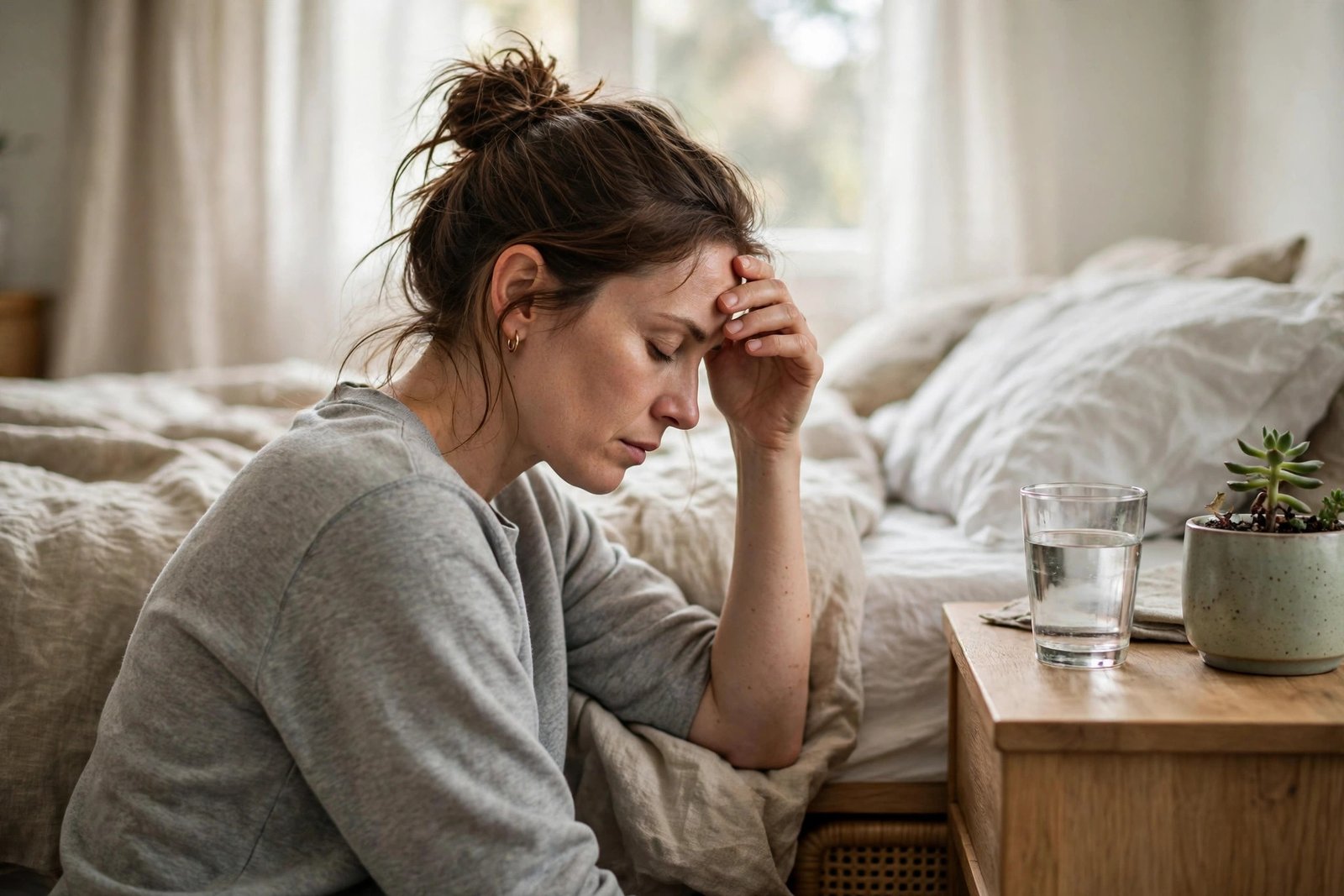
A necessary correction before the advice: this swing is not vanity. Vanity is caring too much about admiration. What most women describe is something else entirely, a private weather system of self perception that affects whether they take the photo, wear the dress, go to the event, or feel present in their own life. Dismissing it as shallowness, including when you dismiss it in yourself, misunderstands what is being swung. It is not your opinion of your cheekbones. It is your sense of being acceptable in the world today.
It is also worth being fair to the other side. Sometimes the mirror is reporting something real and worth hearing. Persistent fatigue, sudden skin changes, hair changes, or a face that looks unlike itself for weeks can accompany illness, thyroid problems, deficiencies, medication effects, or depression, all of which are medical or psychological matters, not beauty failures. The signal is not “you look bad.” The signal is “something in the system has changed.” That is a reason to book a checkup or talk to a professional, not a reason to buy a new serum.
Part of answering why do i feel beautiful some days and terrible on others honestly is knowing when the swing stops being ordinary. Ordinary swings come and go, they follow sleep and stress and cycle, and good days genuinely feel good. A swing that hardens into constant distress, hours lost to checking or camouflaging, social events avoided, or a conviction that strangers are staring at one feature, deserves more than a pep talk. Therapists who work with body image and body dysmorphic concerns have real tools for exactly this, and asking for that help is maintenance, not drama.
For most women, though, most of the time, the honest verdict is kinder: you are a normal person with a state dependent brain, living in a culture that profits from your worst mirror days. The beauty industry sells hardest to the Thursday version of you. Knowing who benefits from her doubt does not cure the doubt, but it does make her a more skeptical customer.
What to do next

You cannot switch off the pattern behind why do i feel beautiful some days and terrible on others, and you do not need to. The goal is not to feel beautiful every day. The goal is to stop letting a state dependent verdict run your calendar, your wardrobe, and your worth. Here is what actually helps, in rough order of impact.
Protect your sleep like it is a beauty treatment, because it is the only one with consistent evidence behind it. Most women who track honestly find their ugliest mirror days trailing their shortest nights by about twelve hours. After that, manage the audit window. The first mirror of the day, under bathroom light, half awake, is the least reliable witness you own. Get dressed, get daylight, get coffee, and let a later mirror have the second word.
Track the pattern for two weeks, briefly and without obsession. Each evening, note three things: how you slept, roughly where you are in your cycle, and how your reflection felt, from one to ten. Most women see the machinery within a fortnight: the terrible days cluster after short nights, heavy feeds, and the same premenstrual window. Treat the question why do i feel beautiful some days and terrible on others as information, not as a verdict, and the information usually answers itself on paper.
Curate the comparison diet the way you would curate food that makes you ill. Unfollow or mute accounts that reliably leave you auditing your face, especially the ones selling the cure for the insecurity they manufacture. You do not have to quit anything. You have to stop drinking from the specific well that poisons your Thursdays. Replace mirror checking with a limit, too: checking twenty times does not produce twenty times the data. It produces the first glance’s mood, rehearsed until it feels like truth.
Build a low day uniform and use it without negotiation. Every woman who handles this well has some version of it: the outfit, the hair, and the five minute face that she knows work on the body and the brain she has today. On low days you do not solve beauty. You execute the uniform, leave the house, and let life provide better evidence than the mirror could. Confidence, on those days, is not a feeling you wait for. It is a procedure you follow.
Finally, talk back to the audit with the one sentence that is always true: my face did not change, my state did, and states pass. The next time you stand at the mirror asking why do i feel beautiful some days and terrible on others, answer yourself the way the evidence would: the same face that looked wrong at 7 a.m. will be photographed laughing at lunch by a friend who thinks you look great, and she will be right too. Her camera is not lying. Neither is yours. They are just reporting different weather, and you are not obliged to build your life around the forecast of the harshest hour of the day.
FAQ

Why do I feel beautiful some days and terrible on others right before my period?
Because several of the main forces stack at once in the late luteal phase. Hormonal shifts increase water retention and skin oiliness, so breakouts and puffiness genuinely peak, while mood and sleep often dip at the same time. Your perception sharpens on flaws exactly when there are slightly more of them to find. The result feels dramatic but is mostly arithmetic: a small real change multiplied by a much harsher filter. It usually lifts within the first days of the new cycle, on the same schedule every month, which is why tracking it for two cycles makes it feel so much less personal.
Can lack of sleep really change how I see my face?
Yes, and it works from both directions. Sleep loss makes skin look paler and less even and makes under eye shadows more visible, so there is slightly more to criticize. At the same time, a tired brain evaluates more negatively across the board, including your work, your relationships, and your reflection. Sleep loss is one of the most reliable triggers behind why do i feel beautiful some days and terrible on others, because it degrades the face a little and the judge a lot. If your worst mirror days follow your worst nights, you have found your first and cheapest fix.
Why do I look good in the mirror but terrible in photos?
Because the mirror shows you the face you know best: reversed, animated, and seen in the lighting you chose. A photo shows the unreversed version, which your brain reads as subtly wrong even when it looks completely normal to everyone else, a familiarity effect psychologists call mere exposure. Phone cameras add real distortion, especially held close with a wide lens, and they freeze expressions mid movement that no human eye would ever catch. Other people, who know the photo version of your face, usually think the picture looks fine. Your discomfort is mostly unfamiliarity, not evidence.
Does social media actually make body image worse?
For many women, on many days, yes. Feeds concentrate upward comparison: your unedited morning face measured against selected, lit, and often filtered peaks, sometimes including edited versions of women who look like you on their best day ever. The effect on state body image is short term but repeatable, and it is strongest when you are already tired or low. For many women it is a major reason the question why do i feel beautiful some days and terrible on others clusters so reliably on heavy scrolling days. You do not need to quit the apps. Muting the specific accounts that reliably send you to the mirror in a worse mood removes most of the damage.
When should I talk to a professional about how I see myself?
When the bad days stop behaving like weather and start behaving like climate. Warning signs include spending long stretches checking, fixing, or camouflaging your appearance, avoiding photos, events, work, or intimacy because of how you think you look, or being unable to believe anyone who tells you that you look fine. A therapist who works with body image can help with all of it, and so can a doctor if sudden changes in skin, hair, energy, or weight arrive alongside the distress. Asking is not an overreaction. It is the same maintenance you would give any other part of your health that started running your life.