

You can be fine in October, fine in November, and then cry in a grocery store because a certain song starts playing near the baking aisle. If you have ever asked yourself why do holidays make us emotional, you are not being dramatic. You are noticing something real, and it has a structure.
Part of why do holidays make us emotional is simple: the season concentrates almost everything that matters to us into a few short weeks. Family, memory, money, food, faith, childhood, loss, love, and the passage of time all arrive at once.
Ordinary months spread those themes out. December stacks them. That stacking effect is a large part of the intensity, in a way that a random Tuesday in March rarely matches.
This article explains why do holidays make us emotional from several angles: memory, expectation, family roles, grief, research on seasonal stress, money, and mental load. It also looks at what those feelings might be telling you, and what to do with them.
Nothing here is a diagnosis. If the season brings up pain that feels too heavy to carry alone, a therapist or counsellor can help, and reaching out is a strength, not a failure.
The short answer

The short answer to why do holidays make us emotional is that holidays are not really about the present moment. They are about every version of the holiday you have ever lived, all arriving at the same time.
A smell, a recipe, a decoration, or a voice on the phone can pull a memory forward in seconds. Your mind compares that memory with your life today, and the gap between the two is where the feeling lives.
Holidays also carry unusually strong expectations. Many people quietly believe the season should feel warm, generous, and close. When real life delivers tension, distance, or an empty chair instead, the disappointment lands harder than it would at any other time of year.
Add tiredness, spending, travel, disrupted routines, and shorter, darker days, and you have a season that asks a lot from the nervous system. Seen that way, why do holidays make us emotional stops being a mystery. It would almost be stranger if they did not.
Why do holidays make us emotional? Memory and nostalgia do the heavy lifting

To understand why do holidays make us emotional, start with memory. Holiday memories are rarely stored as plain facts. They are stored with senses attached: cinnamon, pine, candle wax, a particular laugh from the kitchen.
Sensory memories are powerful because they bypass slow, logical thinking. You do not decide to remember. The smell arrives, and the memory is already there, with the feeling included.
Psychologists who study nostalgia describe it as a mixed emotion. It is warm and painful at the same time, because it holds two truths at once: that moment was good, and that moment is gone.
That mix is central to why do holidays make us emotional. Nostalgia is not only sadness about the past. Research on nostalgia generally links it with a stronger sense of meaning, continuity, and social connection, which is why a painful memory can still feel precious.
Holidays intensify nostalgia because they repeat. The same songs, foods, and rituals return every year, in roughly the same order. Repetition turns a celebration into a measuring stick for your whole life.
You remember who stood in the kitchen five years ago. You notice who is missing now, who has grown up, who has moved away, and how you yourself have changed. Few other dates force that comparison so reliably.
Children experience the season from inside the magic. Adults experience it from behind the scenes, where the work, cost, and compromises are visible. Missing the view from childhood is itself a quiet form of grief, and it is one more reason why do holidays make us emotional for so many grown ups.
There is also a gentler side. Nostalgia can reconnect you with values you learned early: generosity, patience, gathering, care. Used that way, memory is not a trap. It is a compass, pointing at what you want to carry forward.
The expectation gap: the holiday you imagine versus the one you get
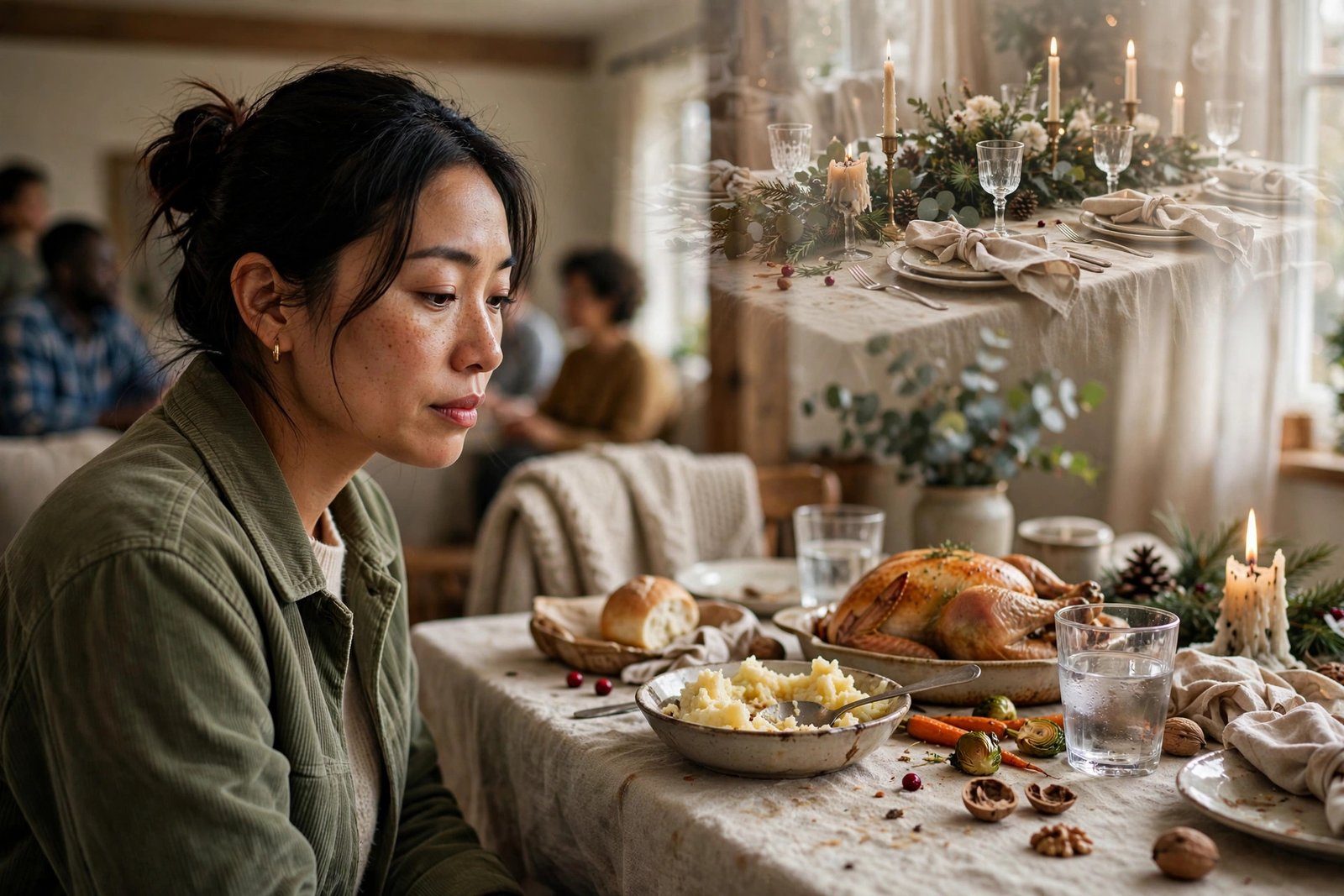
Another major reason why do holidays make us emotional is the gap between the holiday in your head and the holiday in your calendar. The imagined version is edited like a film. The real version includes traffic, budgets, and people being people.
Images of the season are everywhere for weeks: perfect tables, matching smiles, gifts that land exactly right. Even when you know those images are staged or filtered, they set a quiet standard in the background of your mind.
Self discrepancy research, a well known idea in psychology, describes how distress grows when there is a gap between who we are, who we think we should be, and who we hoped to become. Holidays widen all three gaps at once, in public, on a deadline.
You might feel you should be more joyful, more generous, more patient, more successful by now, or more at peace with your family than you actually are. Each should adds pressure, and pressure is emotional fuel.
This is also why do holidays make us emotional even in good years. A happy season can still fall short of an impossible one. The problem is often not the holiday itself. The problem is the comparison running silently underneath it.
Social media sharpens that comparison. You see other families at their best moment, cropped and lit, while you live your own season unedited, including the burnt side dish and the awkward silence at the table.
Naming the gap helps. When you can say, out loud, this year is smaller, quieter, or different, and that is the actual plan, the season stops being a test you are failing and becomes a set of choices you are making.
Anticipation makes the gap wider. The season starts weeks before it arrives, in shop windows, inboxes, and group chats. By the time the actual day comes, many people have already lived an imaginary version of it several times, in detail, and reality has to compete with every draft.
That rehearsal effect explains a familiar pattern: the days before a celebration often feel more emotional than the celebration itself. The mind is running previews, remembering previous years, and bracing for specific moments. When the day finally happens, it is almost a relief to discover it is just a day, with ordinary weather, ordinary people, and a few genuinely good hours inside it.
It also helps to notice who wrote your imaginary version. Sometimes the standard in your head is not really yours. It may belong to a parent, to advertising, to a childhood memory polished by time, or to a feed of strangers. You are allowed to edit a standard you never chose. Lowering it is not giving up. It is taking authorship of your own season back.
Family roles, old patterns, and the inner child at the table

Ask a room of adults why do holidays make us emotional, and sooner or later someone will mention going home. Returning to a family home can feel like time travel. Within hours, grown adults slide back into roles they left years ago.
The responsible one starts organising everyone. The peacemaker smooths over comments. The youngest gets teased as if she were still twelve. These roles were learned early, and family settings reactivate them with very little effort.
Attachment theory offers a useful lens here. Early experiences with caregivers shape what we expect from closeness: whether love feels steady, whether needs get met, whether conflict feels dangerous or repairable. Holiday gatherings press directly on those old expectations.
That is why a small comment can produce a big reaction. A remark about your job, your weight, your partner, or your life choices may land on a much older wound. You are not only hearing this year version. You are hearing every earlier version too.
Consider a simple scene. A mother says, you look tired, in front of everyone. Her adult daughter hears criticism, control, and a childhood of never quite being enough, all inside four words. The tears that follow look out of proportion only if you ignore the history.
The reverse is also true. For people whose families felt unsafe or cold, the season cultural script of warm togetherness can feel like a reminder of what they never had. For them, the emotion is not about missing a perfect past. It is about grieving one that never existed.
If family dynamics cross into patterns that consistently leave you diminished, controlled, or afraid to speak, that deserves honest attention beyond the season. Our guide on how to know if you are in a toxic relationship can help you name those patterns clearly.
Not every difficult family moment is toxic, of course. Some tension is just difference: generations with different politics, habits, and ideas of a good life, sharing one roof for three days. Difference can be managed. Contempt is harder, and it is reasonable to protect yourself from it.
Grief, absence, and the empty chair

Grief may be the most honest answer to why do holidays make us emotional. Celebrations are built around presence, so absence becomes impossible to ignore. The empty chair, the recipe nobody makes the same way, the phone call that will not come.
Grief researchers often note that anniversaries and rituals act as reminders, and reminders are not setbacks. Feeling a loss again at a meaningful date does not mean you have failed to heal. It means the bond still matters to you.
Grief at the holidays is also rarely only about death. People grieve divorces, estranged siblings, friendships that faded, fertility struggles, lost homes, lost health, and lost versions of the future they had planned in detail.
There is a particular loneliness in grieving something other people cannot see. A person who lost a parent gets sympathy. A person quietly grieving the family they hoped to build, or the marriage that ended in spring, often gets asked why they are not more cheerful.
This is one reason why do holidays make us emotional in ways that surprise even the person feeling it. The grief may be real but unnamed, and unnamed grief tends to come out sideways: irritability, exhaustion, tears at small things, or a strong wish to skip the season entirely.
Many people find that a small, deliberate ritual helps more than forced cheer. Lighting a candle, visiting a place, cooking one dish, or saying a name out loud gives the feeling a shape and a time. Ritual does not remove grief. It gives grief somewhere to sit, instead of everywhere at once.
If waves of sadness arrive, try not to argue with them. Feelings at the holidays often move like weather. A hard hour at the table does not have to decide the whole season, and a good hour does not betray the person you miss.
The first holiday after a major change deserves special mention. The first season after a death, a divorce, a move, or a child leaving home is rarely the hardest in every moment. It is the most disorienting. Every routine has to be done for the first time in a new way, and each small first carries its own sting: the first card signed with one name, the first table set for fewer people.
People who have lived through those firsts often give the same advice. Expect it to feel strange rather than expecting yourself to feel fine. Tell one trusted person in advance that this year is a first, so you do not have to explain in the middle of it. And give yourself permission to leave early, cry in the car, or skip one event entirely. A first season is something to get through gently, not something to perform well.
What research says about holiday stress and mixed emotions

Research gives a clear, unsurprising answer to why do holidays make us emotional: the season combines high value with high demand. People care deeply about it, and it costs time, money, and energy, all at once.
Surveys by psychological associations have repeatedly found a pattern of ambivalence. Many adults describe the holidays with positive words like fun and joyful, and in the same breath use words like stressful and exhausting. Both sets of words can be true of the same week.
That ambivalence is worth underlining, because it corrects two myths. The first myth is that everyone else is simply happy and you are the exception. The second is that feeling stressed means you are doing the holidays wrong.
Common stressors identified in that research are familiar: spending and gifts, too much to do, missing loved ones, family conflict, travel, and pressure to make the season special. Read more in this overview from Psychology Today on the hidden emotional burden of the holidays.
Stress science adds a mechanical layer. When demands rise and sleep, daylight, movement, and routine fall, emotional regulation gets harder for everyone. You are not weaker in December. Your resources are thinner, and the load is heavier.
Research on nostalgia adds balance to the picture. Nostalgic reflection, in many studies, is linked with feeling more socially connected and more aware of meaning in life. In other words, the same memories that make the season tender can also make it sustaining. Emotion is not the enemy of a good holiday. Often it is the substance of one.
The honest conclusion from the research is modest: holidays concentrate meaning, memory, and demand, so they concentrate feeling too. Why do holidays make us emotional is not a riddle with one cause. It is a pile up of ordinary causes, arriving together, wearing lights.
Money, time, and the mental load behind the magic

No account of why do holidays make us emotional is complete without the unglamorous part: someone has to produce the magic. Planning, shopping, cooking, wrapping, hosting, travelling, and remembering every preference and allergy is real work, and it is unevenly shared.
Mental load is the invisible part of that work. It is not only doing the task. It is remembering the task exists, anticipating it, and feeling responsible for whether everyone else has a good time. When one person carries most of that load, resentment can build quietly under the tinsel.
Money presses on the same bruise. Gift expectations, travel costs, festive food, and end of year bills compete for the same income. For many people, December spending is not really about generosity. It is about not wanting anyone, especially children, to feel left out.
That mix of love and financial strain explains a lot about why do holidays make us emotional at the checkout, in the car, or late at night over a banking app. The feeling is not shallowness. It is care, colliding with limits.
Time is the third pressure. The season adds tasks but not hours. Work rarely slows down at the same pace the social calendar speeds up, and routines that normally keep people steady, like sleep, exercise, and quiet evenings, are usually the first things traded away.
There is a useful honesty available here. A smaller holiday, planned on purpose, is not a failed holiday. Fewer events, simpler food, a gift limit agreed in advance, and one protected evening of doing nothing can change the emotional weather of the whole month.
Travel can cut both ways in this story. A trip can be the season brightest chapter, full of new streets and shared discovery, the way a winter visit described in our guide to what to do in Montreal can reset a whole month. It can also mean airports, weather delays, and sleeping in a childhood bedroom. Both versions are normal.
Signs your emotions are trying to tell you something

Because the causes are so layered, it helps to read your own reactions as information rather than as a verdict on your character. Strong feelings usually point at a need, a memory, or a limit.
Tears at a song or an old photograph often point at love and loss. The feeling is grief doing its ordinary work, and it usually softens when it is allowed rather than suppressed.
Irritability that flares at small things often points at overload. When everything feels annoying, the problem is frequently not the people around you. It is the total load you are carrying, and the lack of sleep underneath it.
Dread before a gathering often points at a specific dynamic, not the whole family. Ask yourself which moment you are actually dreading. A particular comment, a particular pairing at the table, or the length of the visit. Specific dread can often be planned around.
Numbness is a sign too. Some people do not feel more at the holidays. They feel less, as if watching the season through glass. That can be a protective response to overload or grief, and it deserves the same kindness you would offer tears.
Jealousy or comparison pain often points at an unmet wish of your own. Seeing a sibling announced engagement or a friend big family table hurts most when it touches something you want and do not yet have. Naming the wish takes away some of its sting.
None of these readings are rules, and none of them replace professional support when feelings become persistent, frightening, or hard to function through. They are simply a starting point for the question underneath why do holidays make us emotional: what, exactly, is this feeling about for me, this year?
What to do next: a calmer, more honest season

You cannot remove emotion from the holidays, and trying to usually backfires. The goal is different: fewer ambushes, lower pressure, and more room for the parts of the season you actually value.
Start by choosing your real priorities. Pick two or three things that make the season feel like itself to you: one gathering, one ritual, one quiet pleasure. Protect those. Let the rest be optional, and notice how much calmer the month becomes.
Lower the standard on purpose. Store bought dessert, a shorter visit, a simpler table, gifts chosen early within a set budget. Perfection is the most expensive tradition of all, and nobody remembers it as fondly as they remember an unhurried, kind afternoon.
Plan for grief instead of being ambushed by it. If someone is missing, decide in advance how you want to honour that: a toast, a candle, a story told on purpose. Chosen remembrance is gentler than a surprise wave in the middle of dinner.
Build exits and pauses into gatherings. A walk after the meal, a drive to see lights, an earlier departure time agreed in advance. Knowing you can step out lowers the emotional temperature of staying.
Talk about money early and plainly. Gift limits, shared costs, and honest budgets are not unromantic. They are how families protect both the season and each other from January resentment.
Protect the basics that keep you steady: sleep, daylight, movement, food at normal times, and at least a little solitude if you are someone who recharges alone. These are not luxuries in December. They are the floor everything else stands on.
Learn a few short sentences for hard moments, because in the moment itself most people cannot improvise calmly. Simple lines work: we are keeping gifts simple this year, and we would love you to do the same. We can come for dinner, and we will need to leave by nine. I miss her too, can we talk about her for a minute? Each sentence is small. Each one prevents a much larger emotional cost later.
It also helps to divide the invisible work out loud. Instead of one person silently holding the whole plan, put the list where everyone can see it and let people claim pieces of it. Many holiday resentments are not really about the task. They are about the feeling of being the only one who noticed the task existed at all.
If you are supporting someone else through a hard season, skip the repair attempts. You do not need to fix their grief with perspective or cheer. Presence is the actual gift: sit with them, name the missing person, bring food, and do not require them to be festive in exchange for your company.
Finally, let the season be mixed. Joy and sadness at the same table is not a contradiction. It is the most accurate description of an adult holiday, and accepting it is often the moment the pressure lifts.
FAQ

Is it normal to cry during the holidays even when nothing is wrong?
Yes. Nothing being wrong today does not cancel memory, fatigue, or longing. Many people asking why do holidays make us emotional discover that the tears are about accumulation, not about one single event.
Why do I feel sad at the holidays when I have a good life?
Because the season measures time. It shows you change, distance, and absence alongside gratitude. A good life can still contain losses, and the holidays are skilled at placing them side by side.
Why do family visits make me feel like a child again?
Family settings reactivate old roles and old expectations, often within hours. The reaction is usually about history, not weakness. Noticing the slide back into an old role is the first step to responding as the adult you are now.
Can holidays be emotional even if I do not celebrate much?
Yes. The season is cultural as much as personal. Music, images, closures, and other people plans can still stir memory and comparison, and feeling left out of a collective ritual is its own understandable emotion.
When should I get support for holiday sadness?
If low mood, anxiety, or grief persists beyond the season, interferes with work, sleep, or relationships, or ever feels unsafe, speak with a doctor or mental health professional. Support is not reserved for emergencies. It is for exactly the load you are carrying.
A final word
So, why do holidays make us emotional? Because they gather memory, love, loss, expectation, family history, money, and time into a few bright, demanding weeks, and then ask us to feel it all at once.
Once you see the pile up, the feelings stop looking like a personal flaw. They look like a reasonable response to an unreasonable concentration of meaning. That understanding will not make every moment easy, but it can make the season kinder.
Choose the parts that matter, honour the parts that hurt, and let the rest be ordinary. A holiday does not have to be perfect to be real, and real, most years, is more than enough.