

There is a particular kind of panic that arrives when someone important is coming to dinner. The boss. The in laws. The new partner’s parents, or the friend who cooks beautifully and never seems to try. Suddenly your ordinary food feels too ordinary, and you catch yourself searching for what to cook when you want to impress without trying too hard, as if impressing were a recipe you had simply never been given.
The real question behind what to cook when you want to impress without trying too hard is not only what to serve. It is how you want the evening to feel, for your guests and for you.
It is not a recipe problem. Impressive food is rarely the most complicated food on the table. It is food that tastes confident: well seasoned, served hot and on time, presented with a little care, and cooked by someone who is not visibly exhausted by making it. Guests remember how a meal felt long after they have forgotten exactly what was in it.
This guide answers what to cook when you want to impress without trying too hard in a practical way: one simple rule, three complete menus that never fail, a timing plan you can count backwards on your fingers, presentation tricks that cost nothing, and honest answers for the moments every host quietly worries about. Nothing here requires new equipment, rare ingredients, or talent you do not already have.
The short answer

The short answer to what to cook when you want to impress without trying too hard is this: cook one dish you already know well, cook it beautifully, and surround it with very simple things of excellent quality. One hero, no heroics.
A chicken roasted until the skin is crisp, served with a sharp green salad and warm bread with good butter, will impress more people than an ambitious recipe you are attempting for the first time while apologizing through the kitchen door. A pan of golden salmon with scented rice and garlicky greens does the same work with even less effort.
Notice what every reliable answer to what to cook when you want to impress without trying too hard has in common. The effort is concentrated in one place instead of spread thin across six dishes. Everything else on the table is quiet support. And the cook arrives at the table like a guest at her own dinner, not like staff who has escaped from the kitchen.
Keep that picture in mind every time you catch yourself asking what to cook when you want to impress without trying too hard in a shop doorway or a search bar.
That is the standard for everything in this article. If a dish creates drama in the kitchen, it creates the wrong kind of drama in the dining room. Choose food that lets you sit down, eat, and enjoy the people you invited. A host who is present is the most impressive thing a dinner can offer, and no sauce has ever replaced her.
The secret: impressive is a feeling, not a difficulty level

Complicated food impresses other cooks. Simple food, done properly, impresses everyone else. The difference matters, because most home cooks aim at the wrong audience: they cook to prove skill when their guests came to receive pleasure.
Think about the meals you still remember from other people’s homes. They were probably not technical. They were generous, hot, well seasoned, and served by someone who sat down and ate with you. Memory keeps the feeling of a meal. It is remarkably careless about the recipe, the garnish, and whether the sauce was made from a stock that took two days.
Food psychology backs this up. Research on taste shows that presentation, expectation and context shape how delicious a dish seems. The same food, plated with care and introduced with a few appetizing words, is rated more enjoyable than the identical food served carelessly. Studies of shared meals point the same way: eating together is linked with stronger bonds and greater wellbeing, and the effect comes from the sharing itself, not from technical fireworks on the plate.
This is quietly excellent news for anyone deciding what to cook when you want to impress without trying too hard. It means small signals carry real weight: food served properly hot, a sauce spooned neatly instead of flooded, fresh herbs scattered at the last second, and a cook who describes the dish in one confident sentence and then stops selling it.
Perfectionism pushes in the opposite direction. It whispers that respect must be earned with difficulty, that an easy dish is a lesser offering, that love is measured in hours spent standing up. That belief has deep roots for many women, who were handed the message early that feeding people well is proof of their worth. It is worth saying plainly: your worth is not on the plate.
Comparison makes it worse. Restaurant plates are built by professionals with teams, equipment and unlimited retakes. Social media dishes are lit, styled and filtered. Your table has a different job: feed real people, in a real home, while you also live the evening. Judged by that job, a calm and simple menu is not a compromise. It is mastery of the actual assignment.
Season deserves a mention here too, because seasonal food impresses almost by itself. Tomatoes in their season need nearly nothing done to them. Autumn squash, spring greens, winter citrus and summer stone fruit all arrive with their flavor already built in. Cooking with the season is not a restriction. It is the shortcut professionals rely on constantly, and it is free. Season is one of the oldest answers to what to cook when you want to impress without trying too hard, and it asks nothing of your technique at all.
So the secret is not a hidden technique. Impressive is a feeling guests take home with them: they were expected, they were fed generously, nothing felt frantic, and the person who cooked for them seemed genuinely glad they came. Difficulty never enters into it. Once that settles, choosing the menu becomes the easy part.
Three reliable menus that never fail
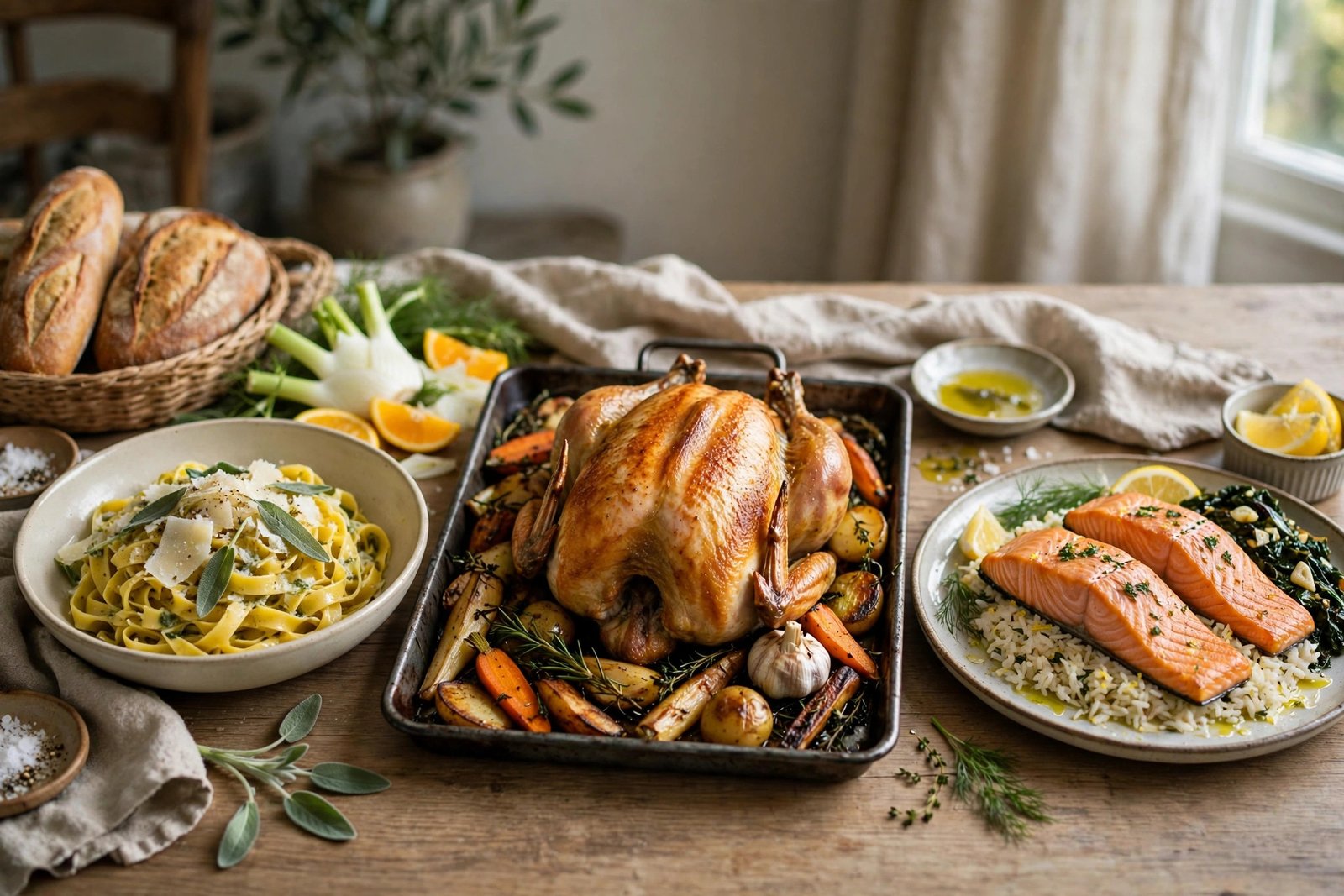
Formulas are useful, but dinner is served in menus, not formulas. Here are three complete menus that answer what to cook when you want to impress without trying too hard in three different moods. Each one has been cooked, in some version, by thousands of home cooks before you, which is exactly the point. Reliability is a feature, not a failure of imagination.
Menu one: fresh pasta and a composed salad
Cook fresh tagliatelle or pappardelle, bought from a good shop if you do not make pasta yourself, and dress it simply: browned butter with sage and parmesan, a slow tomato sauce with a knob of butter stirred in at the end, or lemon, cream and peas in spring. Fresh pasta cooks in two or three minutes, which means the hero of the evening is also the fastest thing you make all day.
Beside it, serve a composed salad, meaning a salad arranged on a platter rather than tossed in a bowl: shaved fennel and orange, pear with walnuts, or tomatoes and mozzarella in their season. Arrange it neatly, dress it lightly at the table, and let its tidiness do a surprising share of the impressing. Add good bread for the sauce, because there is always sauce worth chasing.
Why it works: fresh pasta tastes luxurious because it is luxurious, the platter looks like a restaurant’s, and the whole menu can be assembled in the time it takes water to boil. It is also the kindest menu for mixed tables, since the pasta can be dressed two ways at the last moment if someone avoids cheese or spice. For a first attempt at what to cook when you want to impress without trying too hard, this is the menu to start with.
Menu two: roast chicken and vegetables
Roast a whole chicken the way you already trust, with lemon and herbs if you like them, over a bed of chopped root vegetables that roast in the juices: potatoes, carrots, onions, parsnips. Those vegetables are your side dish, your sauce catcher and your second impressing act, all from a single tray that asks almost nothing of you.
Serve a crisp green salad with a sharp dressing to cut the richness, and warm bread. Carve the chicken at the table if you feel brave, or in the kitchen if you do not. No evening in history was ruined by chicken that arrived already portioned on a warm platter.
Why it works: the smell alone does half your hosting before you say a word, the bird tolerates late guests with grace, and resting time is built into the plan rather than stolen from it. Follow the poultry guidance you trust, rest the bird properly, and let the tray of vegetables be the centerpiece it deserves to be. It is the classic answer generations of hosts have given to what to cook when you want to impress without trying too hard, and it has never stopped working.
Menu three: salmon, scented rice and greens
Roast or pan cook salmon fillets with crisp skin, or a whole side of salmon if your table is large. Serve it with rice that is scented while it cooks: jasmine rice as it is, basmati with a few cardamom pods and a strip of lemon peel, or rice finished with herbs and toasted almonds. Add greens with garlic and lemon: spinach wilted in a hot pan, green beans, or broccolini with a little chili for those who want it.
Why it works: salmon looks elegant because it is uncluttered, scented rice makes the meal feel considered, and the greens bring the color that makes a plate stay in memory. The real technique is restraint. Season clearly, cook the fish until just done, and dress everything at the end with lemon and your best olive oil.
Three menus, three moods, one shared skeleton: a hero, something fresh, something comforting, bread. Once you can see the skeleton, you will start building your own versions without ever opening a cookbook in a panic again. That is the moment what to cook when you want to impress without trying too hard stops being a search and becomes a habit.
What to cook when you want to impress without trying too hard: the one hero dish rule

If this entire article had to shrink to one rule, it would be this one. Choose a single hero dish, the one plate your guests will describe tomorrow, and let it be the only ambitious thing on the table. Everything else is support, and support is not allowed to demand rehearsals.
A hero dish has to pass three tests. You have made it before, at least once, on an ordinary day. It tolerates waiting, so a guest stuck in traffic does not ruin it. And it looks generous when it arrives, because generosity is what guests actually read as impressive. Roast chicken passes. A slow braise passes beautifully. Baked pasta passes. A soufflé, however lovely, fails the second test and should be saved for people who love you already. Choosing by these three tests is how you decide what to cook when you want to impress without trying too hard without gambling on the evening.
The rule exists because attention is the scarcest ingredient in any kitchen. Two ambitious dishes do not double the impressing; they halve the cook. Every additional performance steals calm from the main one, and guests can taste the difference between a cook who was performing and a cook who was hosting.
This is also why experienced hosts repeat themselves without shame. When you picture what to cook when you want to impress without trying too hard, picture a short personal repertoire instead of a new production every time. The friend whose dinners everyone loves is almost never cooking something new. She is cooking her dish, the one her hands know, and spending the saved attention on the people in the room.
So write your hero at the top of the page and let every other decision serve it. The salad exists to refresh the plate. The bread exists to carry the sauce. The dessert exists to end the evening gently. One hero, chosen honestly, is the whole strategy.
Timing: working backwards from the moment guests sit down

Most kitchen stress is not cooking stress. It is timing stress, and it disappears when you plan backwards instead of forwards. Pick the moment everyone sits down, call it T, and hang every task on the clock from there. Once the clock is set, what to cook when you want to impress without trying too hard becomes a question of sequence rather than talent.
Work it through once with a seven thirty arrival and an eight o’clock table. Dessert is made or bought by the morning, because dessert never belongs to the evening itself. Salad components are washed and stored by the afternoon, dressing made and waiting in a jar. The chicken, if chicken is your hero, goes into the oven around six forty, rests from about seven forty under foil, and is carved while guests are finishing their first drink. Pasta water, if pasta is your hero, goes on to boil when guests arrive, not before. Bread warms for the last ten minutes. At five minutes to T, the salad is dressed, plates are warming, and you are pouring water, not chopping anything.
Notice what this backwards plan protects. The final half hour, when most hosts unravel, contains no cooking decisions at all, only assembly. Anything that can be done earlier has been, which is the entire secret of restaurants that look calm at eight o’clock on a Saturday.
Build in one more protection: a holding strategy. Braises hold for an hour on the lowest heat. Roast chicken holds under foil. Greens hold raw and cook in three minutes. Fresh pasta holds for nobody, which is why it goes last and fast. Knowing exactly what your menu can wait for is what lets you greet people at the door like a person instead of a countdown.
The same calm approach applies to the whole evening around the meal, and our guide to how to host a dinner party without stress walks through it step by step. Timing is simply its kitchen chapter. Plan backwards, protect the last half hour, and the dinner will feel easy even when it is not your first time cooking it. It will just be your first time cooking it calmly.
Presentation tricks that cost nothing
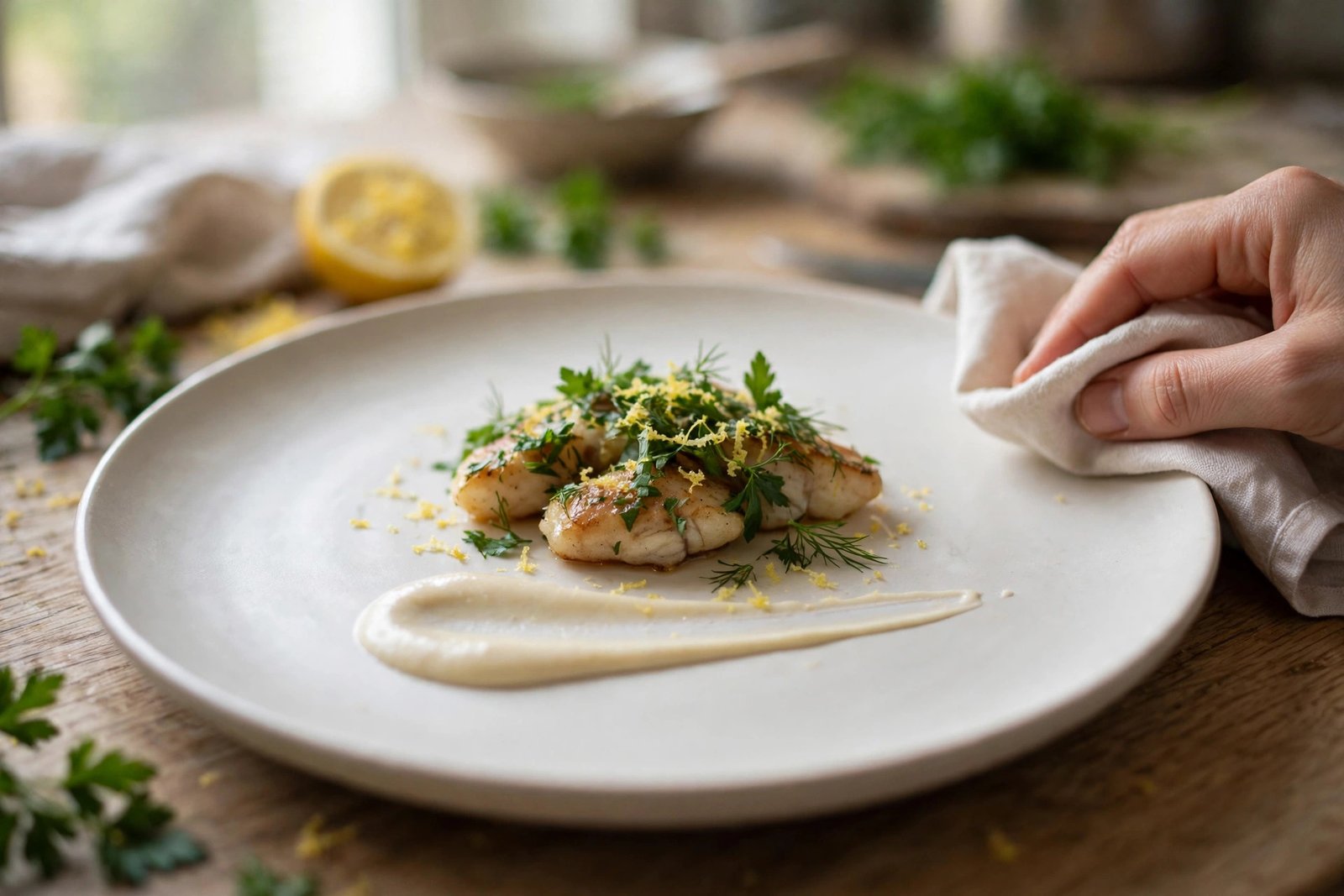
Presentation is the cheapest upgrade in cooking, and the one home cooks skip because it sounds like decoration. It is not decoration. It is framing, and a simple frame makes simple food look intentional. None of the following tricks costs money. All of them change what guests think they are eating. Plating is where what to cook when you want to impress without trying too hard quietly becomes how to serve it, and the second half matters as much as the first.
Serve food hot, on warmed plates. Run plates under hot water or keep them in a low oven while you finish. Warm china keeps food at its best for the length of a conversation, and the small warmth in a guest’s hands registers as care before the first bite.
Use bigger plates than the portion needs. A modest serving centered on a large plate reads as deliberate; the same serving crowded on a small plate reads as shortage. Put the sauce under the hero or spooned over it in one confident line, never flooded across everything. Wipe the rim of the plate with a clean cloth. That three second gesture is the entire difference between canteen and restaurant in most photographs.
Finish with something fresh and green, always at the last moment: herbs, lemon zest, a spoon of yogurt or crème fraîche, a drizzle of your best olive oil, toasted nuts or seeds. Add height where you can, a small mound rather than a flat spread, and serve family style from one handsome platter when the dish allows it. A platter in the middle of the table looks abundant in a way individual plates never do.
Then look at the table itself, because guests eat the room before they eat the food. Clear everything that is not dinner, lower the light if you can, and put one candle where faces can borrow its glow. A table that looks ready tells guests the evening was thought about, which is why simple ideas like those in how to set a beautiful table on a small budget punch so far above their cost. Impressive presentation is ninety percent removal: of clutter, of rush, of anything on the plate that does not belong there.
Dessert without baking talent
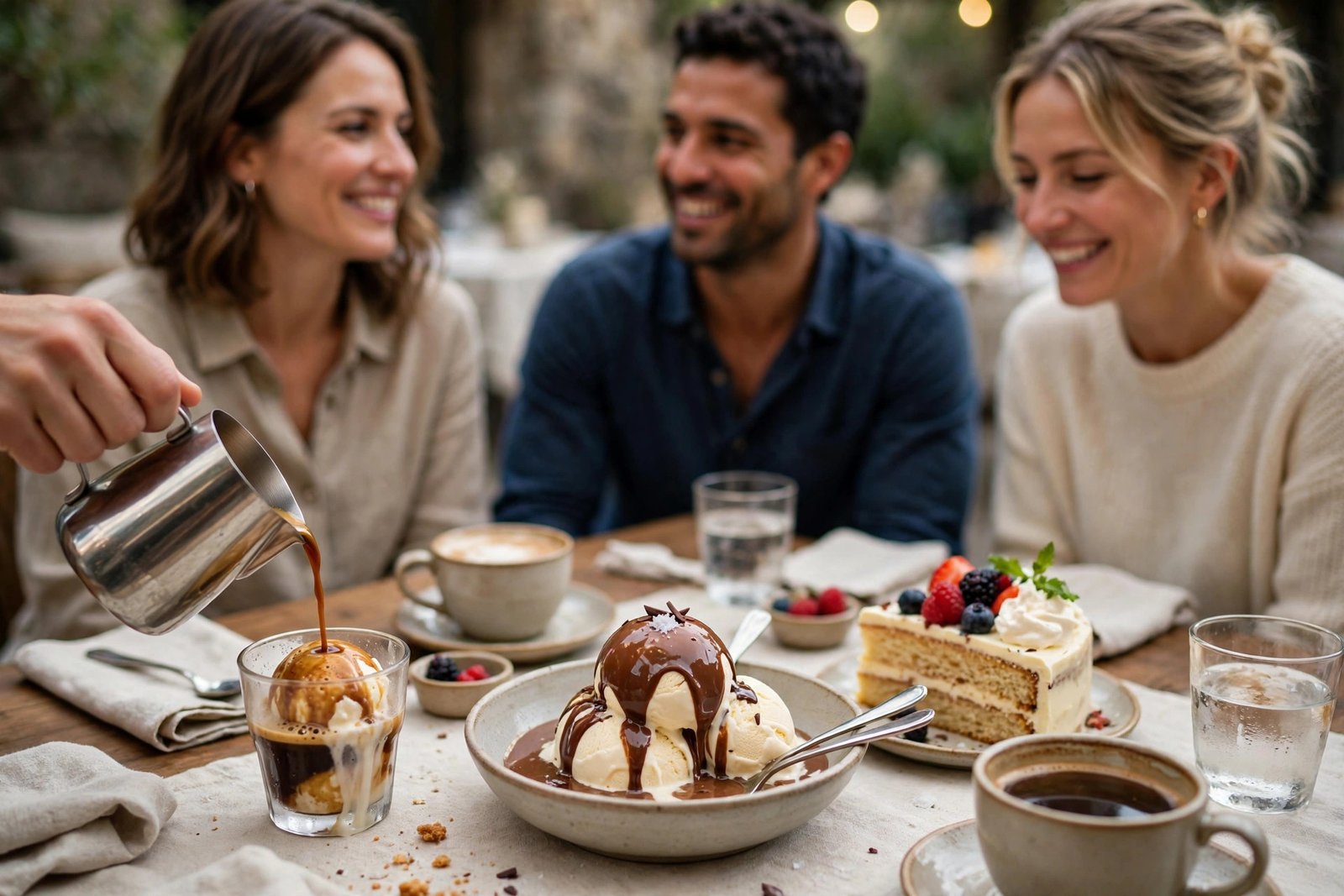
Dessert is where many hosts overspend the energy the evening needs from them, because dessert feels like the verdict on the meal. It is not. By dessert, your guests are fed, relaxed and fond of you. They need something sweet, something warm to drink, and a reason to stay at the table a little longer.
So choose desserts that are assembled, bought, or made ahead, and serve them without a single apology. Excellent ice cream with warm salted caramel or chocolate sauce. Espresso poured over vanilla ice cream, the affogato that takes forty seconds and tastes like a decision. A bakery cake or pastry, served with berries and lightly whipped cream, presented as the treat it is rather than a confession.
Fruit does quiet wonders at the end of a rich meal: roasted or poached pears and plums, a bowl of perfect seasonal fruit with good chocolate, or citrus with a little honey and mint. A cheese course works the same way, one or two cheeses at room temperature with bread, nuts and something sweet, and it has the extra virtue of asking nothing of the oven.
The rule underneath all of these is the hero rule applied backwards. You already spent your ambition on the main dish. Dessert is a full stop, not a second performance, and guests honestly prefer a calm host with bought cake to a heroic host who disappears for twenty minutes to fight a meringue. Dessert handled this way belongs to the same philosophy as the main course: in deciding what to cook when you want to impress without trying too hard, you are always choosing calm over performance. Coffee, something sweet, a table that is in no hurry to end: that is what a good dessert is for.
Cooking for people whose tastes you do not know

The boss, the new in laws, the colleague plus partner: the dinners that feel highest stakes are usually the ones where you know least about how people eat. The answer is not a safer, duller menu. It is a flexible one, built so that nobody at the table has to make a speech about their plate. Flexibility, not caution, is the skill hidden inside what to cook when you want to impress without trying too hard when the table is new to you.
Start before the invitation settles. One short message does the whole job: is there anything you cannot eat, or anything you truly dislike? Asking early is not fussiness. It is competence, and it gives you the two facts that actually matter, allergies and hard limits, while there is still time to plan around them quietly.
Then design for choice without announcing it. Choose a hero most people can share: roast chicken, a baked pasta, a salmon table. Keep the polarizing elements on the side, where guests can take or leave them without ceremony: chili oil, strong cheese, fresh coriander, hot sauce, olives. Always include one substantial vegetable dish that is a real dish and not a garnish, so a guest who eats lightly or avoids meat still gets a plate that looks like dinner.
Avoid making a gamble the centerpiece. Offal, very spicy dishes, powerful blue cheese and unfamiliar seafood are wonderful for people who love them and a long evening for people who do not. Save them for tables whose tastes you know. And when the evening comes, handle every accommodation silently. The guest who finds she can eat everything, without a single announcement, feels more looked after than in any restaurant. That quiet care is a large part of what to cook when you want to impress without trying too hard is really about: people leaving your table feeling considered, not just fed.
What to do next

Turn this article into a small permanent asset. Choose your default menu for each season, three or four complete dinners you can produce calmly, and write them down with their timings while they are fresh. Practice each one once on forgiving guests, the people who love you already, before it ever meets an important table.
Keep a short note after every dinner: what you served, what vanished, what you would change. Within a year that page becomes the most useful cookbook you own, because it is written in your kitchen, for your people, at your pace. It is also the honest cure for the pre dinner panic that sends cooks searching for what to cook when you want to impress without trying too hard at six in the evening with guests at seven thirty.
Stock a tiny finishing kit and you will reach for it automatically: lemons, fresh herbs, good olive oil, a hard cheese, flaky salt, toasted nuts or seeds, and something pickled for brightness. None of it requires cooking. All of it makes cooked food taste considered. For technique you can trust when you want to check a timing or a method, the tested guides at Serious Eats are where careful home cooks verify a classic before adapting it to their own table.
Most of all, sit down when the food does. The dinner where the host eats, laughs and stays is the dinner people describe as impressive on the way home, and they will not be able to tell you why. You will know.
FAQ

What is the easiest impressive dish for a first important dinner?
Roast chicken, with a slow braise a close second. Both are generous, fragrant and forgiving, both feed a table without last minute work, and both smell like care when the door opens. Choose the one you have cooked more often and cook it exactly the way you know.
Should I try a new recipe when the guests matter?
No. An important dinner is a performance night, not a rehearsal. New recipes demand attention, hide surprises and punish small distractions. Test new dishes on an ordinary day, promote them after they have succeeded twice, and let important evenings run on recipes your hands already know.
How can I make plain food taste special without new skills?
Season in layers and taste as you go. Brown food properly instead of crowding the pan. Serve everything at the right temperature, on warm plates, and finish with acid and something fresh: lemon, herbs, good oil. Those five habits, none of them difficult, are responsible for most of the gap between plain and special.
What should I do if the main dish goes wrong?
First, decide whether it is actually wrong or merely not the version in your head; most disasters are seasoning problems, and seasoning can be fixed at the table with salt, lemon and herbs. If a dish is truly lost, serve everything else generously, lean on bread, salad and dessert, and tell one light joke at your own expense. Guests take their emotional cue from you, and a laughing host has never ruined a dinner.
How far ahead can I prepare an impressive dinner?
Further than most people think. Braises and sauces are better made a day ahead, desserts keep for one or two days, dressings and chopped sturdy vegetables wait happily overnight, and even a roast chicken menu needs only the final hour on the day itself. When people ask what to cook when you want to impress without trying too hard, the honest answer is often a dish that lets yesterday do the work.