

It happens before you’ve even decided anything. You’re in the elevator at work, a woman steps in with glossy hair and perfect skin, and your eyes do a quick, quiet scan: her face, then yours in the metal door. Or you open a group photo and check, face by face, who looks best. Or a stranger walks past in a cafe and your brain whispers a ranking you never asked for. You didn’t choose the thought. It just arrived, like a sneeze.
If this is you, please hear this first: there’s nothing shallow or broken about you. Comparing your looks with other women’s looks is a reflex your eyes were trained into, by years of feeds, ads, mirrors, and photos. A reflex isn’t a character flaw. It’s a habit of attention. And habits of attention can be retrained, gently, the same way they were built: one small moment at a time. Learning to stop comparing my appearance to other women isn’t about forcing yourself to feel beautiful. It’s about giving your eyes a fairer job.
This article stays close to daily life. The mirror in the morning. The group photo at lunch. The colleague whose skin always seems lit from within. The influencer whose face is partly a filter. We will look at why each of these moments hooks you, and what to do in the exact second it happens. No lectures. No pretending the reflex will vanish in a week. Just honest tools that make it quieter, rarer, and much less in charge of your day.
By the end, you’ll have a small set of habits you can actually use: how to look in a mirror without starting a trial, how to read photos with kinder eyes, how to survive the front row feeling at work, and how to answer the comparing thought when it shows up. The goal isn’t to stop comparing my appearance to other women by sheer willpower. The goal is a mind where the thought visits, gets a calm answer, and leaves, while you get on with being a person in the world.
The Short Answer

You stop comparing my appearance to other women by treating comparison as a trained reflex and retraining it in small daily moments. Look in mirrors from a normal distance and for a reason, then step away. Read photos as one frozen second with bad light, not as evidence. Curate your feed so real faces outnumber filtered ones. When the thought arrives, name it, answer it with one true sentence, and move your attention to something your body can do or enjoy. Progress is quiet: the reflex still visits, but it stops running your day, your photos, and your mood.
One honest note before the tools: this takes practice, and some days will go better than others. A tired, stressed, or hormonal day can turn the volume up on every reflex you own, including this one. That doesn’t erase your progress. It just means the day is loud. Be patient with the loud days, use the tools anyway, and trust the quieter trend over weeks. Nobody learns to stop comparing my appearance to other women in a straight line, and you don’t have to either.
Comparison Is a Reflex, Not a Verdict

Your eyes compare the way your ears hear a noise: automatically, before you can vote on it. Spotting differences is old wiring. It helped humans read a room fast. The problem isn’t that your eyes notice another woman’s skin, hair, or figure. The problem is the second step, where noticing turns into ranking, and ranking turns into a sentence about your worth. That second step is the trained part, and trained parts can be retrained.
Think about how much training your eyes have had. Hundreds of faces a day on your phone, most of them lit, angled, smoothed, and selected. Ads that place one ideal face next to a product, over and over. Years of comments, rankings, and beauty talk since you were a teenager. If your reflex is strong, it’s because your practice was long. That’s actually hopeful news. Anything practiced can be practiced differently, and women do learn to stop comparing my appearance to other women by practicing a different response, a few seconds at a time.
It also helps to know the ranking is rigged. Your brain compares your full, unedited, 7 am reality with the single best frame of someone else. It compares your inside view, where you know every flaw by name, with an outside view of her, where you see only the surface. No honest judge would accept that evidence. When you remember the contest is rigged, the verdict loses some of its power, and the thought becomes what it really is: a reflex firing, not a truth landing.
If the wider comparing habit, beyond looks, feels familiar too, our piece on how to stop comparing yourself to other women covers the general pattern, while this article stays with appearance specifically: mirrors, photos, work, and your feed. Start here, with the face and body moments, because those are the ones that ambush you daily. Small wins in daily moments are how you stop comparing my appearance to other women in a way that actually lasts.
The Mirror Is Not a Neutral Judge
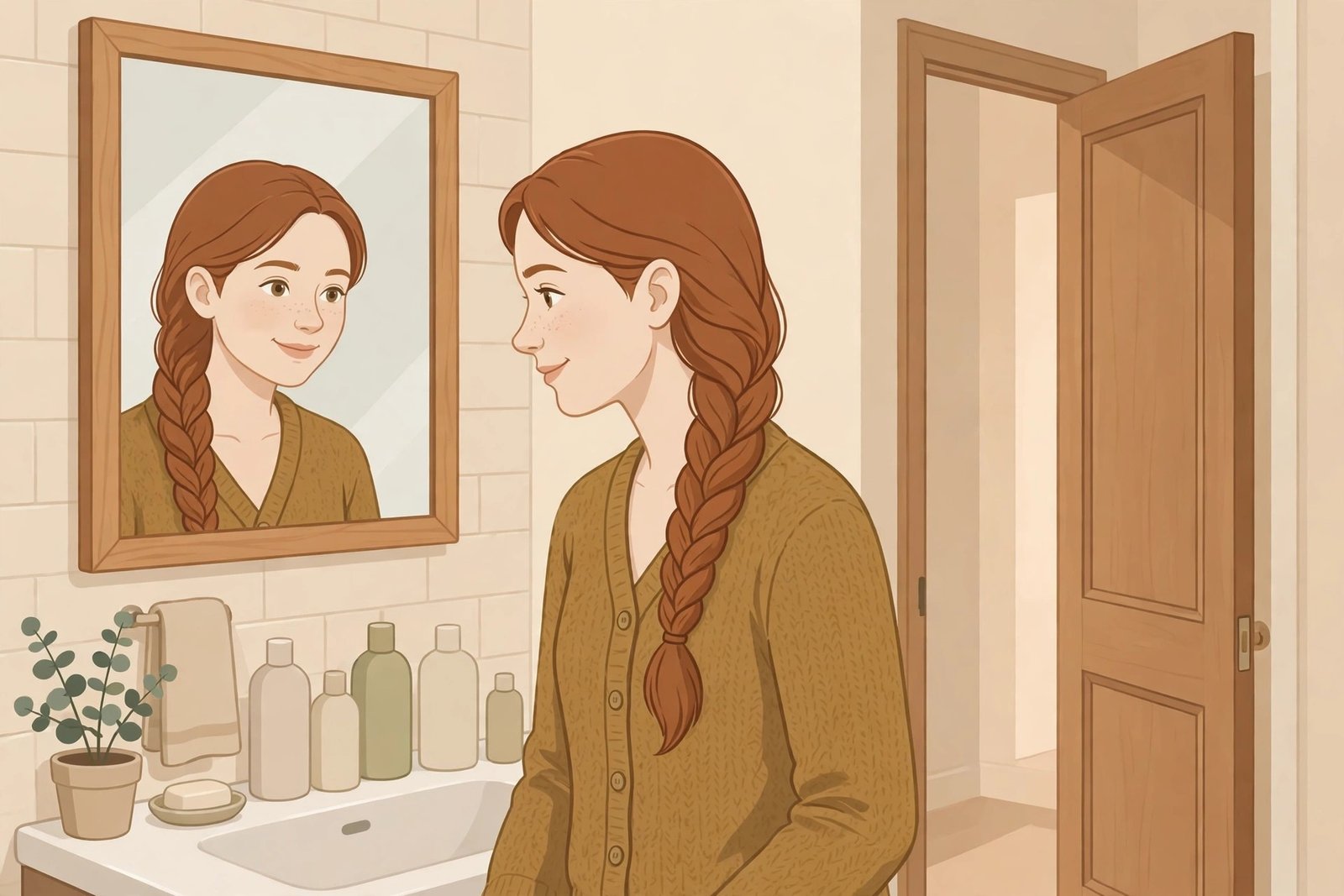
The morning mirror is where the reflex does its deepest work, because you meet it tired, close up, and alone. You lean in. You inspect. Within a minute, a normal getting ready moment has turned into a quiet trial, and the woman in the glass is losing. But that mirror isn’t reporting neutral facts. It’s showing you a face at six inches, in bathroom light, mid yawn, before coffee. That isn’t the face the world sees. That’s a face under interrogation.
Try changing the terms of the meeting. Give the mirror a job and an exit: teeth, hair, outfit check, done. Stand at the distance people actually talk to you from, about an arm’s length or more, and see your whole self instead of a zoomed patch of skin. Real people never see your pores. They see a moving, talking, laughing person. Looking from their distance isn’t denial. It’s accuracy, and it’s one of the simplest ways to stop comparing my appearance to other women, because your reference face, your own, finally gets fair lighting.
What you say during those minutes matters as well. Most women talk to their reflection like a strict critic: the skin, the hair, the stomach, the list. Try neutral words instead, the way you would describe a friend: face washed, hair up, cardigan on, ready. Neutral is a huge step up from cruel, and it’s far more believable than forced compliments. You don’t have to adore the mirror. You just have to stop letting it open a court case before breakfast.
One more gentle trick: finish getting ready, then actually leave the mirror’s neighborhood. No return trips to recheck a cheek from a new angle. No second mirror in the hallway for a fresh verdict. Each recheck feeds the reflex and teaches it that your face needs constant monitoring. It does not. It needs to be lived in. The women you compare yourself with aren’t monitoring their faces all day. They are busy being in them, and that ease is available to you too.
Lighting deserves its own small paragraph, because it rigs so many mornings. Bathroom light usually comes from above or from one side, which carves shadows under eyes and cheeks that simply aren’t there at noon. If your mirror moments keep upsetting you, change the light before you change your opinion of your face. Get ready facing a window when you can. Daylight is the light your face was made for, and it’s the light everyone else sees you in. Judging yourself under interrogation lighting is a rigged start to any day, and kind light is a small daily ally when you’re learning to stop comparing my appearance to other women.
Photos Lie in Very Specific Ways

If mirrors start the trial, photos deliver the sentence. A photo feels like proof, and that’s exactly why it hooks so hard. But a photo isn’t proof of how you look. It’s proof of how one camera, in one light, at one angle, in one frozen second, rendered you. Change any of those and the same face tells a different story, which is why you can feel pretty in the mirror at 8 am and doubt everything by the group photo at noon. We explored that gap in our piece on why do I look pretty in the mirror but not in photos, and it comforts a lot of readers.
Learn the specific lies, because naming them disarms them. Front cameras stretch the center of the face. Overhead office light carves shadows that read as tiredness. A photo taken from below adds a chin nobody has in life. A frozen mid laugh frame catches muscles in positions your living face never holds. And the women you compare yourself with in photos have usually chosen their frame from twenty tries, while you’re judging your one unchosen second. That isn’t a fair contest either.
Here is a kinder way to look at a group photo. Look at it the way you’ll look at it in ten years: for the people, the day, the story. Nobody in your future will zoom into your skin. They will say, that was a good lunch, look how young we all were. Try borrowing those future eyes now. And notice that every woman in the photo is doing the same quiet zoom on herself, certain she is the one who looks worst. The photo isn’t ranking anyone. Everyone just fears it is.
You are also allowed practical mercies. Stand where the light is kind when you can. Ask for one more shot if the first was mid blink. Keep the photos where you look happy, even if they aren’t the most polished. Happy reads as beautiful in every decade. Each of these small choices is a way to stop comparing my appearance to other women in the moments that used to ambush you, and to keep photos as memories instead of verdicts.
Deleting is also allowed, by the way. A photo where you were mid blink, mid word, in terrible light isn’t a document you must keep and revisit. Your camera roll isn’t an archive of evidence. It’s a shoebox of memories, and you may curate it like one. Keep the pictures where the day feels warm. Let the cruel frames go without a hearing. Every woman you admire in photos has quietly deleted a hundred frames of herself. Editing the shoebox is one more way to stop comparing my appearance to other women using evidence that was never fair.
Work Life Puts You in the Front Row

Work is comparison’s favorite theater, because it seats you in the front row of other women’s faces for eight hours a day. The colleague with the flawless skin in the 9 am meeting. The manager whose hair always behaves. The new hire who looks like she sleeps ten hours a night. You see them rested, dressed, lit by purpose. You see yourself from the inside: tired, mid cycle, with a spot that arrived exactly on presentation day. The seats aren’t equal, and it helps to remember that.
It helps even more to remember what you can’t see. You don’t see her bathroom mirror at 7 am, her own zoom on the group photo, her list of things she wishes were different. There’s a real chance she glanced at you this week and thought your skin, your hair, your style looked effortlessly good, while you were busy envying hers. Women do this to each other in a circle, each one sure she is the exception. Hearing that circle exists can loosen the whole thing.
When the reflex fires at work, give your attention a work shaped place to go. What is this meeting about. What do I want to say. How do I want people to feel when I speak. Your face at work is mostly a vehicle for your presence, your ideas, and your kindness, and colleagues remember those long after they forget anyone’s skin. This isn’t a trick to make you feel better. It’s simply true about what people actually carry home from a day with you.
Dress in ways that make your own mornings easier, too. A cardigan you love, a hairstyle you can do half asleep, a lipstick that feels like you: these small reliables lower the volume of the whole topic. When you feel like yourself, the scan of other faces loses urgency, because there’s less doubt for it to feed on. Feeling settled in your own presentation is a quiet, practical way to stop comparing my appearance to other women during the hours when you’re surrounded by them.
There’s one more work trap worth naming: the video call grid. You spend meetings watching your own small square more than anyone else’s, and that square is close, still, and lit by a screen. Everyone’s square looks like that, and everyone thinks theirs is the worst. Pin the speaker, hide your self view if your app allows it, or shrink the window. Your colleagues are listening to your points, not auditing your skin. Removing your own face from your eyeline for hours is a surprisingly peaceful way to stop comparing my appearance to other women at work.
Curate What Your Eyes Eat Every Day

Your feed is a diet for your eyes, and right now it may be serving mostly dessert: filtered skin, sculpted faces, ring light eyes. Brains believe what they see often. If most faces you see in a day are smoothed and selected, real faces, including yours, start to look wrong by comparison. They aren’t wrong. They are just outnumbered. Changing the ratio is one of the most powerful moves in this whole article.
The filter part deserves honesty. Psychology Today has a thoughtful piece on the hidden danger of online beauty filters, which describes how filters quietly reshape faces, how many young women feel pressure to match that look, and how comparing yourself even with your own filtered selfies can leave you less happy with your real face. Read that again: women end up comparing themselves with an edited version of themselves. No one can win a contest against a person who doesn’t exist.
So curate, kindly and practically. Follow women with real skin, varied faces, and lives that look like lives. Follow accounts about your actual interests, where faces are incidental. Mute or unfollow the accounts that reliably leave you in front of the mirror. You don’t owe any account your attention, and you aren’t judging those women. You’re feeding your own eyes a fairer sample of what women look like, which is how you stop comparing my appearance to other women against a fantasy average.
Try a one week experiment. Note how you feel about your face on day one. Then spend the week with the curated feed, and notice again on day seven. Most women feel the shift surprisingly fast, because the reflex was never really about their face. It was about the reference group their brain was using. Change the reference group, and your own face quietly returns to normal in your eyes, where it belonged all along.
The same curation works offline. Notice which rooms and rituals leave you scanning faces: a certain gym mirror wall, a certain brunch spot full of ring lights, a certain group chat where photos get rated. You don’t have to quit them all. Just balance them with places where your body and face get to be background: a swimming pool, a hiking trail, a dance class where everyone is too busy laughing to rank anyone. Real life, unlit and unfiltered, is the reference group your brain was built for, and time in those places teaches your eyes, faster than any pep talk, how to stop comparing my appearance to other women.
Catch the Reflex and Answer It Kindly

Even with a better feed and fairer mirrors, the thought will still visit. The skill is in what happens in the next five seconds. First, name it, silently and plainly: that’s the comparing reflex. Naming it moves it from truth to event. It’s something your mind did, not something the world said. That small distance is where your freedom lives, and it grows with practice.
Then answer it with one true sentence. Not a fake compliment, just a truth that holds. She has nice hair, and my worth isn’t a ranking. Or: I am looking at one photo, not at my whole self. Or simply: not helpful, moving on. Keep your sentence short and pre chosen, like a key you keep in your pocket. Rehearsed answers work because the reflex is fast, and a prepared mind can be just as fast. This is the daily practice at the heart of learning to stop comparing my appearance to other women.
After the answer, move your attention on purpose. Feel your feet on the floor. Listen to the actual sounds in the room. Look at what your hands are doing. Attention is like a flashlight: the reflex wants it pointed at faces and rankings. You can point it at your work, your friend’s story, your lunch, the sky. It feels clumsy at first and natural later, like any skill. Each redirect is one rep, and reps are what retrain a reflex.
Be patient with the timeline. You’re undoing years of training, so measure progress in months, and measure it kindly: the thought comes less often, it stays for less time, it ruins less of your day. That’s real change, even if the reflex never fully retires. And on the days it’s loud anyway, borrow the voice you would use for a dear friend. You would never let her rank her face against strangers in an elevator. Offer yourself the same protection, and you’ll stop comparing my appearance to other women a little more each season.
Build a Life That Is Louder Than Looks

The deepest fix isn’t about faces at all. Comparison gets loud when appearance is carrying too much weight in your life, when it feels like the main thing you bring into a room. It gets quieter when your days are full of other proofs of who you are: work you’re proud of, skills you’re building, people who love your company, a body that gets to do things, not just be looked at. A rich life doesn’t erase the reflex. It demotes it.
Feed the parts of you that have nothing to do with the mirror. Learn something badly, then less badly. Move your body in ways that feel like play or strength, and notice what it can do rather than only how it looks doing it. Spend time with friends who talk about ideas, plans, and jokes more than faces and bodies. Conversations set the volume of our inner talk. Choose rooms where looks are a small topic, and your mind will slowly agree they’re one.
It also helps to speak well of other women’s looks without the ranking attached. She looks lovely today can be a complete sentence, with no second half about you. Practicing clean compliments retrains the reflex at its root: another woman’s beauty becomes information about her, not a measurement of you. Her glow isn’t your shadow. There’s no fixed amount of beauty in a room, and your share was never taken by anyone else’s face.
And if the comparing ever stops feeling like a habit and starts feeling like a weight, listen to that. If you’re avoiding photos, events, mirrors, or people because of it, if your mood sinks for hours after every scroll, talking with a therapist is a normal, wise step, and many women do exactly that. Support isn’t a last resort. It’s maintenance for a mind, like a dentist for teeth. You deserve a life where your face is a small, peaceful topic, and asking for help to get there’s strength, the same strength that brought you to this page to stop comparing my appearance to other women in the first place.
Start smaller than you think. Pick one daily moment, the morning mirror or the lunch scroll, and practice only there for two weeks. Wins in one arena spread, because the reflex is one habit wearing many costumes. When the mirror gets easier, photos get easier. When photos get easier, work gets easier. You don’t need a personality transplant or a month of perfect days. You need one arena, one prepared sentence, and a bit of patience with yourself, and that’s genuinely how women stop comparing my appearance to other women: one small arena at a time, until the whole day feels lighter.
Frequently Asked Questions
Why do I compare my looks to strangers, not just friends?
Because the reflex is about faces, not relationships. Your eyes were trained on thousands of images of strangers, so any face can trigger the scan: a woman in an elevator, a passerby, a background face in a photo. It doesn’t mean you’re jealous of her life. It means the habit is automatic. The same tools work: name it, answer it with your true sentence, and move your attention. With practice, you can stop comparing my appearance to other women you’ll never even meet.
What do I do when a group photo ruins my whole day?
First, remember what the photo is: one frozen second, one angle, one light, chosen by nobody. Zoom out, literally and mentally. Look at the people and the moment, not your skin. Then do something absorbing for twenty minutes so your brain leaves the loop. If certain chats or albums always sting, it’s fine to mute them. Protecting your day is a fair price. Photos get easier as you stop comparing my appearance to other women one picture at a time.
How long does it take for the reflex to get quieter?
Most women notice a real softening within a few weeks of steady small habits: fairer mirrors, a curated feed, a prepared answer for the thought. Deeper calm builds over months. This is retraining, not a switch, so expect progress with wobbles, especially on tired or stressed days when every reflex gets louder. Be as patient with this as you would be with learning an instrument. The direction matters more than the speed, and every calm redirect helps you stop comparing my appearance to other women.
Is it wrong to still care about looking good?
Not at all. Enjoying your style, your hair, a lipstick you love: that’s play, self expression, and care. The trouble starts only when looking good becomes a ranking you must win against other women, and when your mood depends on the result. Keep the joy, drop the contest. You can love getting ready in the morning and still refuse to grade the outcome against the faces you pass. Caring about your appearance and comparing it are two different things entirely.
When should I consider talking to a professional about this?
If comparison is constant, takes up big parts of your day, or starts shrinking your life, like skipping events, hiding from photos, or feeling low for hours after scrolling, please talk to a doctor or a therapist. This is common, it’s treatable, and reaching out is a strong, ordinary step. You don’t need to wait until it’s unbearable. The wish to stop comparing my appearance to other women is reason enough to get support, and with help you truly can stop comparing my appearance to other women far more often.