
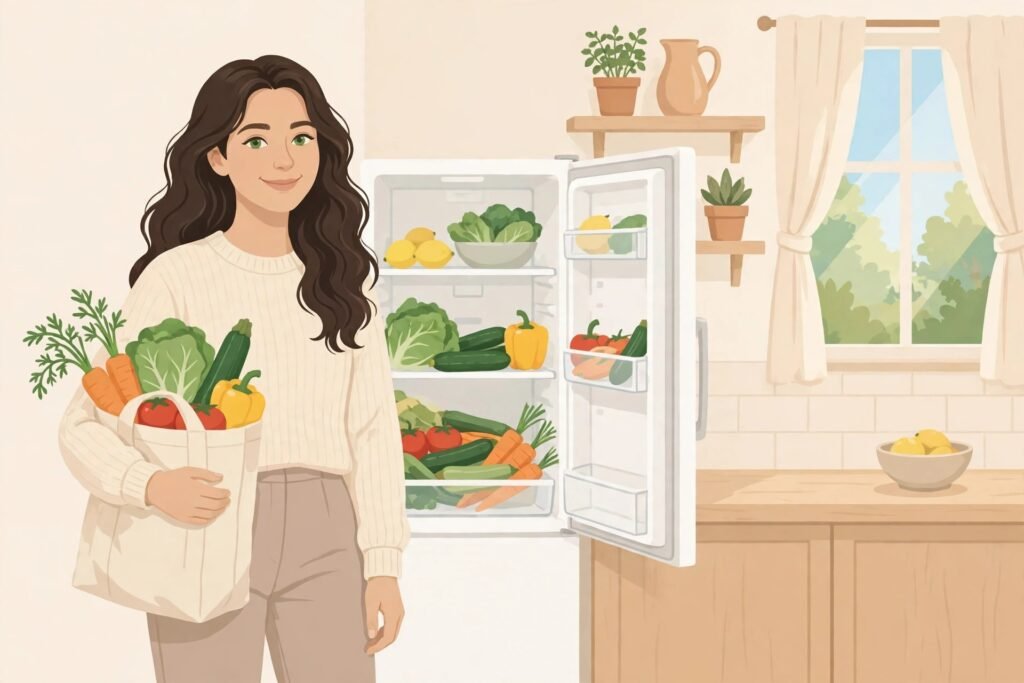
Sunday night, fridge open, and the same small drama: a bag of spinach going soft, cheese you forgot you bought, and nothing that adds up to dinner. So you order in, again, while perfectly good food quietly expires behind the milk. Cooking for one has a reputation problem. Recipes serve four, packs are family sized, and your week never goes the way you planned on Sunday.
If you’re asking how can i organize my groceries for the whole week, you’re not disorganized. You’re running a kitchen for a household of one, and nobody ever taught you the system for it. The system is not fancy. It’s a loose plan made from what’s already in your kitchen, meals that share ingredients, one honest list, one big shop, and storage that keeps food alive until its turn comes. Twenty minutes of thinking, once a week, replaces seven nights of standing in front of the fridge hoping for an idea.
This guide walks the whole week, in order. You’ll start by shopping your own kitchen first. You’ll build dinners that flow into each other, so tonight’s roast vegetables become tomorrow’s lunch. You’ll write one master list you can reuse for months. You’ll do one big shop and one tiny top up instead of five annoyed little trips. And you’ll keep a rescue plan for the nights the plan falls apart, because some nights it will, and that’s fine.
Here’s the promise that matters: how can i organize my groceries for the whole week is a skill of small repeats, not talent. The women who seem effortlessly fed are not better cooks. They just run the same simple loop every week: check, plan, list, shop, store, rescue. By the end of this guide, the loop will be yours, sized for one person, one fridge, and one real life with late meetings and lazy Wednesdays in it.
One more comfort before we start: this system forgives a messy week. Skip the plan one week and nothing collapses; you just pick the loop back up on Sunday. When friends ask how can i organize my groceries for the whole week without turning into a meal prep influencer, the honest answer is this: boring steps, repeated kindly. And if your current answer to how can i organize my groceries for the whole week is “I can’t, my life is too random,” keep reading anyway. This system was built for random lives.
The Short Answer

Organize your week in five moves. First, look at what you already have and plan around it. Second, pick a few dinners that share ingredients, so nothing gets used once and abandoned. Third, turn the plan into one list, grouped the way your store is laid out. Fourth, do one big shop for the week and one small top up for fresh things midweek. Fifth, store food so you can see it, and keep one easy rescue meal in the freezer for off nights. That’s the short answer to how can i organize my groceries for the whole week.
Notice how loose the plan stays. You’re not assigning a chef’s menu to all seven nights. You’re planning four or five real dinners, leaving gaps for leftovers, a night out, and the evening you simply want eggs on toast. A plan with gaps survives real life. A perfect plan dies by Tuesday and takes your motivation with it.
Keep the sequence in that order too. Planning before shopping, and shopping before the week starts, is what makes how can i organize my groceries for the whole week different from just buying food and hoping. And keep the standard kind. Some food will still get wasted now and then. A cucumber will escape. The goal is a calmer week and a smaller bin, not a spotless record. Ask how can i organize my groceries for the whole week with that gentle standard, and the habit sticks instead of becoming one more thing to fail at.
Start With What’s Already in Your Kitchen

Every good week starts with a two minute audit. Open the fridge, the freezer, and the cupboard, and actually look. What’s half used? What needs eating in the next two days? What’s hiding at the back, still fine, completely forgotten? That food is money you already spent. The first dinners of your week should be built from it, not from a recipe you saw online at midnight.
Health Canada’s meal planning guidance starts in exactly this place: plan the week’s meals and snacks, and first check your fridge, freezer, and pantry for foods and leftovers you already have. Their meal planning advice on Canada.ca then builds the grocery list from what’s missing, which is the whole trick. You shop to complete meals, not to collect ingredients.
Make the audit physical. Pull the urgent things to the front of the fridge where you can see them. Soft herbs, open cream, the last two eggs: front row. Write them on a note on the fridge door if your memory is anything like mine. These are your anchors. The spinach becomes Monday’s pasta. The leftover rice becomes Tuesday’s fried rice. The yogurt becomes breakfasts and a sauce. Three dinners just planned themselves, and nothing new was bought yet.
This habit is also where how can i organize my groceries for the whole week stops being about shopping at all. Most single households don’t have a buying problem. They have a using problem. Food comes in with good intentions and leaves in the bin. The audit flips the order: your kitchen tells you the plan, and the store just fills the gaps. Do it every week, same day, and it takes less time than one delivery order.
Keep a tiny use it up list on the fridge door for anything with three days or less left in it. Cross things off as they get eaten. It sounds almost too small to matter, but that little list is where how can i organize my groceries for the whole week becomes visible: the week’s food, on one note, with nothing silently rotting out of sight behind the jars.
Plan Meals That Share Ingredients

Here’s the core problem of cooking for one: ingredients come in packs for four. A bunch of herbs wilts after one recipe. A whole cabbage outlives your interest in it. The fix is not smaller shopping. It’s smarter sequencing. Choose dinners that share their fresh ingredients, so one bunch, one pack, one vegetable carries two or three meals across the week.
Think in chains, not in separate recipes. Roast chicken on Monday becomes chicken wraps on Wednesday and soup on Friday. A big tray of roasted vegetables lands beside the chicken first, then inside a grain bowl, then blended into a pasta sauce. A pot of rice serves three nights in three costumes. Fresh spinach goes into Monday’s pasta, Tuesday’s omelette, and Thursday’s smoothie or soup before it can go sad. Each ingredient gets a plan A and a plan B, and the plan B is what saves your week.
Keep your rotation small and repeatable. Most solo cooks thrive on a loop of eight to ten dinners they like and can make half asleep. Novelty is for one night a week, if you want it. A small rotation makes your list almost write itself, makes shopping fast, and makes you good at your own meals. It’s also how can i organize my groceries for the whole week without a spreadsheet or an app subscription: the repetition does the organizing for you.
Plan the fragile things first. Fish, salad leaves, fresh herbs, and berries belong in the first half of the week. Hardy things like cabbage, carrots, eggs, cheese, and frozen vegetables wait happily for the second half. That one ordering rule, fragile early and sturdy late, quietly kills most of the waste in a one person kitchen. Your Thursday self will thank your Sunday self for it.
If you hate cooking from recipes, plan in formulas instead. A protein, two vegetables, and a base, arranged differently each night: bowl, wrap, tray bake, stir fry, soup. Formulas forgive substitutions and empty shelves. They also make the week’s question, how can i organize my groceries for the whole week, answer itself in the shop, because you’re buying building blocks, not one night wonders. Keep two or three formulas you love and let them carry the ordinary weeks.
Build One Master List You Can Reuse

A list written from zero every week is a list you’ll stop writing. Build one master list instead: the skeleton of your usual shopping, saved on your phone or on paper on the fridge. Milk, eggs, bread, your usual vegetables, the grains and sauces you always use. Each week you only add the few things this week’s dinners need and cross out what you still have. Five minutes, done.
Group the list the way your store is laid out. Fruit and vegetables first, then bread, then dairy and eggs, then meat or alternatives, then cupboard goods, then frozen, then household bits. Canada.ca’s planning advice suggests the same thing: organize your grocery list by headings that match the sections of the store, and keep a running list handy where you can add items as you run low. A list in store order means one calm pass through the shop, no backtracking, and far fewer impulse buys hiding in your basket.
Keep a running list all week too. When the last of the olive oil pours out on Wednesday, it goes on the list on Wednesday, not in a Sunday guessing game. When you notice you’re low on coffee, it goes on the list. The list becomes your kitchen’s memory, so your brain doesn’t have to be. This tiny habit is a bigger part of how can i organize my groceries for the whole week than any gadget: the list remembers, so you don’t have to.
Two guardrails keep the list honest. First, if it’s not on the list, it needs a reason: a meal it belongs to this week, not a vague someday. Second, shop for the week you’re actually having. Guests on Saturday? A late shift on Thursday? Write the real week on the list. The list serves your life, not the other way around.
Photograph the inside of your fridge and cupboard before you write the list, if your memory plays tricks on you. One glance at the photo in the store ends the did I already buy that guessing that fills solo kitchens with three open jars of the same sauce. Small trick, real calm. Half of how can i organize my groceries for the whole week is simply knowing what you already own.
One Big Shop, One Small Top Up

Five small trips a week is where grocery calm goes to die. Every extra trip costs time, transport, and a few unplanned extras that jump into your hands. One big weekly shop does the heavy work: cupboard staples, long life ingredients, hardy vegetables, frozen goods, and everything for the first dinners. It’s focused, it’s once, and it’s done while your list is fresh in your mind.
But one shop alone asks too much of fresh food. Bread goes stale, salad tires, milk runs short by day six. So the system has a second, much smaller move: one top up midweek. Ten minutes, one bag, only the fresh and the finished: bread, milk, salad, fruit, and whatever the plan used faster than expected. The top up is not a second shop. It has its own tiny list, written before you leave, and nothing else is invited.
Pick your shop day like an appointment with yourself and keep it. Sunday afternoon, Monday after work, whatever fits your real rhythm. Anchor it to something that already exists: after the gym, on the way home from a class. Regularity beats intensity here. A modest shop done every single week teaches you how can i organize my groceries for the whole week far better than one heroic monthly haul ever will. An anchored shop happens automatically. A floating intention to shop sometime drifts all week and turns into nightly emergency trips for pasta and hope.
Order matters inside the big shop too. Fill the trolley in your list’s order and keep cold things for last if you can. At home, unpack with the week in mind: this week’s dinners where you can see them, backups to the back. Ten minutes of putting away on purpose is where the plan becomes real. Ask how can i organize my groceries for the whole week on a chaotic week and the answer is mostly this: protect the one big shop, and let the top up be tiny.
Delivery or pick up counts too, by the way. If the weekly shop is the part you dread, ordering the big shop for collection keeps the system intact and skips the wandering aisles completely. The method doesn’t care how the food reaches your kitchen. On weeks when someone asks how can i organize my groceries for the whole week with zero spare time, the answer is: same list, same plan, let the store pack it. Save your presence for the tiny top up.
Shop the Store in the Right Order

A grocery store is designed to slow you down and sell you detours. Your list is your route through it. Start with shelf stable goods that can sit in the trolley longest, move through fresh food, and finish with frozen and chilled items so they spend the least time warming up. In many stores that means starting at the back aisles and ending near the freezers by the tills. Your list, grouped by section, already has this order built in if you wrote it that way.
Shop the edges for your dinners and the middle aisles with a mission. The edges tend to hold the fresh food your plan is built from. The middle holds the thousand tempting things that are not on anyone’s list. Walk in there only for named items: the rice, the tinned tomatoes, the pasta. Eyes on the list, grab, go. The women who breeze through a weekly shop in twenty five minutes are not faster people. They just refuse the wandering that turns a shop into a browsing session.
A few small shop rules protect the plan. Never shop hungry if you can help it; a snack first is cheaper than the three extras hunger buys. Take the size your week actually eats: for one person, the smaller pack that gets finished beats the bargain giant that gets binned, almost every time. And if something on your list is out of stock, swap inside the same role: another leafy green, another firm fruit, another protein. The chain of meals survives one swap easily.
This is the practical heart of how can i organize my groceries for the whole week once you leave your kitchen: the shop itself is a calm, single pass, list in hand, out the door. Speed is a side effect. The real win is that what comes home matches the plan, so the week you imagined on Sunday is the week you actually eat.
Watch your basket size as you go, too. A small basket keeps a solo shop honest; a giant trolley invites giant thinking. If it doesn’t fit the week, it shouldn’t fit the basket. And when a deal tempts you, ask the only question that matters: which night eats this? No night, no deal. That single test is how can i organize my groceries for the whole week while standing in front of a two for one offer.
Store It Right So Nothing Gets Wasted

More food dies from bad storage than from bad planning. The rules are simple and a little boring, which is why they work. Perishable things go at the front of the fridge where your eyes land, not pushed to the back to be found in a sad state later. Canada.ca’s food guidance makes the same point: put perishables at the front instead of the back, because if you can see them, you’ll remember to eat them, and use the older things first.
Give fresh food the conditions it likes. Salad leaves last longer washed later, stored dry with a sheet of paper towel in the box. Herbs stand in a glass of water like flowers, or wrapped loosely and kept cold. Bread freezes beautifully in slices, ready to toast without a special trip. Cheese wants its wrap changed once opened. None of this needs special equipment. It needs ten minutes on shop day and a fridge arranged by this week’s plan: tonight’s and tomorrow’s food at eye level, later food below and behind.
Your freezer is a pause button, so use it like one. Freeze the half loaf, the extra portions of soup, the chicken you won’t reach by its date, in single servings you can actually use. Label with a date, even just on tape. A freezer full of mystery parcels helps no one; a freezer with four known rescues is a weeknight treasure. When a plan breaks, and it will, the pause button feeds you.
Do a two minute fridge glance midweek, at top up time. What’s drifting? Move it into tomorrow’s dinner or freeze it now. Waste rarely happens in one big failure. It happens in small ignorings. The glance is the fix, and it’s part of how can i organize my groceries for the whole week in the real world, where weeks wobble and appetites change by Wednesday.
One last storage kindness: keep a small eat first box or shelf in the fridge. Anything close to its limit goes in the box, and the box gets checked before any cooking starts. It turns the midweek glance into a glance of two seconds. Systems survive on tricks this small. Stack enough of them together and how can i organize my groceries for the whole week stops feeling like a project at all.
Keep a Weeknight Rescue Plan Ready

Every weekly plan meets a night it didn’t predict: the late meeting, the train that crawled, the day that simply empties you. Without a rescue, that night becomes delivery, guilt, and a fridge of ingredients quietly aging. With a rescue, it’s just dinner. Build your rescue shelf on purpose: two or three meals that take ten minutes and ask nothing of your mood.
The classic solo rescues earn their fame. Eggs, in any form, with toast and whatever vegetable is left. A freezer portion of soup or curry you made double of last week. Pasta with tinned tomatoes, garlic, frozen peas, and cheese. A wrap with hummus, leaves, and the last of the roast chicken. Keep their ingredients in stock the way you keep toilet paper in stock: automatically, without debate, topped up on the big shop whenever they run low.
Planned leftovers are a rescue you build yourself. When you cook something that reheats well, make one extra portion on purpose and freeze or fridge it with its name on it. Your future self, home at nine and hollow, opens the fridge and finds a meal with her name on it. That’s not laziness. That’s the system working. Our guide to what to cook when you want to impress without trying too hard leans on the same idea: a few reliable dishes, ready to go, beat a dozen ambitious ones.
And protect the joy in all this. One night a week, plan nothing at all. Eat out with a friend, order the thing you love, cook the weird experiment. A grocery system for one person should make your week easier and your food happier. When friends come over, our stress free notes on how to host a dinner party without stress keep it simple. The loop serves your life: check, plan, list, shop, store, rescue, and one night gloriously off duty. That rhythm is how can i organize my groceries for the whole week becomes a question you stop asking, because the answer is just what you do now.
After a month of this loop, something quiet changes. You stop thinking about food as a daily problem to solve and start treating it as a weekly rhythm that mostly runs itself. Sunday’s twenty minutes buy back your weekday evenings. That’s the real prize here, bigger than the money saved or the waste avoided. Anyone still wondering how can i organize my groceries for the whole week a month from now will find the question has shrunk: it’s no longer about organizing at all. It’s just how your kitchen works.
Frequently Asked Questions
How many dinners should I actually plan for one week?
Plan four or five dinners, not seven. One night will become leftovers, one will become a rescue meal, and one will likely become a night out, a work thing, or eggs on toast. Planning all seven nights usually means buying food for a fantasy week, and the extras end up wasted. Four or five planned dinners, built from ingredients that chain into each other, cover a real week for one person with room to breathe.
What if I get bored eating similar ingredients all week?
Chain the ingredient, not the dish. The same chicken can be a roast with vegetables, a wrap with a sharp sauce, and a soup with noodles, and none of those plates feel like repeats. Change the costume each time: sauces, spices, bread versus grains, hot versus cold. Keep one novelty night in the week for a new recipe. A small rotation with changing costumes stays interesting far longer than seven unrelated experiments.
How do I stop fresh herbs and salad from going to waste?
Use them early and give them a second job. Plan herb and salad meals in the first three days, while those ingredients are at their best. Then give leftovers a planned escape route: herbs into a sauce, a soup, or the freezer in oil; salad leaves into wraps, sandwiches, or a warm grain bowl where a little wilt is welcome. Storing leaves dry, with a paper towel in the box, buys you extra days too.
Is one big weekly shop really cheaper for one person?
For most solo households, yes, mostly because of what it prevents. One planned shop stops the four small trips that each add unplanned extras, and it makes sure food at home gets used before more arrives. The savings come less from prices and more from waste: fewer forgotten vegetables, fewer duplicate jars, fewer emergency takeaways. A small midweek top up for bread, milk, and salad keeps the fresh side working without reopening the whole shop.
What should I do when the whole plan falls apart by Wednesday?
Shrink the plan, don’t abandon it. Look at what you have, pick the two ingredients closest to their limit, and build tonight and tomorrow around them. Freeze anything that won’t survive until it can be used. Then let the rescue shelf carry one night. A week where three planned dinners happened is still a well organized week. That’s the honest spirit of how can i organize my groceries for the whole week: a flexible system that bends, not a strict menu that breaks.