

Your bag goes everywhere you go. It sits through your classes, your bus rides, your shifts, your long walks home. It holds your whole portable life: phone, keys, wallet, water, snacks, the lip balm you can never find, and at least three things you forgot were in there. And yet most of us picked our bag in about four minutes, because it was pretty, or on sale, or the one our friend had. Then we spend a year fighting it: straps that dig, a size that’s wrong for our real days, a black hole inside where small things go to retire.
It doesn’t have to be that way. A bag is a tool before it’s a decoration, and tools can be chosen well. When you set out to choose a bag that fits my daily life, and by that I mean your actual days, not your prettiest day, the choice gets surprisingly clear. This article walks through it in order: what you carry, honest size, straps and weight, materials that survive real life, the inside, the one bag or two bags question, and a simple in store test. By the end, your next bag won’t be a guess. It’ll be a fit.
And you’ll see why girls who choose a bag that fits my daily life, instead of just a bag that fits my outfit, stop thinking about their bag at all, which is the whole point. Treat this article like a fitting session for your days. By the end, you’ll know how to choose a bag that fits my daily life on the first try, not the fourth.
The Short Answer

Here’s the short version. To choose a bag that fits my daily life, start with your real daily load, not the bag section of a store. List what you carry on your busiest normal day, then pick the smallest size that holds it with a little room to spare. Choose straps your shoulders can live with for hours, a material that survives rain, floors, and bus seats, and an inside with at least two pockets and a closure that actually closes. Test it in the store with your real things inside. That’s it. A bag chosen this way disappears into your day, in the best sense.
And when you choose a bag that fits my daily life this honestly, you buy once, instead of buying three almost right bags in two years. Read the sections in order the first time, then keep the test from the last one in your phone for shopping days. The list, the size, the strap, the skin, the inside: each one removes a way a bag can fail you.
Start With What You Actually Carry Every Day
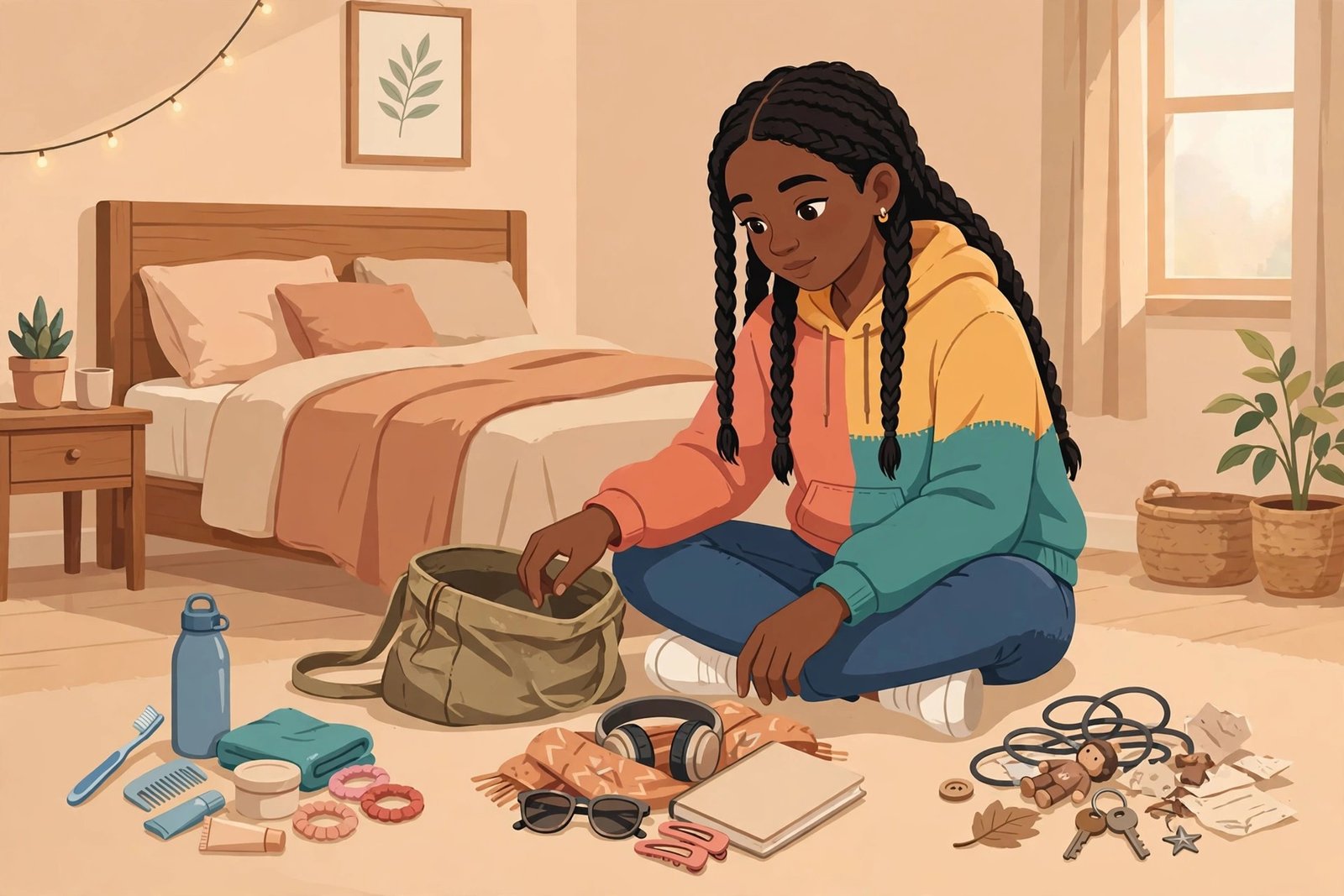
Every good bag choice starts on your bed, not in a store. Empty your current bag completely. Yes, all of it, including the receipts from another era and the hair ties that live at the bottom. Now sort what came out into three piles. Pile one: the daily non negotiables, the things that leave the house with you every single day. Pile two: the sometimes things, carried a few days a week. Pile three: the squatters, things that moved in months ago and never left, which you carry daily without ever using. That third pile is heavier than you think, and it’s been riding on your shoulder for free.
Now look at pile one with honest eyes. This is your real load, and it’s the load your next bag must fit. Notice its shape, not just its weight. A water bottle is tall. A book or tablet is flat and wide. A makeup pouch is bulky in the middle. Bags fail less from total size than from the wrong shape for the load. A deep narrow bag swallows a bottle happily and fights a book. A wide flat bag loves the book and lets the bottle roll like it’s on holiday. Shape is the quiet half of learning to choose a bag that fits my daily life, and it’s the half most people skip.
When you choose a bag that fits my daily life, you’re matching a container to a cargo you’ve actually met, not a cargo you imagine.
Add one more step: think about your busiest normal day, not your lightest. The day with school, then practice, then a stop at a friend’s. The bag that survives that day will cruise through every easier day. But be careful not to size for the once a year day. The giant trip day, the beach day: those can borrow a tote or a backpack you already own. Daily bags sized for rare days become heavy, half empty caves you lug around all year. The daily load, on the busy end of normal: that’s the target. Write your pile one list in your phone.
That humble list is the most useful shopping tool in this whole article, and it’s how every smart girl I know starts when she wants to choose a bag that fits my daily life instead of a bag that fits a mood.
Size It Honestly: Too Small and Too Big Both Fail

Size is where most bag mistakes live, in both directions. Too small is the obvious heartbreak. The pretty little bag that fits your phone and nothing else, so your bottle rides in your hand, your keys live in your pocket, and your sweater ties around your waist like a flag. A bag that can’t carry your day isn’t a bag. It’s a decoration with a strap, and it quietly splits your life into things carried properly and things carried awkwardly. Size honesty is where choose a bag that fits my daily life stops being a slogan and becomes a measurement you can stand behind.
Too big is the sneakier failure. A huge bag feels like freedom in the store. By the second week, it has become a moving storage unit. Because the space exists, things move in: the extra book, the just in case umbrella, the snack collection, the other bag you folded inside it once. Weight creeps up a little every week. Your shoulder starts voting against the whole arrangement by 4 pm. Big bags also hide things. The bottom of a big bag is an ecosystem with its own lost property office. When you choose a bag that fits my daily life, honest size is the middle path: your daily load, plus a small margin, and not a centimeter more of temptation.
Here’s a quick way to find your size without a tape measure. Take your pile one items and arrange them in the rough shape of a bag on your bed. Now look at the footprint. That’s your minimum inside space, plus a finger’s width of mercy on every side. In the store, any bag whose inside is clearly smaller fails, no matter how cute. Any bag that’s double the footprint will punish you by filling itself. Between those two lines lives your size, and it’s usually a medium, the least glamorous word in fashion and the right answer surprisingly often.
One more honesty check, about shape again, because it hides inside size. Try to match your tallest daily item. If a bottle or a book stands taller than the bag, you’ll spend the year with a bag that won’t close, or a bottle worn like a hat on top of your things. A bag that closes fully, over your real load, with the zip or flap sitting flat: that’s a small daily peace you will feel every single day. Girls who learn to choose a bag that fits my daily life always mention the closing test. If it doesn’t close over your life, it doesn’t fit your life, whatever the mirror says.
Straps and Weight: Your Shoulders Vote Too

Now let’s talk about the part of the bag that touches you for hours: the straps. A strap is not a detail. It’s the whole relationship between the bag and your body. Thin straps concentrate all the weight into one small line on your shoulder, and by the end of a long day that line has opinions, expressed in aches. Wide straps spread the load. Padded straps spread it kindly. Adjustable straps let the bag sit where your body wants it, instead of where the designer guessed.
Length matters as much as width. A shoulder bag that hangs too low bangs against your hip with every step and pulls your posture sideways. A crossbody worn diagonally shares the load across your back and keeps your hands free, which is why so many busy girls swear by it. A tote with short handles lives in your hand or the crook of your arm, fine for short trips, tiring for long ones. Think about your longest normal walk with the bag, school to bus, bus to home, and let that walk judge the strap.
When you choose a bag that fits my daily life, you’re really choosing what your shoulder will feel at the end of the day, and your shoulder deserves a vote.
The weight of the empty bag itself is the trap inside this section. Some bags are heavy before anything goes in: thick leather, big metal hardware, chains that look great and weigh like jewelry for a horse. Pick a loaded bag up in the store and you can’t tell what’s bag and what’s stuff. So test the bag empty first. If the empty bag already feels like a small workout, your daily load will turn it into a big one. Health pros who treat shoulder and neck pain say the same thing in fancier words.
This handbag ergonomics guide from Core Concepts Physio explains how a heavy one shoulder load can strain your neck and back, and suggests keeping the total weight low, choosing wide adjustable straps, and switching sides often. It’s written for adults with handbags, but your school bag obeys the same physics.
Simple version to carry in your head: wide strap, adjustable length, light empty weight, and a shape that lets you switch shoulders or wear it crossbody on long days. Meet those four, and your body will quietly thank you every afternoon at 4 pm, in the language of not aching. That’s the real luxury in a bag. Not the logo. The not aching. Hold those four checks in your head on shopping day and you’ll feel the difference before the mirror even gets a vote. This is the body chapter of choose a bag that fits my daily life, and bodies don’t negotiate.
Materials That Survive Real Life

Your bag lives a harder life than your clothes do. It sits on classroom floors, bus floors, cafe chairs, and the ground beside your feet in the park. It gets rained on, stuffed into lockers, swung onto hooks, and opened a thousand times a month. So material is not a style footnote. It’s a survival question. The prettiest delicate fabric can be a fine choice for a rare occasion bag. For a daily bag, choose the material like you mean it. Material is where choose a bag that fits my daily life meets the weather forecast, the bus floor, and your real habits, all at once.
Start with the weather where you live. If rain is a regular guest in your life, a material that shrugs off water will save you weekly stress. Many synthetics and treated fabrics wipe clean and dry fast. Leather and faux leather handle scrapes well and age with character, though they can be heavier, so weigh them empty as we said. Canvas is light and friendly, but it shows dirt and soaks up rain unless it’s coated. None of these is the right answer for everyone. The right answer is the one that matches your sky, your floors, and your habits.
A girl who sets her bag on the ground daily needs a tougher skin than a girl whose bag lives on hooks and chairs.
Check the wear points like a detective. Corners get scuffed first, so see if they’re reinforced or at least double layered. The base of the bag meets every floor it will ever sit on; a slightly structured base or little feet can keep the bottom cleaner. Stitching should be even and tight, especially where the straps meet the body of the bag, because that’s where the load pulls. Zips should glide, not argue. A zip that sticks in the store will wage war by winter.
And cleanability is a love language to your future self. A bag you can wipe down in one minute stays nice for years. A bag that needs special care will slowly wear its stains like a diary. When you choose a bag that fits my daily life, read “daily” as a promise the bag has to keep in weather, dirt, and hurry. Choose the material that can keep it. Your future self, wiping it clean on a Sunday in thirty seconds, sends her thanks. The girls who choose a bag that fits my daily life always end up here eventually: pretty is a bonus, but tough is the job description.
Pockets and Closures: The Inside Matters
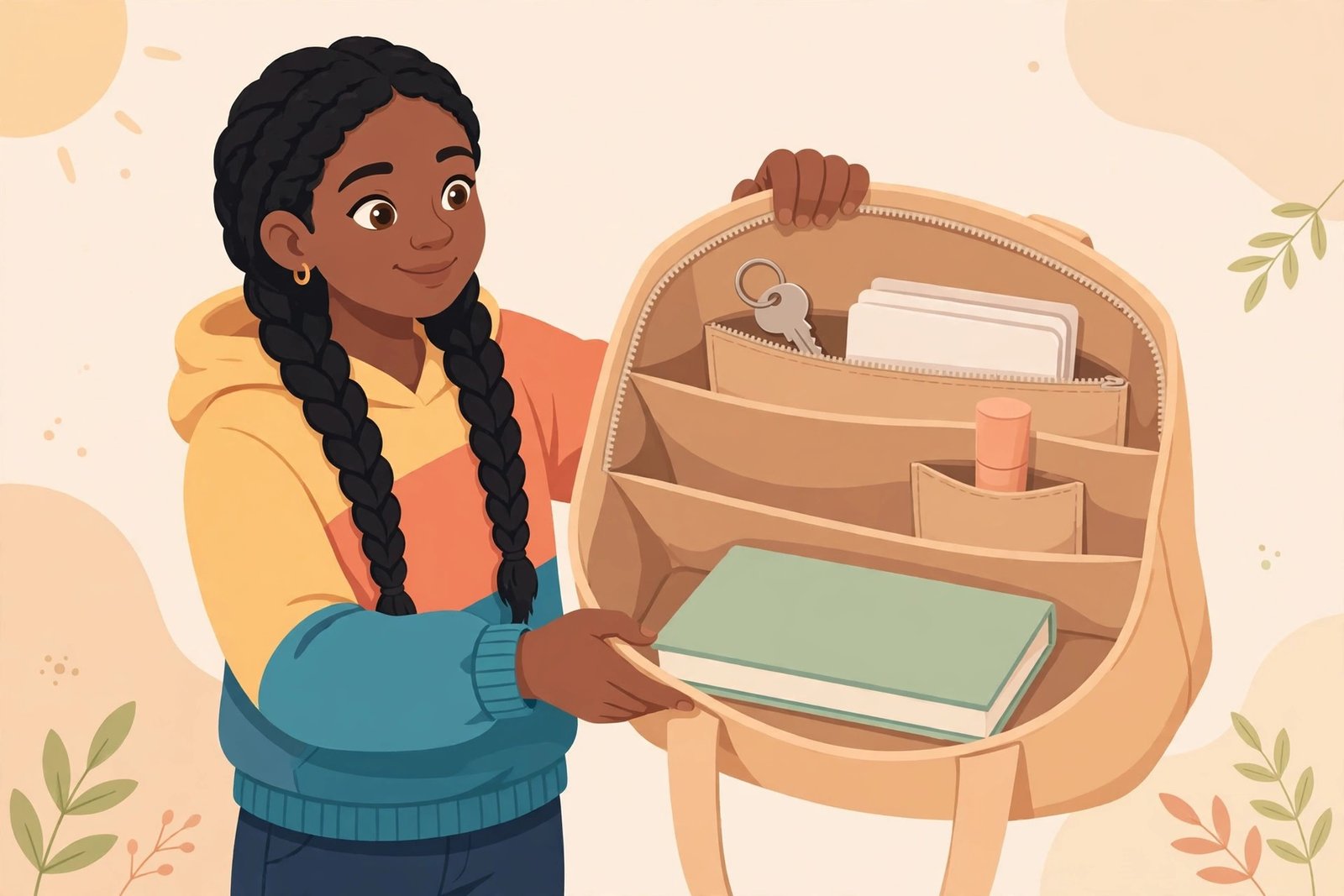
Two bags can look identical from outside and live completely differently inside. The inside is where your daily peace is decided. One big open compartment sounds simple, and for about a week it is. Then the bag becomes a soup. Your phone sleeps under your book. Your keys migrate to the deepest corner, always during the exact moment you’re standing at a locked door in the rain. Small things don’t get lost in bags. They get lost in bag soup. Pockets are how you fire the soup.
You don’t need a maze of compartments. You need a minimum working set: one secure zipped pocket for the valuables, phone, cards, money; one quick access pocket for the things you grab twenty times a day, like your balm or pass; and a main space that fits your flat items without bending them. That’s it. Three zones. With three zones, your hand learns the map, and finding things becomes touch, not sight. You can fish out your keys in a dark cinema or a moving bus without the archaeological dig.
Closures deserve the same respect. A bag that doesn’t close is a bowl with straps. Pretty, but your things are one trip or one bump away from a public spill. A zip top is the safest for busy, crowded, moving days. A flap with a real clasp is a good middle ground. An open tote is fine for controlled days, car to office, short errands, where the bag stays upright and watched. Match the closure to your most chaotic normal moment, not your calmest. If your bag rides a packed bus daily, it needs to close like it means it.
A secure closure is a small, unglamorous promise, and keeping promises is the whole job when you choose a bag that fits my daily life.
While you’re inside the bag, check the lining color too. A light lining is a small gift: you can actually see your things. A black lining inside a black bag turns every search into a trust exercise. It sounds tiny until you’ve done the rainy door key search inside a dark bag. Tiny is where daily life happens. When girls talk about the moment they finally learned to choose a bag that fits my daily life, they rarely mention the outside first. They mention the pocket that holds their phone, the zip that works, the lining where they can find things. The inside is the job. The outside is the uniform.
One Bag or Two Bags? The Honest Decision
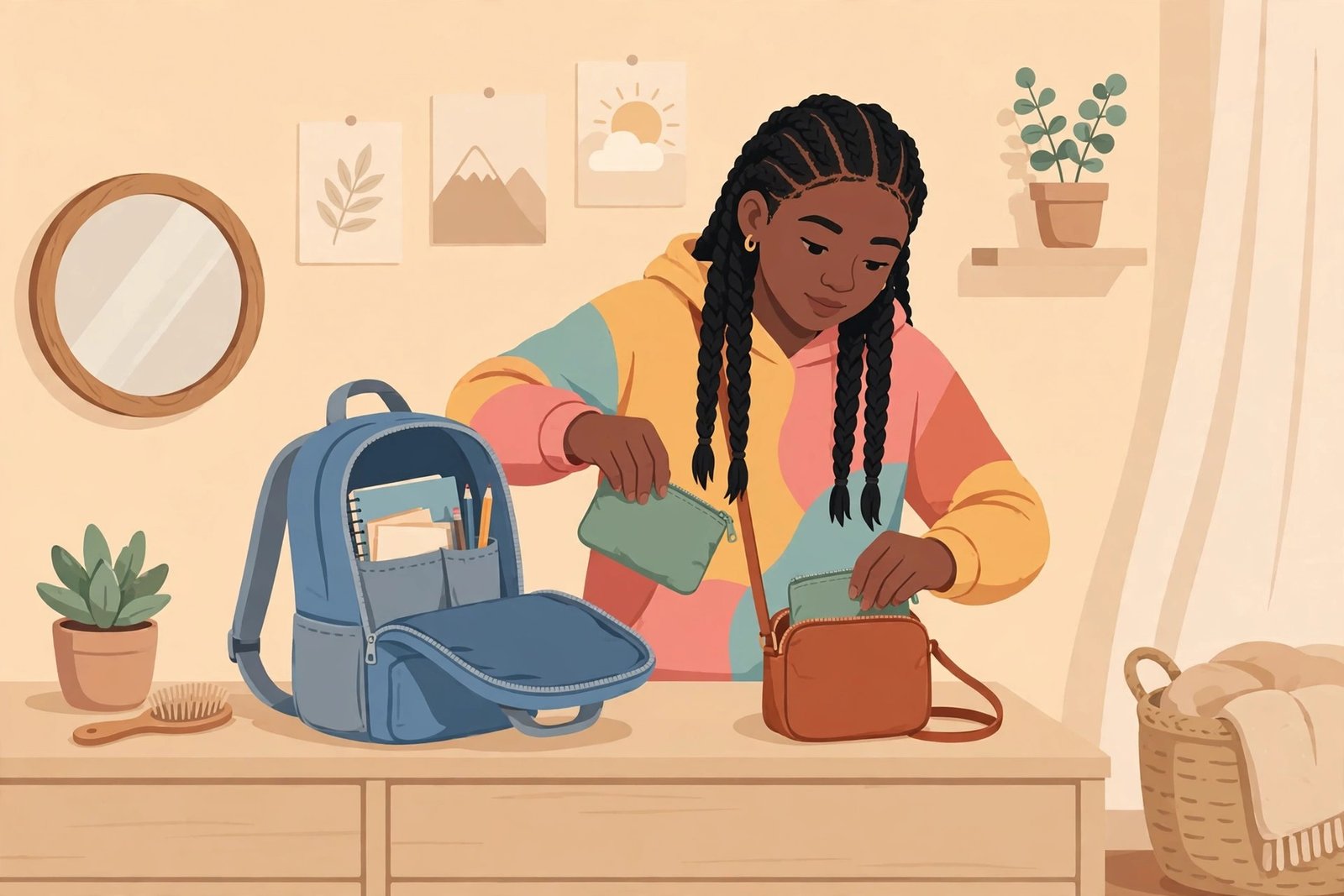
At some point, every girl asks the question: should one bag do everything, or should I keep two? The honest answer depends on how different your days are. If your days are cousins of each other, school, errands, friends, one well chosen daily bag can carry them all, and life gets beautifully simple. You stop moving your things between bags, which is the moment keys and cards get left behind. One bag, one home for everything, one grab and go.
If your days split into two very different shapes, two bags can be the honest answer. The classic split is a bigger structured bag for school or work days, and a small crossbody for light days and evenings. The small bag forces a happy edit: phone, cards, keys, balm, done. The big bag handles books, bottle, and layers. What doesn’t work is the messy middle: three or four half used bags, things scattered across all of them, and a daily treasure hunt to assemble your own life. The number isn’t the problem. The scattering is.
There’s a middle system that helps the split work: a small pouch that holds your core items, phone excluded: cards, keys, balm, a little cash. Moving bags becomes moving one pouch, thirty seconds, nothing forgotten. Girls who travel between a school bag and a small bag swear by the pouch like it’s a life philosophy. It also gives you a free bonus: emptying your bag for cleaning takes a minute, because your life comes out in zones, not in handfuls.
Budget speaks here too, kindly. One good bag costs less than three cheap ones that each annoy you in a different way. If money is tight, put it into the bag that matches your most common day, and let the rare days borrow, swap, or make do. And if you love the idea of one bag that flexes across outfits, our guide on building a capsule wardrobe on a budget shows the same thinking for clothes: fewer pieces, chosen to work together, zero daily drama. One bag that works with every outfit in the rotation is exactly how you choose a bag that fits my daily life without collecting almosts.
And to watch one set of pieces, bag included, cover a whole season of looks, our fall outfit formulas from a capsule are a fun place to see it happen. Whether you land on one bag or two, decide like it’s a system, not a mood. That’s what it means to choose a bag that fits my daily life at the level of your whole week.
The In Store Test Before You Pay

Everything in this article becomes real in one five minute test, in the store, before you pay. Most people skip it because it feels a little silly. Do it anyway. Silly in the store is cheaper than sorry for a year. Step one: put your real things in the bag. Your actual bottle, book, pouch, phone, keys, not the store’s tissue paper. If you didn’t bring your load, bring it next time. A bag test without your cargo is just a mirror selfie.
Step two: close it. Zip or clasp it over your real load and look at the shape. A bag that bulges, strains, or won’t fully close over your normal day is telling you the truth early. Believe it. Step three: wear it the way you’ll wear it, on the shoulder or crossbody, and walk the store. A full lap. Feel the strap at minute three, not second three, because straps confess slowly. Does it slide? Does it dig? Does the bag swing and bang your leg with every step? Your body is giving you data. In the store, that data is free. At home, it costs the price of the bag.
Step four: the find it test. Close your eyes or look away, and find your keys, then your phone, by touch. If both come to hand fast, the inside works. If you dig, imagine that dig at a rainy door with an armful of groceries. Step five: the floor test. Set the bag down like you would in class. Does it stand, slump, or spill? Then pick it up by its straps fifty times in your mind. The stitching you checked earlier now has a job to do.
If a bag passes all five steps, it has earned its price, high or low. If it fails one, you have honest information, not a failure of taste. Walk away kindly. The right bag exists, and now you know your load, your size, your strap, and your test. Carry your pile one list with pride. It’s the list that lets you choose a bag that fits my daily life in one store visit, instead of five hopeful purchases. And if the bag also happens to be beautiful, and many of the right ones are, that’s the best kind of luck: the kind you built yourself. Your days are about to get quietly easier, one grab and go at a time.
The girls who choose a bag that fits my daily life all say the same thing afterward: I stopped thinking about my bag. That’s the review that matters.
Frequently Asked Questions
What size bag is best for school days?
Aim for the smallest size that swallows your busiest normal school load with a finger of room to spare: books or tablet, bottle, pouch, phone, keys, and one layer. Arrange your load on your bed to see its real footprint, then match bags to that, not to a size name. Medium usually wins. Too small splits your life into carried and awkwardly carried. Too big fills itself with just in case things and taxes your shoulder. When in doubt, run the closing test: your load inside, zip shut, shape calm.
Is a crossbody or a shoulder bag better?
It depends on your longest walk. A crossbody spreads weight across your body, keeps hands free, and stays put on buses and bikes, so it wins for long, busy, moving days. A shoulder bag is quicker to slip on and off and can look dressier, but it loads one shoulder and likes to slide. Many girls land on the honest split: crossbody for heavy moving days, shoulder bag for short calm ones. Whichever you pick, choose a wide adjustable strap. Your shoulder at 4 pm is the real judge here.
How heavy should my daily bag be?
Lighter than you think. Physiotherapists who see shoulder and neck pain often suggest keeping a one shoulder bag under ten percent of your body weight, and many say a few kilos is plenty for daily carrying. The simplest test is your own body: if your shoulder aches, your neck feels tight, or you keep switching sides and sighing, the bag is too heavy, whatever the scale says. Weigh your loaded bag once at home. The number usually explains the ache, and trimming the squatter pile fixes most of it.
How many bags does a girl actually need?
Most girls are well served by one or two: one daily bag matched to the most common day, and optionally one small light bag for evenings and quick errands. More bags than that usually means more scattering, with keys and cards playing hide and seek between them. If you run two bags, use a small core pouch that moves between them so nothing gets left behind. It’s not about owning the fewest bags. It’s about every bag having a clear job, and your things having one home at a time.
What is the biggest mistake when buying a bag?
Buying for the mirror instead of the day. A bag chosen in four minutes for how it looks, without your load inside it, will spend a year apologizing: not closing, digging in, hiding your keys. The fix is the in store test: things in, bag closed, a walking lap, find your phone by touch. Five minutes, and the truth shows up while it’s still free. When girls tell me they finally learned to choose a bag that fits my daily life, this test is usually the turning point they describe.