
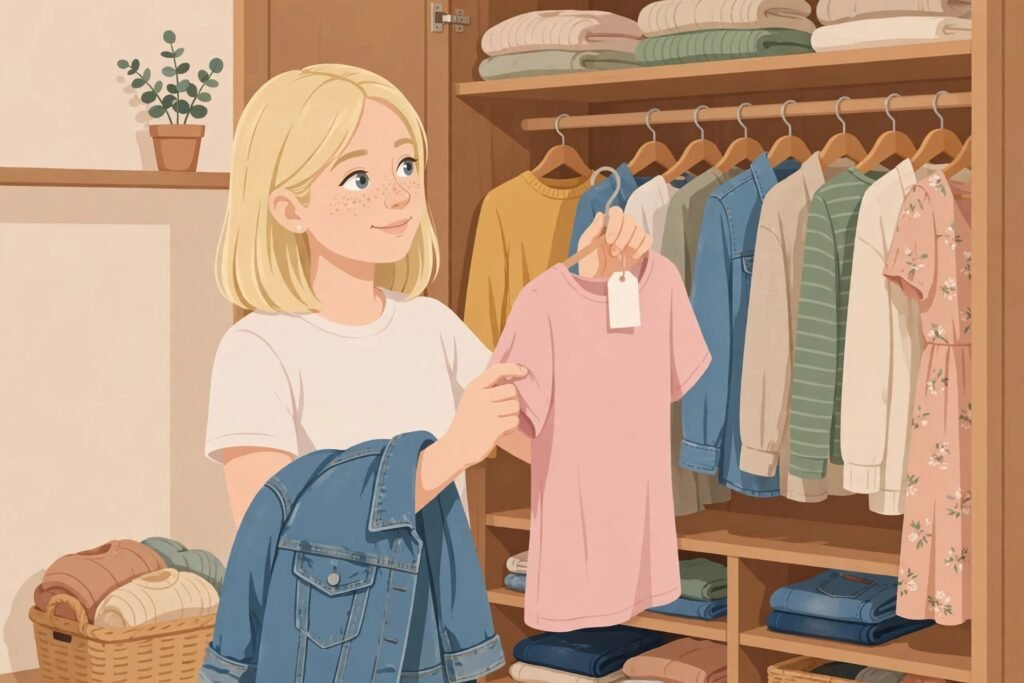
Open your closet and count the tags. Not the clothes you love. The tags. The little paper cards still hanging from tops you bought months ago, dresses that never left the house, jeans waiting for a version of you who wears jeans like that. Almost every girl has a corner like this. And almost every girl has asked herself the same quiet question while staring at it: how do I stop buying clothes I never wear?
Here is the part nobody tells you. You are not bad with money. You are not weak, silly, or spoiled. You are caught in a small, well built loop that stores and apps designed very carefully. The loop runs on feelings, not on logic. That’s why logic alone never breaks it. You can know a top is a bad idea and still buy it, because the part of you doing the buying isn’t the part that does the knowing.
This guide is not about the moment in the store. It’s about the habit that lives at home, in your room, on your phone, late at night. You’ll learn why the rush feels so good, what feelings are really pulling the strings, and how to face the clothes you already own without shame. Then you’ll build rules that work on your real life, not on some perfect version of it. By the end, the goal “stop buying clothes I never wear” stops being a guilty wish and becomes a calm, doable plan.
And be gentle with yourself as you read. Every unworn piece in your closet was bought by a girl who wanted to feel better, prettier, or more ready for her life. She wasn’t foolish. She was hopeful. We’re not going to scold her. We’re going to understand her, and then help her shop like a friend instead of a reflex. That’s how you stop buying clothes I never wear for good: not with guilt, but with a kinder system. And remember, learning to stop buying clothes I never wear is a skill. Like every skill, it feels clumsy at first and then, one day, it just feels normal.
The Short Answer

Here’s the short answer. You don’t stop buying clothes I never wear by trying harder at the checkout. You stop by changing what happens before and after the buy. Before: notice the feeling that starts the loop, like stress, boredom, or a bad day. After: build a pause between wanting and paying, so the feeling cools down before your money moves.
The loop works like this. A feeling shows up. Your brain remembers that scrolling and buying gave you a quick lift last time. You open an app or walk into a shop. You buy. The lift fades in a day or two. The piece joins the others, tags on. Repeat that a few times, and the loop feels automatic. But automatic doesn’t mean unbreakable. It means the loop runs on cues, and cues can be changed. Every time you break the loop once, you prove to yourself that you really can stop buying clothes I never wear. And proof is what makes the next break easier.
Three moves break it. First, meet the clothes you already own with honest eyes, because a closet you know well stops feeling empty. Second, add a waiting rule: nothing gets bought the day you first want it. Third, give the rush a cheaper place to go, like restyling an old outfit or planning one on your phone without paying.
If you take only one sentence from this page, take this one: the wish to stop buying clothes I never wear is not about willpower. It’s about building a small system that protects you on the days your willpower is tired. Systems work on bad days. Willpower doesn’t. So let’s build the system.
Why the Rush Feels So Good in the Moment

Let’s slow the loop down and watch it in tiny steps. You’re on your bed, a bit flat, a bit bored. You open a shopping app just to look. A top appears. It’s your color. It’s on sale. Your heart does a small jump. For about ten seconds, you can see a whole new you wearing it. That little movie in your head is the product. The top is almost an extra.
That jump has a name in plain words: a reward hit. Your brain loves new things, deals, and treats. It pays you a tiny dose of feel good energy when you find one. The dose is short, but it’s real, and it lands right when you’re stressed or bored, which is when you need it most. So your brain files a note: feeling low? Shopping fixes it, fast.
Notice what the note doesn’t say. It doesn’t say the top will be worn. Your brain isn’t buying a top. It’s buying ten bright seconds and a fantasy outfit. That’s why the piece can hang untouched for months while the buying still felt worth it at the time. The reward was never in the wearing. Once you see that, the wish to stop buying clothes I never wear makes a new kind of sense. You’re not fighting a top. You’re retraining a reward.
Sales pour fuel on this. A countdown timer, a “only 2 left” label, a price slashed in red: these are not information. They are pressure, dressed up as information. They tell your brain to decide now, before the treat escapes. Deciding now is exactly how a piece you never wear gets bought. Nobody calmly, slowly, and thoughtfully buys a top she’ll never touch. Speed is the trick, and the trick is built on purpose.
There’s one more quiet player: the package. Waiting for a parcel gives the fun a second act. Tracking it, opening it, holding the new thing: all tiny hits, spread over days. By the time the piece reaches your closet, the fun is used up. The top did its job before it was ever worn. When you understand that the package was the party, you can plan other parties. And that is good news, because it means you can stop buying clothes I never wear without giving up treats. You just move the treats.
The Real Reasons Behind the Buy

If you ask girls why they bought the unworn piece, most say the same words: “I don’t know, I just liked it.” But sit with the memory a little longer, and a feeling usually shows up underneath. Feelings are the true shoppers here. Naming yours is the first real step, because each feeling needs a different answer.
Stress is a big one. After a hard day, a tense week, or a fight at home, buying something pretty feels like taking your life back for a minute. It’s a small reward you control when everything else feels out of control. Boredom is another. An empty evening and a phone in your hand is the most common shopping mall on earth. The scroll fills the silence, and the buy fills the scroll.
Then there’s the future self fantasy. You buy for the girl you plan to become: the one who goes to parties like that, wears dresses like that, has a life like that. The piece isn’t for your Tuesday. It’s for an imaginary Friday. Imaginary Fridays rarely come, and when they do, you wear your favorites anyway. And there’s the copycat buy: a creator wears it, it looks amazing on her, and your brain quietly skips the part where her body, budget, and life are not yours.
None of these feelings are shameful. Stress, boredom, hope, admiration: that’s just being a person. The problem is only that shopping is a poor answer to all four. It answers for ten seconds and bills you for months. A girl who wants to stop buying clothes I never wear doesn’t need fewer feelings. She needs better answers to the same feelings. A walk, a call, a shower, a playlist, a snack, a nap: boring list, powerful list. The feeling passes in about twenty minutes whether you buy or not. The bill doesn’t.
Watch your own pattern for one week. Each time the urge hits, write one line in your notes app: time, place, feeling. Just that. By day seven, you’ll see your personal map. Maybe it’s always Sunday night dread. Maybe it’s always after seeing one account. A map turns a foggy habit into a few clear moments, and clear moments can be planned for. You can’t fight fog. You can absolutely plan for Sunday night. Meeting the feeling first, before the scroll starts, is the quiet move that helps you stop buying clothes I never wear without white knuckling your way through every urge.
Meet the Clothes You Already Own
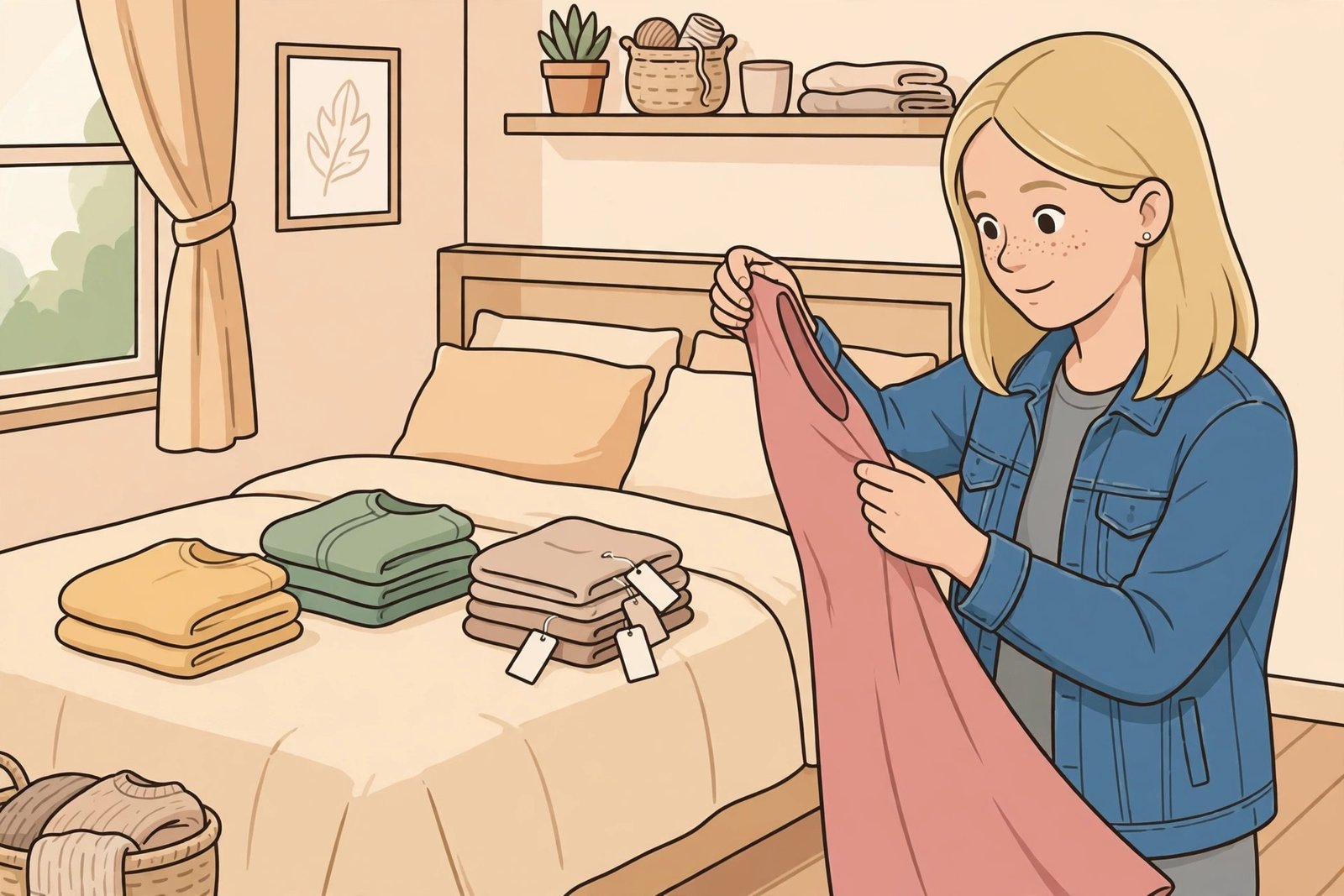
Now for the part most girls skip, and it’s the part that changes everything. Before any rule, any ban, any fresh start, you need one honest hour with the closet you already have. Not a tidy up. A meeting. You’re going to look at every piece and ask it one question: do we actually have a life together?
Set a timer for one hour. Take everything out, yes, everything, and lay it on your bed. Then sort into four piles. Pile one: loved and worn often. Pile two: liked, but rarely worn, and you can say why. Pile three: never worn, tags on or worn once. Pile four: worn out, stained, or dead. Be honest, not harsh. This is a fact finding hour, not a courtroom.
Pile three is the teacher. Hold each piece and finish this sentence out loud: “I bought you because…” You’ll hear your own patterns in your own voice. Because I was sad. Because it was 70 percent off. Because it looked good on her. Because I wanted to be a dress person. Saying it out loud moves the lesson from your closet into your memory, where it can protect you next time. This is the closet work that helps you stop buying clothes I never wear: the next time the loop starts, you’ll hear your own voice first.
Do the math, gently. Add up roughly what pile three cost. Not to punish yourself. To make the number real. For many girls it’s a phone, a trip, or months of savings, sitting quietly on hangers. Money on hangers can’t take you anywhere. Let the number be information, not a verdict. Then decide pile three’s future: sell what’s sellable, swap with friends, donate the rest. An unworn piece that leaves teaches twice: once when it goes, and once every time you remember.
End the hour by putting piles one and two back in a way you can see. If you can’t see it, you won’t wear. Fold nothing into dark corners. Your favorites deserve front row seats, because the next section depends on this: a closet that shows you what you own stops feeling empty, even when it’s small.
What Those Unworn Pieces Are Really Costing You
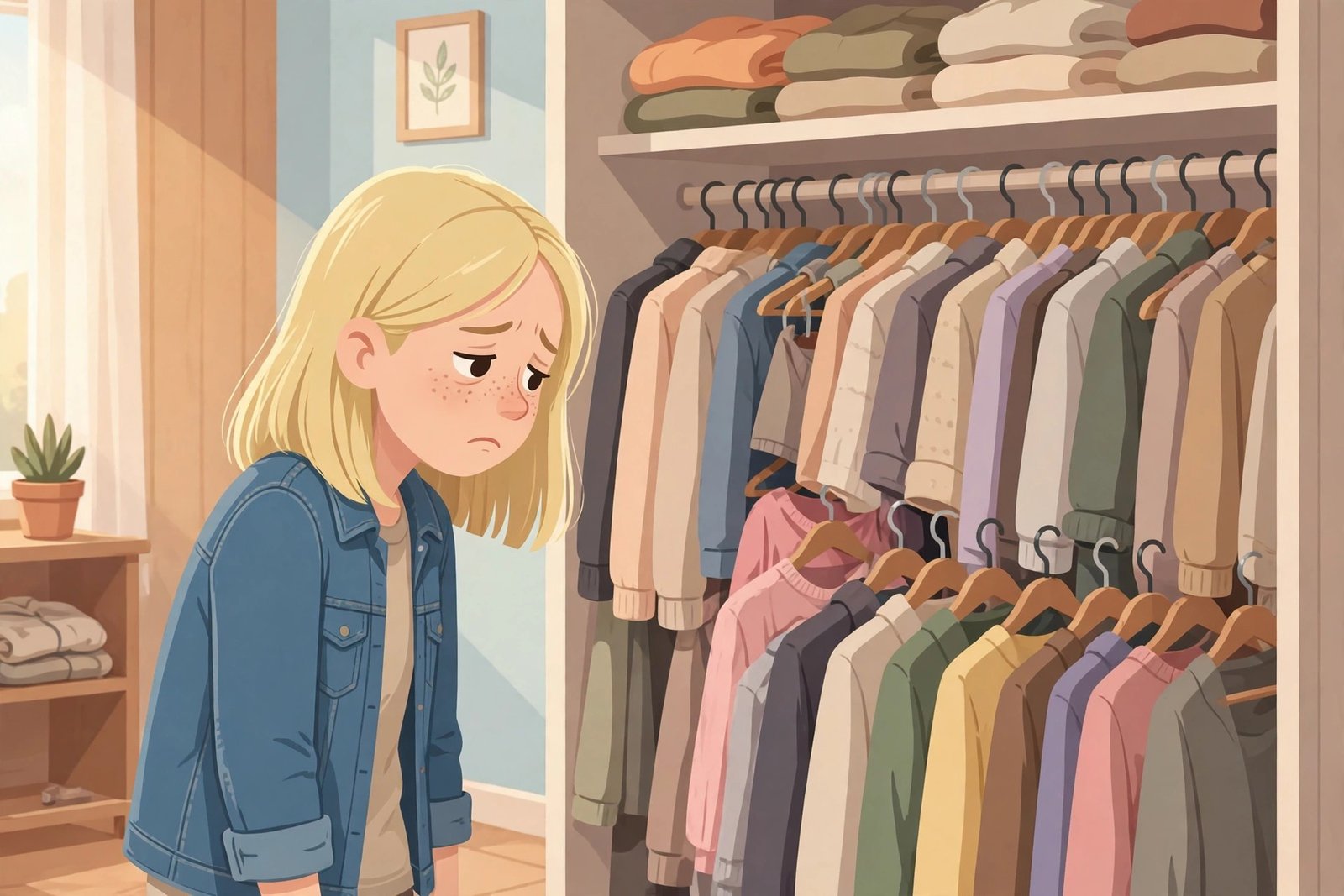
The price tag is the smallest cost of an unworn piece. The real costs are quieter, and they charge you a little every day. Once you see them clearly, the loop loses some of its shine, and your future self gets a voice in the store.
Cost one is guilt. Every morning, getting dressed, your eyes pass the tags. And every morning, some small part of you feels scolded by your own closet. That’s a rough way to start a day. The pieces were meant to make you feel good. Instead they stand there like tiny unpaid bills of the heart. Girls who stop buying clothes I never wear often say the first reward isn’t money. It’s silence in the morning. No tags, no scolding, just clothes.
Cost two is choice fog. A closet stuffed with maybes makes the real favorites harder to find. You stand there longer. You feel like you have nothing to wear while owning plenty. That’s not a clothes problem. That’s a crowding problem. A calmer, clearer closet is one more reason girls want to stop buying clothes I never wear: they want their mornings back. The unworn pieces aren’t neutral. They are noise, and noise makes the good stuff harder to hear.
Cost three is the money itself, frozen. Add it up and it’s rarely small. It’s a concert ticket, a course, a gift for someone you love, or the start of real savings. Money spent on fantasy outfits can’t do any of that. And here’s the honest flip side: the money already spent is gone, and no amount of guilt brings it back. The point of counting it once is to protect the money you haven’t spent yet. That’s the money that can still change. Protecting future money is the whole game when you want to stop buying clothes I never wear, because the past pile has already taught its lesson.
Cost four is trust in yourself. Every broken promise of “this time I’ll wear it” makes the next promise feel hollow. You start to feel like someone who can’t be trusted with her own wallet. That feeling is heavy, and it isn’t even true. You were never the problem. The loop was. Naming the costs puts the blame back where it belongs: on a habit design, not on your character.
A Waiting Rule That Kills the Impulse

Here is the single most powerful tool in this whole guide: the wait. Not a ban. Not a promise carved in stone. A simple rule that says: nothing gets bought the day I first want it. Wanting is free. Wanting can last as long as it likes. Buying has to wait its turn.
Make it concrete. When a piece calls your name, screenshot it or add it to a wishlist note with the date and the price. Then close the app. The rule is 30 days for bigger buys, 72 hours for small ones. If you still want it when the time is up, and it fits your budget and your real life, you may buy it with a clear head. Most of the time, you won’t. The fantasy fades in about three days. What’s left after the wait is the truth about the piece.
Why does waiting work so well? Because the rush has a short life. The reward hit is built for minutes, not weeks. A wait doesn’t fight the rush. It just outlives it. Girls are often shocked by their wishlist after a month: half the pieces look strange to them, like they were chosen by someone else. In a way, they were. They were chosen by a feeling, and the feeling has moved out. When girls say they finally managed to stop buying clothes I never wear, this simple wait is almost always the tool they name first.
Keep the wishlist somewhere you can see it grow old. Watching items expire, unwanted, is deeply satisfying. It’s proof, in your own handwriting, that wanting and needing are different animals. Every expired item is money still in your pocket and space still in your closet. This is the daily practice that helps most girls stop buying clothes I never wear: not one big heroic no, but a hundred small, boring, victorious waits.
Add one partner rule: the real life test. Before the wait even starts, describe where the piece would go in the next two weeks. Name the day, the place, the shoes. If you can’t, the piece is a fantasy outfit, and fantasy outfits don’t get a wishlist spot. They get a screenshot in a folder called “pretty, not mine.” Looking is allowed. Admiring is allowed. Your wallet just stays out of the admiration business.
Make Your Closet the Shop You Visit First

The urge to buy often starts with a sentence: “I have nothing to wear.” Most of the time, that sentence is a lie your mood tells. What you usually mean is: “I have nothing new to feel.” New is the craving. And new can be made at home, for free, from pieces you already own and already fit.
Try this on a slow afternoon. Pick one favorite piece, something pile one, well loved. Now build three outfits around it that you’ve never worn together. Add the jacket you always save for other tops. Swap the shoes. Borrow a belt from a dress. Take photos of each outfit on your bed or on you. You’ve just “shopped” three new looks without spending a cent, and your brain got its favorite thing: novelty. This is why girls who shop their closets stop buying clothes I never wear so much faster. The craving gets fed at home.
Writers who cover slow fashion often point to challenges like the no buy trend explained for the same reason: a break from buying shows you how much life your closet already holds. You don’t need the full trend. Borrow its best tool, which is attention. A closet you pay attention to feels bigger every week.
Make getting dressed a small daily pleasure again. Keep only pile one and two in reach. Put outfits together the night before, when you’re calm, instead of in the morning rush. Hang a tiny list inside the closet door: combos you loved and forgot. Rotate your favorites through different partners so nothing feels stale. And when a piece hasn’t been worn in a year, let it go without drama. Space is a feature, not a failure.
One more trick: the wear count game. In your notes, give each favorite a tally mark every time you wear it. Watching a cheap top earn tally thirty while a costly one sits at zero teaches your eye what value really means. Cost per wear, not cost per tag. Future you will shop with that eye, automatically. If you want a wardrobe that works like that on a small budget, our guide to building a capsule wardrobe on a budget pairs well with everything in this section.
Gentle Rules That Hold for the Long Run
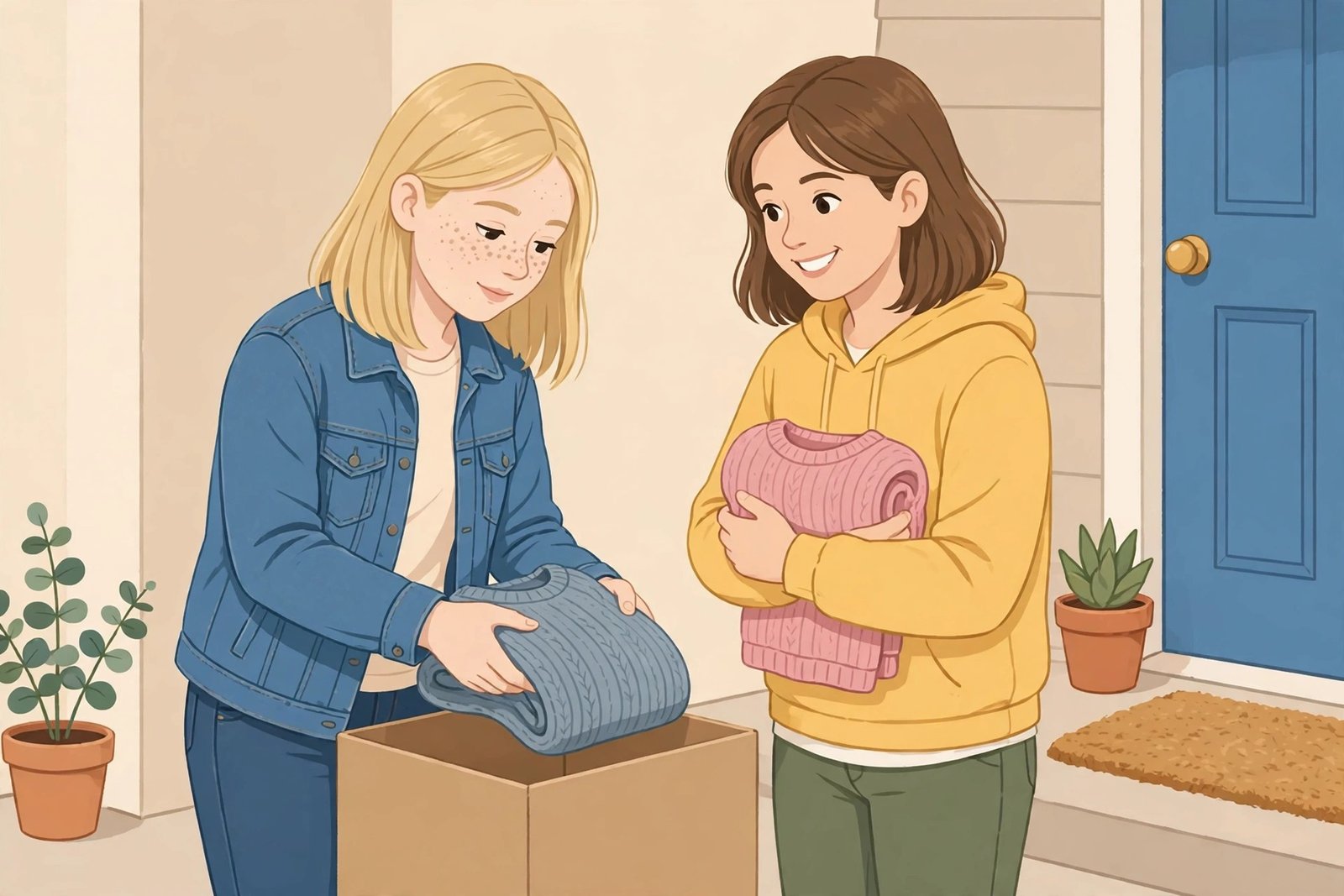
Rules fail when they’re cruel. “Never buy anything again” lasts nine days and ends in a binge. The rules that hold are gentle, clear, and built for a real girl with real moods. Here are the ones that last, tested by many closets before yours.
Rule one: one in, one out. A new piece may enter only when an old one leaves, sold, swapped, or donated. This keeps your closet at a size your brain can actually see. Rule two: a monthly fun budget, small and guilt free. Inside the budget, buying is allowed and even enjoyed. Outside it, the wishlist and the wait take over. A budget turns you from a girl fighting herself into a girl managing herself, which is a much calmer job. Small systems like these are how real girls stop buying clothes I never wear without turning shopping into a daily war with themselves.
Rule three: cut the cues. Unsubscribe from sale emails. Unfollow the accounts that make your chest tight with wanting. Remove saved card details so buying takes one extra minute of friction. You are not weak for needing this. Stores remove friction on purpose; you are allowed to add some back. Every cue you cut is a battle you never have to fight.
Rule four: plan for the slip. You will slip. Everyone does. A slip is one piece, bought fast, on a bad day. It is not the end of the world and it is not proof that you failed. Learn its lesson, wear it or return it, and go back to the system the same day. The girls who stop buying clothes I never wear for good aren’t girls who never slip. They’re girls who restart fast. If buying ever starts to feel truly out of control, with debt or hiding purchases, that’s a sign to talk to someone you trust or a counselor.
Writers at Psychology Today explain how online shopping can slide into compulsive buying, and knowing the far end of the road helps you stay far from it.
And rule five, the kind one: celebrate the closet you have. Take photos of outfits you love on you. Keep them in an album called “it works.” On flat days, scroll that album instead of a shop. Your own style, on your own body, in your own life: that’s the only feed that tells the truth. The day shopping stops being your hobby and becomes just a tool, quiet and rare, is the day you know the loop is broken.
Frequently Asked Questions
Is it normal to have clothes with the tags still on?
Yes, very normal. Most closets hold a few pieces bought for a fantasy day that never came. A sale, a mood, or a hopeful moment did the buying, not the real you. The tags don’t make you wasteful or silly. They make you human, and they make a great map of your triggers once you read them kindly. And once you know that, the tags lose most of their power to shame you.
How long should I wait before buying something I want?
Give small pieces 72 hours and bigger ones a full 30 days on a dated wishlist. The rush behind wanting fades fast, usually within three days. If you still want the piece after the wait, and it fits your budget and your real plans, buy it calmly. If the wanting died, let the item expire and enjoy the proof. Waiting is the quiet habit that helps you stop buying clothes I never wear, one calm urge at a time.
What should I do with the unworn clothes I already have?
Sort them once, honestly. Sell the pieces with value, swap favorites with friends, and donate the rest. Keeping them as a guilt display doesn’t teach anything new after the first honest look. Letting them go frees space, and some money, and it turns an old mistake into room for the clothes you truly wear and love. Every piece that finds a new home also reminds you why you chose to stop buying clothes I never wear in the first place.
How do I stop feeling guilty every time I open my closet?
Start by changing what the closet says to you. Remove the tags on pieces you keep, or let the unworn ones leave, so mornings stop starting with scolding. Then fill the front row with outfits that work. Guilt fades when the evidence changes. A closet full of worn, loved pieces quietly proves you’re learning, every single day. Small proof like that beats big promises, every single time.
What if I slip and buy something fast again?
Then you’re a normal person in the middle of changing a habit, nothing worse. Wear it, return it, or learn from it, and restart the system the same day. One fast buy doesn’t erase months of progress. The girls who finally stop buying clothes I never wear aren’t perfect shoppers. They’re fast restarters with a kind system and a short memory for slips.