

Sofia’s standing in the schoolyard with her snack in her hand, but she’s not eating it. She’s just watching her best friend, and she’s so confused.
Alone, her friend’s sweet and silly, she saves Sofia a seat, and she asks about her day and really listens.
But in a big group? It’s like a switch flips, and she’s loud now, talks over everyone, and shows off like Sofia’s barely there.
Sound familiar? You’re not making it up. And you’re not the only one. Lots of girls stand there and think, wait, what just happened?
It hurts, of course it does, because you trust this person, and then other people show up and she changes. So you start asking why do my friends act differently in a group. And you wonder if the kind version was even real.
This guide won’t jump to the worst answer. We’ll look at it together, step by step. You’ll see how group energy works. You’ll spot when a friend’s just trying to impress someone. And you’ll learn the big one. There’s a huge gap between a friend who gets loud and a friend who gets mean.
The Short Answer

Here’s the short answer: groups change people, and almost everyone acts a bit different in a group. Even kind friends do, even loyal friends do, and even you do, if you’re honest.
Your friend might be calm and soft and real with you alone, but then a crowd shows up and she gets loud, or silly, or quiet, or she puts her guard up.
That doesn’t mean she’s fake, so please don’t jump there yet. It often just means she’s nervous, or hyped up, or trying to work out where she fits.
Once you get that, why do my friends act differently in a group gets easier to answer. The place changes the vibe. And the vibe changes how people act. It’s true for almost all of us.
Think about you for a sec. Be real. Don’t judge yourself. You don’t talk the same way with one close friend as you do at a packed lunch table. Right? You’re not the same in class either. Or at a big family dinner. You’re still you. You just shift a bit.
And a group isn’t just a bigger hangout. It’s a whole new thing. It has its own energy. It has rules no one says out loud. And it often has an audience. So when you ask why do my friends act differently in a group, part of the answer is the group itself. It’s pulling on everyone in it. Not just her. You too.
But let’s be clear. You don’t have to put up with stuff that hurts. There’s a big gap here. One friend gets a bit showy in a crowd. That’s one thing. Another friend mocks you in front of people. She leaves you out to look cool. That’s not the same thing at all. You can take that seriously. Even if it only happens when others are watching.
If you’re asking why do my friends act differently in a group, you’re already doing the hard part. You’re looking at the full picture. You’re not judging one bad lunch. That will help you. It’ll protect your friendships. And it’ll protect your self respect too.
Understand That Groups Change People’s Energy

Picture Sofia later that week. She’s on a bench with her friend. It’s just the two of them. No one else is around. Talking feels easy. They laugh at dumb stuff. They finish each other’s snacks. It’s calm.
Now picture them an hour later. Same girls. Same day. But now they’re in a loud group by the lockers. Her friend’s bouncing. She’s cutting in. She’s telling a story at double speed. Her voice is way up.
Did their friendship change in one hour? No. The place changed. And that’s why do my friends act differently in a group so often comes down to energy. Not character. Energy.
Groups are a lot, and there’s so much going on, with more voices, more faces, and more jokes flying past. You have to keep up and read every reaction, and one wrong word can make you feel silly while one quiet moment can make you feel left out.
That buzz does things to people, so a lively girl gets even more lively and a shy girl gets more shy, and it can flip in five minutes. Energy spreads really fast, and not everyone knows how to stay calm inside it.
There’s also this quiet pressure. You feel it, even if no one says it. You have to match the group. If everyone’s loud and jokey, a calm comment can flop. It just lands flat. So your friend speeds up. She plays along. She gets bigger.
Or flip it. If everyone’s acting cool and bored, she might hide how much she cares. She loves that song? She won’t say it. She’s upset about a grade? She’ll shrug. She wasn’t lying with you before. She’s just reading the room. She’s trying, in a clumsy way, to belong.
Watch the pattern over time. That’s what matters. Not one loud day. Does she come back to herself when the crowd leaves? Then the group probably just turned her volume up. That’s it.
But if you keep coming back to why do my friends act differently in a group, with the same friend, again and again, pay attention. That pattern means something. We’ll dig into it next.
Notice Who Your Friend Is Trying to Impress

Sofia started watching closer. And she spotted something she’d missed. Her friend’s show off moments weren’t random. Not at all. They had a pattern.
They happened when one girl was near. You know the type. She’s popular. Her laugh decides if a joke was funny. If she laughs, everyone laughs. If she doesn’t, the joke dies.
Her friend kept looking over at her. She told her stories a bit bigger. She laughed a bit too loud. It wasn’t hard to see once Sofia looked.
So here’s a big clue for you. When you wonder why do my friends act differently in a group, look at who’s in the group. The answer might be right there. Standing two feet away.
Your friend might want to impress an older girl. Or a crush. Or a team captain. Or just the girl everyone seems to follow. She wants to be picked. She wants to be liked. She wants in.
Look for small signs. Don’t guess big, wild motives. Does her voice change when that person walks up? Does she talk about plans she never tells you about? Does she brag about clothes or grades out of nowhere? Does she fix her hair a lot? Does she check her phone and smile too much?
Don’t turn it into a fight. Not yet, anyway. Calling her out in front of people won’t help. It’ll just make her defensive. Keep what you see for yourself at first.
Still, there’s a line. And it matters a lot. Trying to impress someone can explain a big laugh. It can explain a tall story. It can’t explain putting you down to get a laugh. It can’t explain sharing your private stuff for fun. And it can’t explain dropping you the second someone cooler shows up.
If impressing people keeps costing you, it’s not just nerves anymore. It’s about respect. That’s when why do my friends act differently in a group stops being a puzzle. It becomes a real question about how she treats you.
If it’s mild, give it a bit of time. Don’t decide on day one. Sofia did that. A few weeks later, her friend calmed down a lot. She didn’t feel like an outsider anymore. She didn’t have to earn her spot each day. So she stopped trying so hard. Sometimes that’s all it is.
See If She Becomes Meaner or Just Louder

This is the part Sofia needed most. Because not all change is the same. Not even close.
Some friends just get louder, and that’s it. They talk more, wave their hands more, and fight for space to speak, but they’re still kind and their kindness doesn’t move.
Other friends cross a line, their jokes get sharp and their teasing gets personal, and you walk away feeling small. You replay it on the walk home and you replay it in bed, and that’s different.
Learning to split those two is key. It’s right at the heart of why do my friends act differently in a group.
Louder looks like this. She tells the same story three times. The group keeps cutting her off, so she starts again. She laughs at her own jokes. She talks over the music in the cafeteria. She forgets to ask about your day. It’s a bit much. You might feel unseen. But she’s not aiming at you. She’s just buzzing.
Meaner looks different, and your body knows it first, so your stomach drops and your face gets hot. She teases you about stuff she knows bugs you. She repeats a private thing because it gets a big reaction. She leaves you out of the photo. Or the plan. Or the inside joke. Then she watches to see if you noticed. Ouch.
Sofia had a moment like that. It stuck with her for days. Her friend joked about her handwriting in front of everyone. In private, she’d only ever said it in a kind way. In the group, she made it a punchline. Everyone laughed. Sofia laughed too, but it felt fake and thin.
If a moment sticks with you, don’t brush it off. Don’t say it’s fine when it’s not. Everyone else laughed, sure. That doesn’t make it okay. Your discomfort is real info. It counts just as much as their laughter.
Try this test. Say something small and calm about it later. See what she does. A kind friend who got carried away will say sorry. She might feel awkward. She might get defensive for a sec. But she’ll care. She’ll try to fix it.
A friend who likes your discomfort will act different. She’ll laugh it off. She’ll call you too sensitive. Or she’ll do it again the next day, even bigger. That’s not an accident anymore. That’s a choice.
So keep asking one simple question. Meaner, or just louder? That answer tells you your next step. Way more than volume does.
Louder friends need patience. And maybe one honest chat. Meaner moments need clear limits. And sometimes they need space. That’s also why do my friends act differently in a group is such a good question to sit with. It makes you look at the kind of change. Not just the fact that she changed.
Think about the walk between classes too. Is she fine when it’s just you two in the hall? Then cold when her other friends join? That quick switch can sting the most. It’s fast. It’s right in front of you. Note it. Don’t explode over it. But don’t pretend you didn’t see it either.
Remember That Quiet Friends Can Disappear in Groups

Not every friend gets bigger in a group. Some get smaller, way smaller, and they’re easy to miss because everyone’s watching the loud ones.
Sofia learned this at lunch. She looked across a big table one day. And she saw Yuki. Yuki’s funny one to one. She’s deep. She notices everything. But she hadn’t said one word in twenty minutes. Not one.
Yuki wasn’t mad. She wasn’t bored. The chat was just too fast. People talked over each other. Jokes stacked on jokes. She couldn’t find a gap to jump in. So she just went quiet and ate her fries.
Quiet friends fade for normal reasons. They need a beat to think before they speak. But the group rewards whoever talks first. And fastest. They hate cutting in. They worry their idea isn’t good enough. Noise drains them. Too many voices at once drains them.
This is a softer way to see why do my friends act differently in a group. Because the quiet friend changes too. She just changes the other way. The group isn’t showing she’s boring. It’s not showing she’s distant. It’s showing that big, fast talk doesn’t fit how she talks. The setting is doing a lot here. Once you see that, you get your whole circle better.
You can help. In small ways. Real ways. Make space in the circle. Don’t let it close around the loudest people. Save her a seat at the table. Pass her the snack. Ask her a direct question. Make it easy, not scary.
Try things like, what did you think of that test? Or, have you seen that show yet? Pick up something she said before and bring it back. Like, wait, Yuki said something good before. Sofia started doing this. The look Yuki gave her said it all. She felt seen.
But don’t make it a big rescue. That can backfire fast. Don’t shout, hey, you’ve been so quiet! That’ll make her want to vanish. She’ll stare at her phone. She’ll wish the floor would open. Gentle invites work better. Let her choose how much she wants to join in.
And if you’re the quiet one, listen up. Your needs count too. Fully. You deserve friends who notice when you go silent. Friends who make room without making a scene. You don’t have to get loud to be worth hearing.
Check In With Your Friend One-to-One Afterwards

A group hangout left you confused? Here’s your best move. It’s not a big move. It’s a quiet one. Wait till you’re alone with her. Pick a calm spot. Then check in with her, one to one.
Lots of girls who ask why do my friends act differently in a group find this one chat helps more than weeks of guessing. Guessing fills your head with worst cases. Talking gives you real answers.
Keep it small, kind, and clear, and pick one moment, just one. Don’t bring a list of everything she’s ever done, because that’ll overwhelm her and she’ll shut down before you get anywhere.
You could say you felt left out at lunch yesterday. Or that her joke landed harder than she meant it to. Use words like, I felt. Not, you always. I felt tells her your side. You always sounds like an attack. Most people can hear a feeling. Almost no one stays open when they feel attacked.
Try it like this. Hey, can I say something small? At lunch I felt a bit invisible. I don’t think you meant it. I just wanted you to know. That’s it. Short. Honest. No drama.
Then listen. Really listen. Even if her answer shocks you. She might say she was nervous around the new girls. She might say she had no clue it bugged you. She might say she felt you pulling away, so she panicked and got loud.
Watch what the one to one version does with your honesty. That’s pure gold. Does she care you were hurt? Even if she saw it in a different way? Does she try to do better next time? And can you actually see her try?
That’s a friend who values you. Sofia had this talk on the school steps. The group had left. They shared a snack. And Sofia felt relief wash over her. Her friend was right there. Listening with her whole face. The girl she knew hadn’t gone anywhere.
Of course, a check in doesn’t always go well. Be ready for that too. She might mock you for saying it. She might tell the group what you said in private. She might do the same thing again the next day, on purpose, and look proud of it.
Believe that info. You did the brave thing. You spoke calmly. You spoke in private. You were fair. Her reply shows you what you need to know. It tells you if why do my friends act differently in a group has a kind reason for her. Or if the group version is showing you something you need to guard against.
Make check ins a habit. Not just a rescue plan. Little honest chats after hangouts stop small confusion from turning hard. They stop it turning into resentment. A friendship that can handle a soft, hey, that felt weird for me, is a strong one. It’ll hold up in any size group.
Decide Which Version of Her You Can Count On
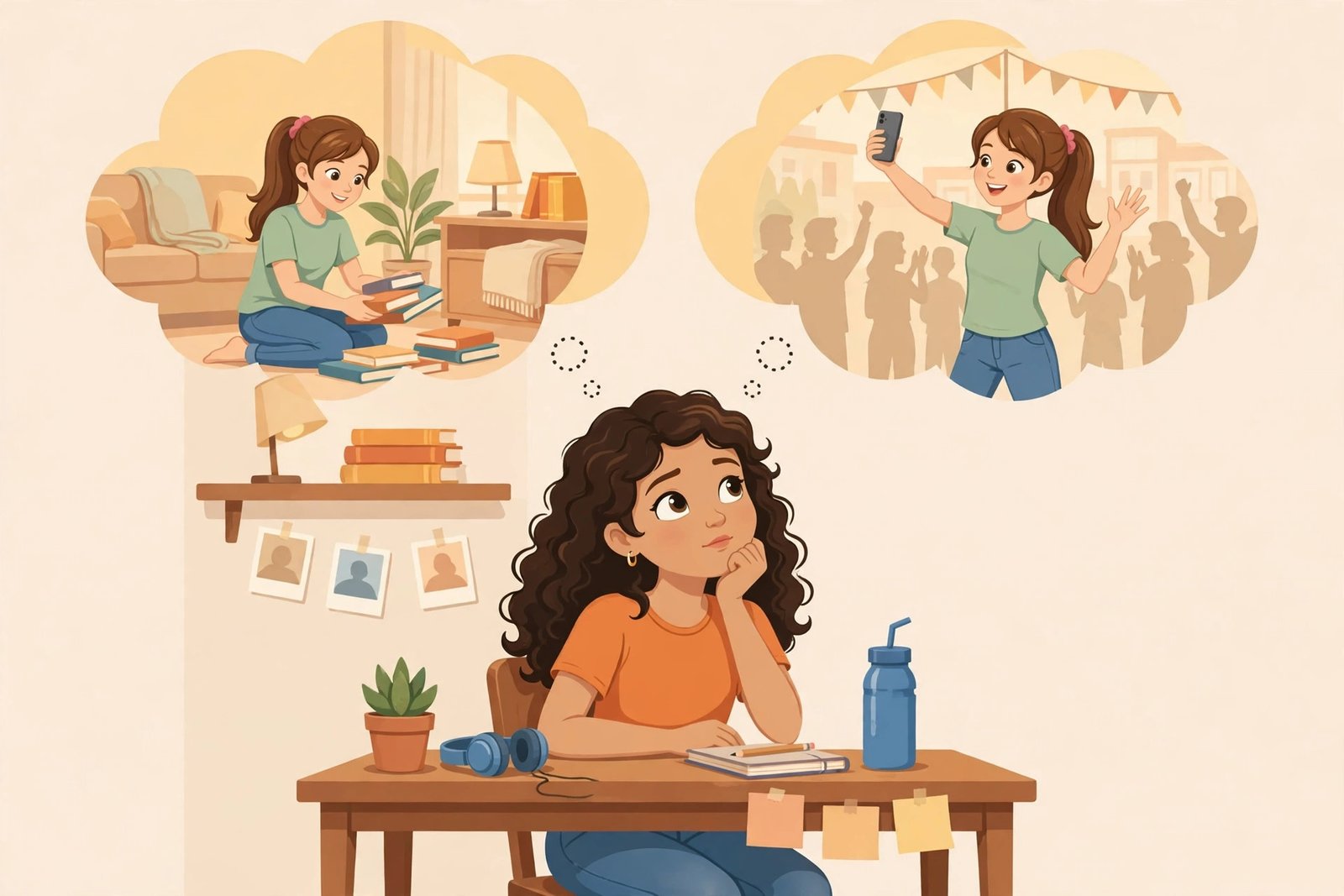
At some point, watching has to turn into a choice, and that’s not cold, it’s self respect. You’re allowed to think about what you need.
Sofia sat at her desk one night. Her homework was open. She wasn’t doing it. She was thinking about her friend. She pictured both versions, honestly. In private, her friend was kind. She was funny. She was loyal. In a group, she could be showy. She could be careless. But she was learning. She said sorry when she messed up. She tried to do better.
When you ask why do my friends act differently in a group, this is where it leads. It doesn’t lead to a label like good or bad. It leads to a real life call about your own life.
Which version shows up most? Which version shows up when it counts? When you’re sad. When you’re in trouble. When you tell her something private and it has to stay private. That’s what matters most.
A friend can be dazzling in a group but vanish when things get hard. That’s telling you something. A friend can be awkward in crowds but solid everywhere else. That’s telling you something too. Often it’s the better something.
Look at patterns, not highlights. One sweet afternoon doesn’t cancel months of mocking in front of people. It just doesn’t. And one bad group moment doesn’t erase a long run of loyalty. Not if she owned it and changed. Patterns are less dramatic than single scenes. But they’re way more honest.
You also get to pick her role. It’s not just keep her or drop her. Some friends are great small hangout friends. Two or three people, a movie, some popcorn. Perfect. But they’re stressful in a big group. So you mostly pick the small stuff with them. That can work beautifully.
If the group version keeps hurting you, and talks change nothing, stepping back is a fair choice. You can do it calmly. Quiet distance isn’t revenge. It isn’t leaving someone out to be cruel. It’s you trusting what you’ve lived through. That’s part of growing up, even when it stings.
Whatever you pick, pick it from the whole person over time. That’s the heart of why do my friends act differently in a group as a question. It won’t let you excuse everything. And it won’t let you condemn everything either. She’s a whole person. She has pressures. She has a pattern. And you’re a whole person too. You have a right to friendships where you feel safe, seen, and respected. In private. And in front of everyone.
Choose Hangouts That Bring Out the Best in Everyone

Now for the hopeful part, and it’s stronger than it sounds. You can’t control every group, no one can, but you can shape a lot of your social life and pick settings where you and your friends do your best.
Sofia tried it. She had small game afternoons at home. Three friends. Warm light. Snacks on the table. Cards in their hands. And guess what? The change was almost funny. Her showy friend relaxed. Her quiet friend talked. A lot. Same girls. Different room. Different vibe.
Setting changes pressure. And pressure changes people. A hangout with something to do works wonders. Bake cookies. Go skating. Study together at the library. Play a board game. People have a task. They don’t have to perform the whole time. Their hands are busy. Their brains are busy. The show just fades.
When girls ask why do my friends act differently in a group, they often find this out. A different kind of group makes different friends. That’s genuinely good news. This guide to handling cliques from KidsHealth says much the same thing. It talks about picking circles and plans that fit what you value.
You’re allowed to suggest the plan. Yes, you. Don’t just drift into the same crowd and hope it feels better. Invite two or three friends to do one clear, low pressure thing. A walk and hot chocolate. A craft afternoon. Homework and pizza at your place.
If Sofia’s story feels close to yours, you’ll get a lot from this piece on feeling lonely even when you’ve got friends. And have a look at this honest take on when your best friend acts different around her other friends. Lots of girls have felt exactly what you’re feeling. You’re not alone in it.
Keep it kind as you do this. Smaller shouldn’t mean crueler. There’s a gap here too. A cozy plan with three close friends is normal. It’s healthy. Making a plan just to freeze someone out is not. That’s the exact thing this whole guide pushes against.
The trick is balance. Put your closest talks in safe settings. Put your soft, private moments where they’ll be looked after. And enjoy the crowd for what it’s good at. Noise. Games. New faces. Silly energy.
In the end, it’s about building a friendship life that fits real people. That includes you. Your friends will still shift a bit with the setting. Everyone does. That’s the hopeful answer inside why do my friends act differently in a group. Change the room. And very often, you change what the room brings out in the people you love.
Frequently Asked Questions
Is it normal for a friend to act like a different person in a group?
Yes, it’s super normal. It happens to kind girls. It happens to loyal girls too. Groups add noise and pressure. They add an audience. So lots of girls get louder or quieter than they are one to one. Normal doesn’t mean every act is okay, though. If she’s often mean to you in a group, that’s a pattern. Talk about it calmly. And add some space if nothing changes. You’re not alone in wondering why do my friends act differently in a group.
Does acting differently in a group mean my friend is fake?
No, not usually. Most times she’s just reading the room. She’s nervous. She’s trying to belong. That’s human, not fake. It’s a huge part of why do my friends act differently in a group for so many girls. Watch her pattern over time. Don’t judge her from one lunch. If she’s warm and honest in private, she’s rarely fake. She’s just a bit wobbly in crowds. Crowds are hard for lots of us.
Should I tell my friend that she changes in a group?
Yes, tell her if it bugs you. Do it one to one. Pick a calm time. Name one thing that happened. Say how it felt. Don’t call her a bad person. Lots of friends don’t even know they seem different in a crowd. Her reply will teach you a lot. A caring friend listens. She adjusts. A friend who mocks your honesty is telling you something big too. Listen to that as well.
What if I am the one who acts differently in a group?
Then you’re in good company. Almost everyone does it in some way. Look at your own pattern. Do you get louder? Quieter? Do you agree with stuff you don’t believe? Do you tease more when people watch? Once you see it, pick one small change. Check on the quiet girl. Skip the joke at someone’s cost. Girls who ask why do my friends act differently in a group often grow most when they include themselves in it.
When should I step back from a friend who changes in groups?
Step back when the pattern is clear and it keeps costing you. She mocks you for a laugh. She shares your private stuff. She leaves you out to look popular. And calm talks change nothing. Then distance is fair and healthy. You don’t need a big fight. You don’t need an announcement. Just put more time and trust into friends where you feel safe. In private and in front of everyone too.
If you keep wondering why do my friends act differently in a group, remember the pattern, not one loud day. The question why do my friends act differently in a group is worth asking again, calmly, because it helps you tell a loud friend from a mean moment.
When you ask why do my friends act differently in a group with a kind, one to one chat, you give the friendship a fair chance to get better. That is why do my friends act differently in a group stays such a useful question: it points you back to what you can see, what you can say, and what you can choose next.