

At home, you eat without thinking. You talk with your mouth half full, you go back for seconds, you laugh at the table. Then you sit down in the school cafeteria, or at a party, or across from certain people, and suddenly every bite feels like a performance. Your hands feel clumsy. You chew like the whole room can hear it. And you ask yourself: why do I feel embarrassed eating in front of people?
You’re far from the only one. Cafeteria awkwardness is one of the most common quiet struggles of the teen years, and girls rarely say it out loud, which is exactly why everyone thinks she’s the only one. She isn’t. Look around any lunchroom and you’ll find girls taking tiny careful bites, hiding behind their hair, waiting for the bell.
Let’s be clear about what this feeling is, because it matters. This is social embarrassment: the feeling of being watched and judged in a normal moment. It’s the same family of feelings as blushing when a teacher calls on you. It’s about eyes on you, not about food itself.
This guide walks through why certain people make it stronger, what everyone else is actually paying attention to (spoiler: not you), small tricks that make a table feel safer, and the one case where the feeling deserves an adult’s help. So if why do I feel embarrassed eating in front of people is your question, settle in. There’s nothing odd about you. There’s just a spotlight in your head, and spotlights can be turned down.
Almost every girl has a table where she relaxes and a table where she performs, and most girls have never said that sentence out loud to anyone. If nobody has ever told you this is common, let this be the moment you hear it: your cafeteria feelings put you in a huge, quiet club. The club has no meetings, because everyone in it is busy pretending not to be a member.
The Short Answer

Yes, this feeling is common, and it has a simple root. Eating is something you normally do without an audience in your head. With certain people, your brain suddenly imagines an audience, and every normal movement, chewing, swallowing, reaching for your drink, feels loud and visible. That imagined audience is the whole problem.
In real life, people at a table are busy with their own food, their own phones, and their own worries. Nobody is scoring your bites. Your brain just plays the scene on a bigger screen than it deserves.
The feeling also changes with practice and with the right people. Girls who once dreaded the cafeteria eat happily with their close friends by spring, because the table became familiar. Familiar tables feel safe. Safe tables make the spotlight fade.
So why do I feel embarrassed eating in front of people? Because your brain treats eating, a private feeling act, like a public show when certain watchers are near. It’s a shy moment, not a flaw. And like most shy moments, it softens with time, tricks, and the right company. The rest of this guide shows you how.
And if why do I feel embarrassed eating in front of people is the exact sentence in your head, you are in the right place, because it is the sentence this whole guide answers.
Lunch Is Never Just Lunch at School
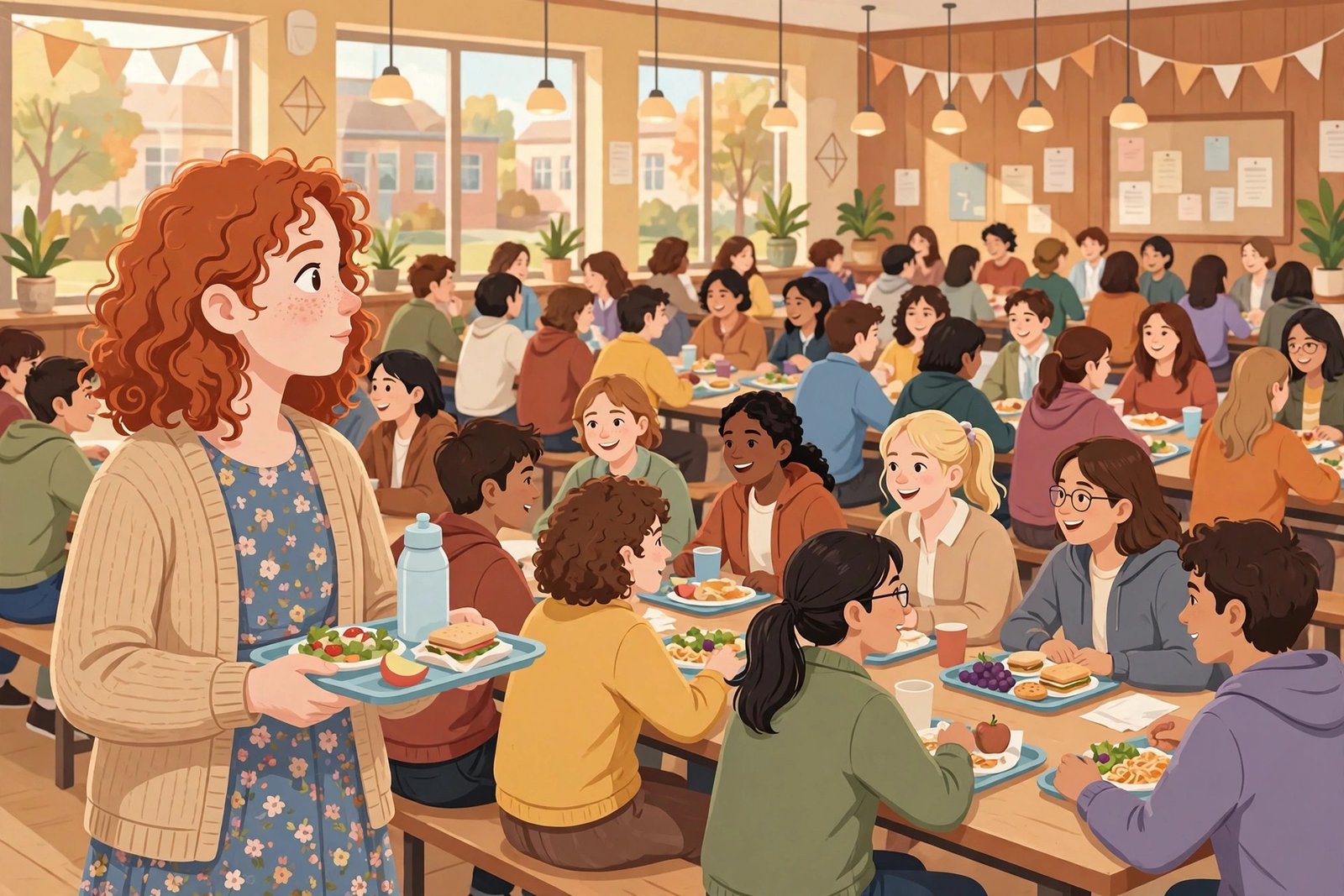
To understand this feeling, you have to understand the cafeteria. The school lunchroom is one of the most socially loaded rooms in a teen’s life. Where you sit says something. Who you sit with says something. Everyone is watching everyone sort themselves into groups, all while pretending not to watch. Eating happens in the middle of that theater.
At home, the table has no theater. Your family has seen you eat a thousand times. There’s nothing to perform. At school, especially in the first weeks of a school year or after changing schools, every table feels new, and new tables come with new eyes.
Add the noise, the rushing, the trays, the short lunch break, and you get a room designed to make a shy eater tense. Even confident girls have cafeteria moments. The girl who performs on stage at the school play may still take mouse bites at lunch when she sits near older students.
There’s also the simple fact that eating is a bit unguarded. You can’t look polished while eating a sandwich. Hands get messy. Crumbs exist. For girls who work hard to feel put together, a moment where nobody can look perfectly composed can feel exposing, even though every single person at the table is in the same boat.
So the lunchroom version of this question has a clear shape. Why do I feel embarrassed eating in front of people at school? Because school lunch mixes food with audience, ranking, and rush. It’s a lot to ask of one meal. Outside school, at a calm table with your people, the same girl eats like she does at home. The setting changed. She didn’t.
The timetable adds its own pressure. Lunch is short, so there is no time to warm up. You sit, the clock starts, and the meal has to happen in front of everyone right away, ready or not. At a family party, you can drift in slowly, snack standing up, find your corner. The cafeteria allows no drift. It is audience first, food second, from the very first minute of the very first day.
No wonder why do I feel embarrassed eating in front of people gets asked about school lunch more than any other meal of the day.
Why Being Watched Makes Every Bite Feel Huge

Here’s the engine under the whole feeling: self consciousness. When you feel watched, your brain zooms in on you. A normal bite becomes a close up. You hear your own chewing like it’s through speakers. You notice your jaw, your hands, the crumb you can feel but can’t find. The zoom is lying to you, but it feels like truth.
Psychologists have a name for a cousin of this: the spotlight effect, the way we overestimate how much people notice us. We walk around feeling like there’s a light on us, while everyone else walks around feeling the same light on themselves. Two spotlights, both imaginary, both pointed at people who are mostly thinking about their own lunch.
This zoom is the same one behind the feeling in the guide about why am I sometimes embarrassed by my own body. Different scene, same engine: the belief that all eyes are on you, studying you. In the locker room it’s your changing body. At the table it’s your eating. Naming the engine helps, because a feeling with a name feels less like a verdict.
Your body adds small effects that make the zoom worse. When you’re tense, you swallow less smoothly, your hands feel awkward, and you spill more, which “proves” the fear. It’s a loop: fear of being watched makes you clumsy, clumsiness makes you more scared of being watched. Loops like this are common, and they can be broken from the outside, with tricks we’ll get to.
For now, keep hold of the core answer. Why do I feel embarrassed eating in front of people? Because feeling watched turns the volume up on a normal act until it seems like a show. The volume knob is in your head. The audience, mostly, isn’t even looking.
Try a tiny experiment the next time you are at a loud table. When you catch yourself mid worry, look at one person’s hands or plate and ask: could I pass a quiz on how they are eating? You will find you know almost nothing, even about the friend right beside you, the one you like most. That blank in your own attention is the same blank in everyone else’s. The quiz cannot be passed, by anyone, about anyone.
That shared blindness is the kind truth under why do I feel embarrassed eating in front of people: the watchers you fear are barely watching at all.
Why It Is Worse With Certain People

You have probably noticed the feeling has favorites. With your best friends, you eat like family. With certain people, a single bite feels risky. That pattern isn’t random. Your brain ranks watchers by how much their opinion matters to you and how little you can predict them.
Your crush sits at the top of the list, for obvious reasons. You care what he thinks, so his eyes feel heavier. The same goes for his friend group, where you’re a guest and the rules of the table aren’t yours. Older students rank high too. They feel like judges from a future grade, even though most of them are busy worrying about their own image.
New people are another trigger. With friends, you know the script. With new classmates, a new team, or a friend’s older cousins, you don’t know what’s normal at that table, so your brain scans for mistakes nonstop. Being the new one at any table is enough to make a confident eater careful.
People who have teased you before sit in their own category. One comment, even a joking one, about how or what someone eats can echo for months. If a comment like that’s part of your story, your caution makes complete sense. Your brain is protecting you at tables that feel similar.
Even family events can do it: the big holiday table with aunts who comment on everything, where you feel like the youngest and the most watched. Different rooms, same ranking system.
So the “certain people” in your question aren’t a mystery. They’re the people whose judgment you fear most or predict least. And why do I feel embarrassed eating in front of people changes table by table because the watcher ranking changes. That’s actually good news. It means the feeling is about situations, not about you being broken at every table. Situations can be chosen, practiced, and grown out of.
Notice something else about the ranking: it moves. The older students who feel like judges this year will be familiar faces next year, and their tables will lose their power. The new people become known people. Even the crush effect fades as he turns from a symbol into a person who spills juice and laughs too loud at bad jokes. Your watcher ranking is a weather system, not a life sentence, and weather always changes.
So why do I feel embarrassed eating in front of people has a hopeful twist: the people change, the tables change, and the feeling follows them out the door.
What Everyone Else Is Actually Paying Attention To

Time for the most comforting section in this guide: a reality check. What are the people at your table actually noticing during lunch?
Their own food, first of all. Their fries, their sandwich, whether the cafeteria line gave them the good dessert. Then their phones. Then the conversation: who said what in the group chat, what happened in math class, the plan for the weekend. Then their own self consciousness, because here’s the secret: a good share of them are running their own spotlight loop. The girl across from you is wondering if she chews loudly. The boy two seats down is sure everyone saw him spill his drink. You’re a background character in their lunch, exactly as they’re in yours.
Think back and test it. Can you describe how your friend ate yesterday? Her bite size, her chewing, the order she ate things in? Of course not. You were friends at a table, not judges at a contest. Now flip it: she can’t describe your eating either. That blank memory is the real size of the audience.
There’s research flavored common sense behind this, but you don’t need a study. You need one lunch of honest observation. Watch how little watching happens. People glance, they talk, they laugh, they eat. Nobody’s eyes are locked on anyone’s plate. The guide on this site about how to stop feeling insecure about your body makes the same point for a different room: the mirror in your head is harsher than any real pair of eyes.
One more detail: comments about eating feel enormous when aimed at you, but tables forget them in minutes. If someone once said something about your meal, it lives in your head on repeat, while the speaker has forgotten it entirely. Your memory zooms. Their memory deletes.
So when the question why do I feel embarrassed eating in front of people spins at a loud table, answer it with the reality check. The audience is small, distracted, and busy fearing its own spotlight. You’re free to eat like a person, because that’s all anyone else is doing.
There is a flip side worth smiling about. Because nobody is studying your eating, you also get to be a kindness in the room. The girl who eats calmly and chats normally gives every shy eater at the table permission to relax. Tables copy the calmest person more than the coolest one. One day soon, without trying, you may be the reason another girl’s lunch feels safe, and she will never even know it was you.
Calm is catching, which is one more reason why do I feel embarrassed eating in front of people fades fastest at tables where even one person eats in peace.
Small Tricks That Make the Table Feel Safer

You can’t delete the feeling overnight, but you can make tables easier while it fades. These are small, kind tricks, the kind girls pass to each other.
Sit in your safe zone when you can. A seat with your back to the room, or at the edge of a table with a close friend beside you, lowers the imagined audience. Arriving with your people instead of walking in alone with a tray also helps, since the solo walk across the cafeteria is the hardest part for many girls.
Start with foods that feel easy. On days with a scary table, a meal you can eat calmly, without a wrestling match, lowers the stress. This isn’t about hiding. It’s about picking the simple path while you build comfort. Comfort grows from good experiences, so stack the odds in your favor.
Give your hands and eyes jobs. Hold your drink. Talk. Ask someone a question and listen to the answer. Attention is a flashlight: pointed at the conversation, it can’t stay pointed at your chewing. The more real the chat, the quieter the zoom gets.
Breathe out the first minute. The first bites are the worst, because the spotlight feels newest. After five normal minutes, almost every girl notices the tension dropping on its own. Knowing the drop is coming makes the first minute bearable: you just have to surf a small wave, not a whole ocean.
And collect proof. Every lunch you get through is data that the world didn’t end. Your brain updates slowly, but it does update. Why do I feel embarrassed eating in front of people gets asked less often by girls who stack small, safe lunches, with kind people, week after week. That’s the whole method: smaller spotlights, kinder tables, steady reps.
One more trick lives in your habits: the phone break and the bathroom mirror are fine in small doses, but do not build your whole lunch around escapes. Escapes teach your brain the table really was dangerous. Small stays teach it the opposite. Stay for the first ten calm minutes, then, if you need air, take it as a victory lap, not a rescue. Your brain counts what you did, so give it victories to count.
Victory by victory, week by week, why do I feel embarrassed eating in front of people turns from a daily question into an occasional one.
Eating With Your Crush, His Friends, or Older Students

Some tables deserve their own section, because they spike the feeling like nothing else. The crush table. His friends’ table. The table where older students sit and you have been waved over, thrilled and terrified in equal parts.
First, a truth that calms: he invited you, or welcomed you, to eat near him, not to perform eating. Boys at lunch are focused on food and jokes, in that order. The idea that he’s grading your bites would honestly surprise him. Most boys your age couldn’t describe how their best friend eats, and they have eaten together five hundred times.
His friends can feel scarier than him, because a group has more eyes and an unknown sense of humor. Go in with your own anchor: one friend of yours, or one friendly face in his group. Anchors turn a foreign table into a table with one safe corner. From a safe corner, the rest warms up fast.
Older students carry a special glow of intimidation, but here’s their secret: they felt exactly like you two years ago, at someone else’s table. Many of them remember it clearly and are kinder than you expect. The ones worth sitting with will make room, pass things, and pull you into the talk.
If your hands shake a little or you go quiet, forgive yourself in real time. Quiet is fine. Nobody’s lunch was ruined because a girl was shy once. You don’t need to be sparkling. You need to be fed and roughly comfortable, and both are allowed at every table.
Still, know your limits kindly. If one particular table makes you miserable every time, you’re allowed to drift back to your own people. Choosing your table isn’t failure. It’s taste. And the question why do I feel embarrassed eating in front of people will visit less often as you learn which tables feel like yours, and give yourself permission to sit there without guilt.
If you do sit at the big table and it goes well, notice how fast your brain tries to erase it. It will say the day was a fluke, or that they were just being polite. Do not let it. A good lunch at a scary table is real data, and data beats dread. Tell a friend about it, or write one line in your notes app. Girls who record their wins find the scary tables shrinking term by term.
Recorded wins are how girls stop asking why do I feel embarrassed eating in front of people and start simply picking their table and enjoying lunch.
When the Awkward Feeling Deserves an Adult’s Help

Almost everything in this guide is about a normal, shy feeling that fades. This last section is about the edge of it, and it matters, so read it with care.
For most girls, the embarrassment stays small: a hot face, a careful bite, a table they avoid for a month. It shrinks with time and kind tables. That version needs tricks and patience, nothing more.
A different version deserves backup. If eating in front of people starts to mean regularly skipping lunch to dodge the table, dreading every shared meal, or feeling strong distress that follows you all day, that’s your signal to bring in an adult. Not because something is deeply wrong with you, but because feelings that change what you do all day deserve support, the same way a sprained ankle deserves a look.
Tell someone you trust: a parent, a school counselor, a nurse, a favorite teacher. You can say it simply: “Eating around people has started to scare me, and I’m skipping lunch sometimes. I want help with it.” Adults hear versions of this more often than you think, and there are people whose whole job is helping teens with social fears.
If you want to understand the bigger picture first, the KidsHealth guide on social anxiety explains, in calm teen friendly language, how plain shyness can grow into something heavier, and how support and small steps help it shrink again. Reading it doesn’t label you. It just gives the feeling a map, and maps make things less scary.
Most girls reading this will stay in the normal zone, and that’s good news. But a guide wouldn’t be honest if it skipped the edge. So keep the rule: awkward is normal, and we handle it with tricks; skipping meals and strong daily distress are the line where an adult joins your team. And for every girl asking why do I feel embarrassed eating in front of people, the deepest answer is the same: you deserve to eat in peace, at any table, and asking for help to get there is strength, not shame.
And if you do tell an adult, give them a fair chance to surprise you. Girls often imagine the talk will be brushed off, and then watch a parent or counselor take it completely seriously and move fast to help. You will not know how strong your net is until you let it hold a little weight. That is what it is there for, and using it early, while the feeling is still small, is the smartest version of brave.
Brave, in the end, is the last answer to why do I feel embarrassed eating in front of people: tricks for the shy days, support for the heavy ones, and peace at the table as the goal.
Frequently Asked Questions
Why can I eat fine at home but not at school?
Because home has no audience in your head. Your family has seen you eat forever, so your brain doesn’t switch on the spotlight. School adds new people, ranked tables, noise, and rush. When girls ask why do I feel embarrassed eating in front of people, the home versus school gap is usually the first clue that the feeling is about setting, not about them. Change the room and the watchers, and the same girl eats like herself again.
Is it weird to choose foods that feel easy to eat around people?
Not weird at all. It’s a smart comfort trick. Plenty of girls pick calm, simple foods on big table days. You aren’t hiding or being fake. You’re lowering the difficulty while your comfort grows, the same way new runners choose a flat road. Over time, as tables feel safer, the menu in your head opens up on its own. That is also why do I feel embarrassed eating in front of people fades as comfort grows.
What if someone comments on what or how I am eating?
A comment says more about the speaker than about you. Some people tease because they feel awkward themselves, and food is an easy target. You can answer lightly (“Yep, and it’s delicious”), change the subject, or simply not react. If the same person keeps commenting and it starts to hurt, that’s worth telling a friend or an adult. And if you keep replaying the comment for weeks, remember why do I feel embarrassed eating in front of people is often just this: one careless sentence, echoing too long.
Why do I lose my appetite when I sit with new people?
Nerves talk to your stomach. When your brain feels watched, it switches into alert mode. Your appetite isn’t broken; it’s waiting for you to feel safe. This is why the first lunch with new people can be mostly water and small bites, while the fifth lunch with the same people feels normal. Safety grows with repeats. Arriving with one known friend helps more than forcing yourself to eat bravely. It is the same safety math behind why do I feel embarrassed eating in front of people everywhere else.
When should I tell an adult about this feeling?
Tell an adult if the feeling starts changing your days: skipping lunch often, dreading every shared meal, or carrying strong worry about eating with people from morning to night. That’s the line between shy and needing support, and adults can truly help with it. Most girls who ask why do I feel embarrassed eating in front of people are in the normal, fading zone. But if you’re near that line, saying it out loud to someone you trust is the strongest, smartest move in this whole guide.