
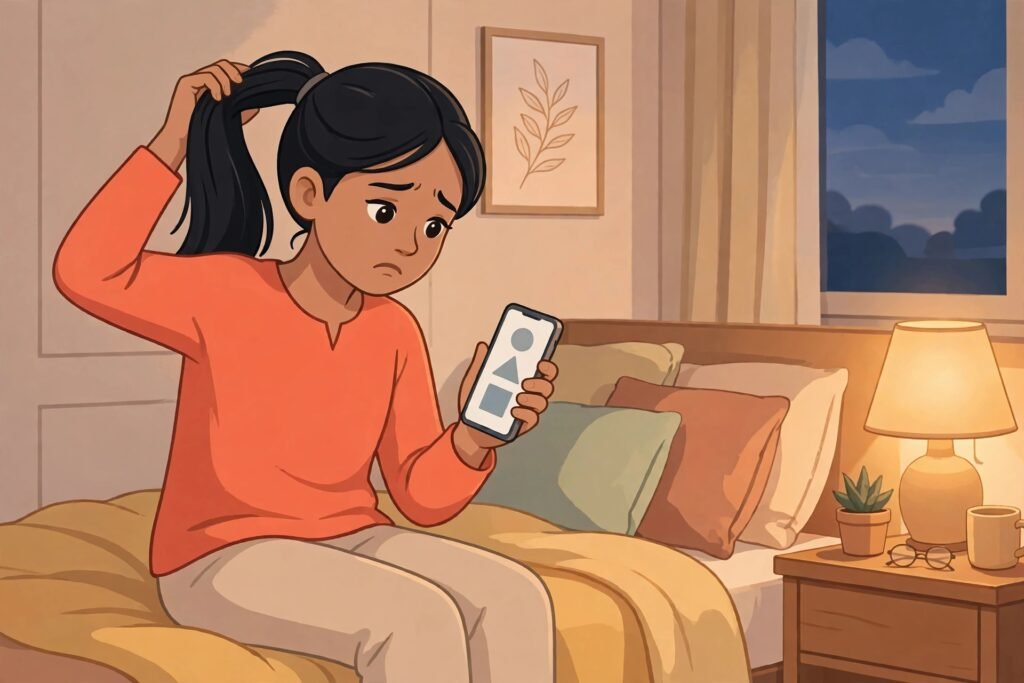
You wrote it. You read it twice. Maybe you showed it to a friend first, maybe you just went brave and pressed send. And then, about four seconds later, it hit you. That was too long. That was too eager. That joke wasn’t funny. Why did I add that emoji? The message is gone, it lives on his phone now, and your brain starts its favorite show: the replay. So you lie there asking, is it normal to regret a text sent to your crush?
Yes. So normal that it might be the most shared secret of the whole texting generation. Girls who look ice calm in the hallway are replaying their sent folder at midnight like it’s a courtroom tape. The regret doesn’t sort by confidence. It visits everyone who cares, because caring is the whole ingredient.
This guide is about the days after. Not the first frantic hour, but the long tail: why your brain keeps replaying a few harmless words, what the regret does and doesn’t mean, and how to loosen its grip until it fades. Because it does fade. Every girl who has ever asked is it normal to regret a text sent to your crush has eventually forgotten a text she once lost sleep over. Yours will join that pile.
There’s nothing wrong with your texting, and nothing wrong with you. There’s just a heart that wanted to make a good impression, and a brain that reviews everything the heart does with far too much care. Let’s walk through it, kindly and slowly.
Notice, before we go any further, what this guide won’t do. It won’t grade your text, because from out here it’s clear the text was fine. It won’t hand you emergency moves for the first hour either, because that hour isn’t the problem anymore. The problem is the echo, the days long replay that keeps a small moment feeling large. Echoes respond to understanding, so understanding is exactly what we’re going to build.
The Short Answer

Yes. When you ask is it normal to regret a text sent to your crush, the answer is yes, completely, for almost everyone who has ever had a crush and a phone. The moment a message leaves your hands, control leaves with it. You can’t edit it, soften it, or add the smile you would have worn saying it out loud. Your brain hates that loss of control, and it answers by replaying.
The text itself is almost never the disaster your brain describes. A few friendly words, a joke, a question about the homework. Through his eyes, it’s a small bright moment in a busy day. Through your replaying eyes, it grows three sizes and gains flaws it never had.
Regret also has a lifespan. It spikes, it loops for a few days, and then it thins out as real life brings new moments. Every day, the text becomes a smaller part of a bigger story between you and him. One text never carries a whole story. Stories are built from many days, and yours is still being written.
So, is it normal to regret a text sent to your crush? Yes. And it’s also normal for that regret to be lying to you about how big the moment is. The rest of this guide shows you the machinery behind the loop, so the loop loses its power over you.
Once you see the machinery, is it normal to regret a text sent to your crush stops sounding like a verdict and starts sounding like weather.
The Send Button Has No Undo for Your Brain

Start with the simple machine problem: speaking and texting work differently, and your brain knows it. In a real talk, you can soften a sentence as you say it. You can laugh, add “you know what I mean,” read his face, and fix things on the spot. A text allows none of that. You press send and the words freeze exactly as they’re, in his pocket, out of your reach.
Frozen words invite endless review. A spoken sentence evaporates. A text stays, perfectly preserved, so your brain can return to it again and again with fresh panic. The wording never changes, but your mood while reading it does, and a tired or anxious mood reads the same line as far more embarrassing than a calm one does.
There’s also the silence after. In person, you would know in one second how your words landed. By text, landing is invisible. The not knowing leaves a blank, and the brain fills blanks with its favorite material: worry. It writes his reaction for him, usually in the harshest voice available.
Notice how the regret rarely matches the text itself. You don’t regret sending something cruel or wild. You regret a normal text: a bit long, a bit eager, a bit you. That mismatch is the tell. The regret isn’t reporting on the message. It’s reporting on how much you care, and on how little control you have now that it’s sent.
This is why the question is it normal to regret a text sent to your crush shows up even among girls who text with total confidence all day. The send button creates the same trap for everyone: frozen words, invisible landing, a brain left alone with both. Understanding the trap doesn’t just comfort you. It starts to disarm it.
Disarmed a little, the trap explains why is it normal to regret a text sent to your crush gets asked by girls who text perfectly well.
Think about how different the same words feel depending on the channel. Say the joke out loud to him by the lockers and you’d see his face answer you in real time: smile, laugh, done. The story ends in two seconds. By text, the story has no ending supplied, so your brain volunteers to write one, nightly, in its darkest ink. The channel created the ghost. The ghost was never in your words.
Why Your Brain Replays the Text on a Loop

The replay has a name: rumination. It means going over the same thought again and again without reaching an end. Your brain isn’t doing it to torture you. It’s doing a job badly. It believes that if it examines the text from enough angles, it can protect you from ever feeling this exposed again. It’s studying for a test that already happened.
The Psychology Today guide on rumination explains the pattern well: the mind repeats a painful moment because it’s trying, in its clumsy way, to solve it, and the repetition itself keeps the pain fresh. Knowing the loop has a name and a reason helps. You aren’t dramatic. You’re running a very common brain program.
Crush texts are perfect fuel for this program. The stakes feel sky high: his opinion of you. The data is tiny: a few words and a lot of silence. And the event is finished, so there’s nothing left to do but review. High stakes, tiny data, nothing to do: that’s rumination’s favorite recipe.
The loop also edits the evidence. Each replay adds a little shame and removes a little context. By day three, you “remember” the text as longer, needier, and weirder than the one in your sent folder. If you actually reread it, it often looks startlingly normal. Your memory of the text under rumination is a rumor. The text itself is the fact.
Here’s the hopeful part: loops weaken when you see them as loops. The next time your brain presses play, you can name it silently: that’s the replay again, not new information. Naming doesn’t erase the feeling in a day, but it puts a frame around it. And every girl who has asked is it normal to regret a text sent to your crush has had to learn this: the replay is weather, not truth. Weather passes.
The loop has one more trick worth seeing: it changes its questions. First it asks, why did I write that? Then, why did I write it like that? Then, what’s he thinking of me now? Each question feels new, which keeps you answering, but they’re the same question wearing different coats. Once you spot the coat change, the questions lose their power to drag you back in. It’s one loop, not a hundred problems.
One loop, seen clearly, is also why is it normal to regret a text sent to your crush has such a plain answer: your brain is doing its overprotective job again.
What the Words Look Like Through His Eyes (Probably Fine)

Now for the view your brain refuses to show you: his side of the screen.
He gets your text in the middle of a normal day. He’s eating, gaming, half listening to a teacher, arguing with his brother about the remote. He glances at his phone, reads your words once, maybe smiles, answers or plans to answer, and life carries him on. That’s usually the whole event for him: one pleasant glance. He doesn’t screenshot your message to study its tone. He doesn’t count your words or grade your emoji.
Compare that to your side: forty rereads, three friends consulted, an hour of analysis. The same text exists in two worlds. In his, it’s small and warm. In yours, it’s a novel with a worrying plot. Both of you’re looking at the same words, which tells you the size difference lives in the looking, not in the text.
Boys also simply process texts differently, on the whole. Many of them send short, sloppy, typo filled messages without a second of regret, which proves the medium itself is forgiving. Texting culture is loose. A slightly long text, an extra exclamation mark, a joke that lands at eighty percent: none of these register as events on his side. They barely register as anything.
And here’s a kindness to borrow: if a girl you liked sent you that exact text, word for word, would you judge her the way you’re judging yourself? You would probably smile and feel pleased she wrote. Give your own text the same fair reading. Your crush isn’t a stricter judge than you’re. He’s, almost surely, a much easier one.
So when the replay insists the text was a catastrophe, answer it with his likely reality: a boy, a phone, a small smile, a day that moved on. That’s what your words look like through his eyes. Probably fine was always the most likely story.
One more piece of evidence from his side of the screen: boys rarely even keep score of their own sent texts, let alone yours. Ask a boy about a message he sent last week and he’ll often blink, unable to recall its exact words. That’s the weight texts carry in his world: feathers. Your text landed in a feather world. It only gained weight when it came home to live in your head.
Feathers on his side, bricks on yours: that gap is the whole mystery inside is it normal to regret a text sent to your crush. And once you see the gap, the question is it normal to regret a text sent to your crush answers itself a little more each day.
What Post Send Regret Means, and What It Does Not

Regret talks loudly, so it’s worth translating. What does this feeling actually say about you and your text?
It means you care. That’s genuinely all it proves at its core. You like him, you hoped the text would land well, and the caring brain reviews caring work. Girls who feel nothing after sending aren’t better at texting. They just care less about that particular boy. Your regret is the receipt for your feelings, not for your failure.
It doesn’t mean the text was bad. Regret is a feeling, not a review. It follows your mood, your sleep, your day. The same text sent on a confident morning might have earned zero regret by lunch. Feelings are weather reports about your insides. They aren’t critics grading your writing.
It doesn’t mean he judged you. You have no data about his judgment, and regret happily fills that empty space with fiction. Fiction isn’t evidence. Until a real reaction exists, the kindest and most accurate position is the boring one: a normal text was sent to a normal boy, and nothing dramatic has happened at all.
It doesn’t mean you should text less like yourself. Some girls, after a few rounds of regret, start sanding every message down to two safe words. That solves the regret and kills the charm. He can’t get to know a girl who only sends the texting version of a shrug. Your warmth, your humor, your slightly long messages: that’s you, arriving by phone. Let it arrive.
So keep the translation close. When the feeling swells and you ask is it normal to regret a text sent to your crush, answer yourself: it means I care, it arrived safely, and my brain is being overprotective again. That’s the whole translation. There’s no hidden sentence underneath saying you failed.
Regret can even be a strange compliment to your character. It shows up in girls who think before they speak. You aren’t built careless, and the people who matter will be grateful for that one day. The goal was never to stop caring. It’s to stop paying for caring with days of needless replay.
Caring was never the problem, which is why is it normal to regret a text sent to your crush is really a question about a tender heart, not a failed message.
The Days After: Why It Fades Slower Than You Want

Here’s the frustrating part everyone wants explained: if the text was fine, why does the regret take days to leave?
Because regret feeds on quiet moments. In class, your brain is busy and the loop fades to background. Then comes the bus ride, the shower, the last ten minutes before sleep, and the loop walks back in with its slideshow. Days feel long because the loop only visits in the gaps, and the gaps are where you judge how you’re doing.
Because your phone keeps offering the evidence. The chat sits there, one tap away, asking to be reread. Rereading feels like research, but it works like scratching: brief relief, worse itch. Girls often find the regret stretches exactly as long as the rereading habit does. There’s a close cousin of this habit in the guide about how to stop checking if your crush is online, and the two loops love to team up on the same girl in the same week.
Because nothing has replaced the moment yet. Your brain keeps the text in the “unfinished” drawer while it waits to learn how the story goes. New moments file it away. A normal chat tomorrow, a joke in the hallway, seeing him be perfectly ordinary with you: these teach your brain the story continued fine, and the drawer closes.
And because feelings fade on biology’s schedule, not yours. A few days of loop for a text that matters to you is a standard human timeline. You aren’t slow at recovering. You’re recovering at the normal speed of a person with a working heart and an overprotective brain.
So measure the fade fairly. Day one: constant replay. Day three: the loop visits a few times and leaves faster. Day six: you remember the regret more than the text. That slope is healing, even when it feels slow. The girls who once typed is it normal to regret a text sent to your crush into the dark all reached the flat part of that slope. Time, plus fewer rereads, plus new moments: that’s the whole recipe, and it’s already cooking.
A fair warning about measuring the fade: it doesn’t move in a straight line. A quiet Tuesday can be followed by a loud Wednesday, because you slept badly or saw him laughing with someone else and your brain reached for the old file. A loud day inside a fading week isn’t a relapse. It’s a wave on a falling tide. Judge the tide, not the wave, and you’ll see your progress clearly.
Clear progress is the tide going out on is it normal to regret a text sent to your crush, one quieter day at a time.
Gentle Ways to Let the Loop Loosen

You can’t order the loop to stop. But you can make your days less friendly to it. These are comfort tools for the feeling itself, gentle and proven by many girls before you.
Give the replay a container. Take a notebook and write the whole worry out once: the text, your fear, the worst case your brain invented, and the boring likely truth beside it. Writing moves the loop from a circle in your head to lines on a page, where it looks much smaller. Then close the notebook. When the loop returns, remind yourself: it’s in the book. I already thought it. I don’t have to think it again today.
Feed your brain other material. The loop loves empty, tired hours, so load the hours it haunts. Music practice, a run, baking with your sister, the hard homework first instead of last: a busy brain has no spare stage for the replay. This isn’t faking fine. It’s starving a habit that only grows in idleness.
Talk about the feeling, not just the text. Tell a friend, “My brain won’t drop a text I sent Tuesday, and it’s making me feel silly.” Naming the loop out loud shrinks it, and friends almost always answer with their own sent folder horror stories, which is the best medicine: proof that this exact loop is a shared human experience, not your personal flaw.
Be kind to the girl in the story. When the replay calls her embarrassing, answer like a good friend would. She liked a boy. She wrote him a normal message. End of charges. Self kindness sounds soft, but it’s the strongest tool here, because shame is the loop’s fuel and kindness cuts the supply.
None of this works in an hour, and it isn’t meant to. The loop loosens over days, a little at a time, as your brain learns the moment was safe. One morning you’ll realize you haven’t thought about the text since yesterday. That’s the loop, leaving the way it came: quietly, while you were busy living.
Friends deserve a special mention here, because the right friend does something no trick can do: she makes the loop funny. One shared look, one impression of your own dramatic rereading face, and the heavy thing becomes a story you tell together, laughing. Shame grows in the dark and shrivels in company. Let one trusted person into the loop and watch it lose its solemn power within a single afternoon.
Company, kindness, and a closed notebook: with those three, is it normal to regret a text sent to your crush shrinks from a nightly haunting to an occasional thought. And each time the thought visits and leaves faster, is it normal to regret a text sent to your crush loses a little more of its power over your evenings.
What This Teaches You About Texting Next Time

When the regret finally fades, it leaves a small education behind. Not rules written in fear, but a few things you now know about yourself and your phone.
You know your patterns now. Maybe you regret texts sent late at night, when tiredness writes half the message. Maybe the loop hits hardest when you send something braver than usual. Knowing your pattern lets you choose your moments: write the brave text in the morning, with a clear head, and it’ll cost you far less sleep. That isn’t holding back. That’s timing, and the guide about how long should you wait before texting a boy back digs into the same calm, unhurried approach to timing.
You know regret is survivable and temporary. That knowledge changes the next send. The fear before pressing send shrinks when your brain remembers: even if the loop comes, it lasts days, not forever, and last time the world didn’t end. Courage is mostly memory.
You know the text is never the whole story. One message, good or clumsy, is one brick. Crushes are built from months of moments: talks, jokes, kindness, showing up. No single brick carries the building, which means no single text can knock it down either. That thought alone frees a lot of girls from the replay.
And you know yourself a bit better. You’re a girl who cares about how her words land. That isn’t a weakness to fix. That’s tenderness, and the right people will love exactly that about you. So the next time you press send and the old question rises, is it normal to regret a text sent to your crush, you’ll smile a little, because you have been here before, and you know how the story ends: the loop fades, the sky stays up, and you stay gloriously yourself.
Keep one sentence from this guide for the next time the loop starts, whichever month that is. It’s carried many girls through the replay: a text is a moment, not a verdict. Moments pass, stories continue, and the boy, the friendship, and your own heart are all bigger than a few frozen words on a screen. You’ll send braver texts and sleep fine. That future’s already on its way to you.
That future is the long answer to is it normal to regret a text sent to your crush: yes, and then it fades, and then you barely remember it.
Frequently Asked Questions
How long does the regret after sending a text usually last?
For most girls, the sharp part lasts a day or two. It visits in quiet moments and grows weaker each day. Bad sleep and stress can stretch it, which is why the same girl can shake one text in a day and replay another for a week. That timeline is exactly why is it normal to regret a text sent to your crush is such a common question. If your regret follows this shrinking pattern, it’s the normal loop doing its normal fade.
Why do I regret the text so much more at night?
Night removes every distraction. No class, no noise, no people, just you and a brain with empty hours to fill, and it fills them with its favorite unfinished file: your text. Tiredness also turns the volume up on every fear. Many girls ask, in the dark, is it normal to regret a text sent to your crush this strongly, and the night itself is half the answer. The text didn’t grow worse at 1 a.m. Your defenses just went to sleep before you did.
Does regretting a text mean the text was actually bad?
No. Regret measures how much you care, not how well you wrote. Girls regret warm, funny, perfectly fine texts every day, and forget genuinely clumsy ones by lunch when they don’t care about the boy. Read the text once with a rested, calm head and judge it like a friend’s message. If it looks kind and normal, it’s kind and normal. Your 1 a.m. brain is a drama critic. Your rested brain is the fair reviewer. Believe the fair one.
Why do I keep opening the chat to reread the text?
Because rereading promises control. Your brain thinks one more look will settle how the text comes across, the way checking a locked door feels safer. But the look never settles anything, since the worry isn’t really about the words. It’s about not knowing his reaction. Each reread restarts the loop instead of ending it. When girls wonder is it normal to regret a text sent to your crush, the rereading habit is usually the engine keeping the regret fresh. Starve the habit, and the feeling starves with it.
Will texting him always feel this heavy?
No. It gets lighter for two reasons. First, you’ll build a history of normal exchanges, and your brain will stop treating each text as a first impression. Second, you’ll have survived the loop, and survivable things lose their scare power. One day you’ll send something brave, feel a five minute flutter, and move on. When that day comes, remember the girl who asked is it normal to regret a text sent to your crush for days on end. She got you here, one faded loop at a time.