
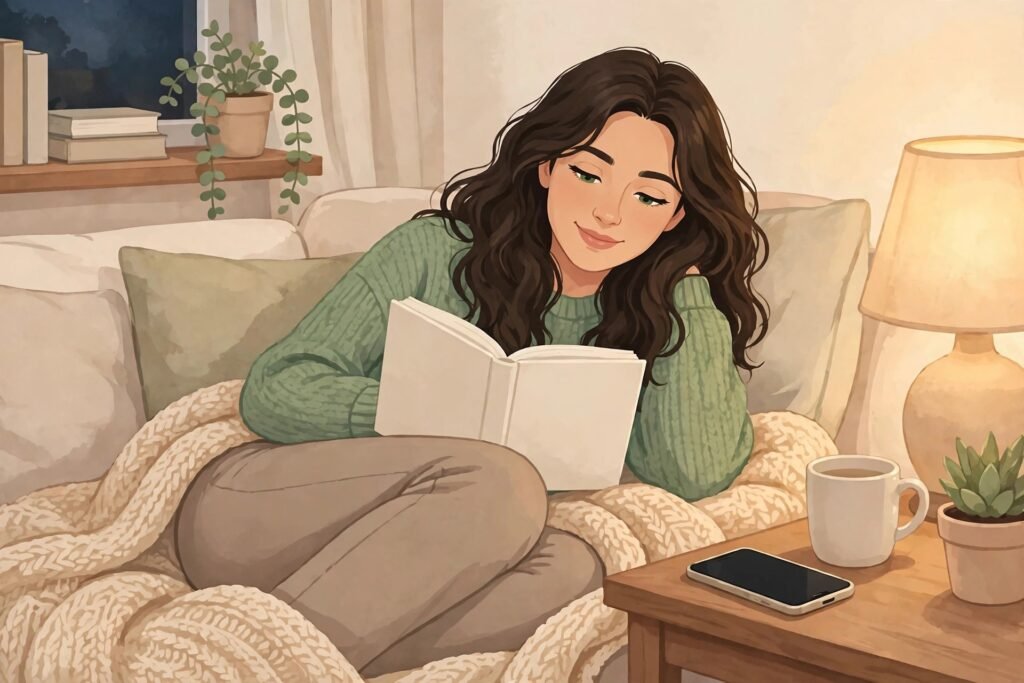
Friday, 6 pm. Your phone lights up with the group chat: drinks, a birthday thing, a maybe plan that needs an answer now. And under the noise of it, you feel something very clear and very quiet: relief at the thought of your couch, your door closing, your own silent kitchen. You prefer spending your weekends alone, and you’ve started to wonder if that says something worrying about you. Does it mean you’re becoming a hermit? A bad friend? A red flag in leggings?
Let’s set the scene honestly. Your week is five days of meetings, messages, small talk, and being needed in stereo. By Friday your social battery isn’t low; it’s blinking red in the corner. For a woman whose job spends her people energy all week, to prefer spending your weekends alone is often not withdrawal. It’s refueling. Planes don’t apologize for landing to refuel. Neither should you.
This guide is your permission slip, with a fair test tucked inside. We’ll look at why the weekend alone feels so good, how a social battery actually works, and the gentle line between chosen solitude that restores you and isolation that quietly hurts. You’ll also get words for your friends, so your rest stops sounding like rejection. If you prefer spending your weekends alone, this is the honest, kind answer to the question you keep Googling at midnight.
The Short Answer

Yes, it’s normal, and for many working women it’s healthy. Weekends are recovery time, and recovery looks different on different nervous systems. If your alone time leaves you rested, warm toward your people, and glad to see them when you do, it’s doing its job. The version worth a closer look is different: alone time that leaves you numb, dreading everyone, and losing interest in things you used to love. Chosen rest is a green flag. So if you prefer spending your weekends alone and come back to life by Monday, there’s nothing here to fix.
This is also what the writing on solitude keeps finding. In Psychology Today’s overview of the benefits of spending time alone, freely chosen time alone is linked with feeling calmer, more energized, and even kinder in your relationships afterward, because a rested person has more to give. The key word is chosen. Solitude you pick is a tool. Solitude you hide in is a symptom, and later in this guide we’ll separate the two with care. For now, hold the simple version: to prefer spending your weekends alone after a draining week is a preference, like preferring tea over coffee. It describes your wiring, not your worth.
Plenty of deeply loved, well friended women prefer spending your weekends alone style rest, and their friendships are fine, because rest is what lets them show up fully when it counts.
There’s a small Friday ritual that tells the truth about all this. Watch what your body does when the last meeting ends. Some women feel energy rise at the thought of people. Others feel their whole system exhale at the thought of quiet. That exhale isn’t antisocial. It’s a nervous system voting for its own repair. Learning to hear that vote, instead of overriding it with guilt, is the beginning of an honest week. The rest of this guide is about building a life that respects the vote.
Your Weekend Is Recovery, Not a Report Card

Somewhere along the way, weekends became a performance. The brunch photos, the market hauls, the sunset hikes with matching captions: a full feed can make a quiet Saturday look like a failing grade. Let’s retire that idea right now. Your weekend isn’t content, and it isn’t a report card. It’s the repair shop where your week gets fixed.
Think about what your job actually spends. Attention, patience, facial expressions, decisions, feelings managed in public. That’s real labor, and it draws from the same well your friendships drink from. When the well is dry, a party isn’t fun; it’s overtime with better snacks. Choosing the couch, the book, the long bath, and the early night isn’t laziness. It’s maintenance. You don’t skip oil changes and then act surprised when the engine complains.
Reframe the math and the guilt shrinks. Five days of output need real input to balance. If you prefer spending your weekends alone, you’re simply choosing the highest quality input your body knows: quiet, autonomy, and no demands. Nobody at work gets to vote on your recovery plan. And your friends, the real ones, don’t need you at every event. They need you alive, rested, and actually glad to be there when you come. A woman who protects her rest shows up better than a woman who attends everything and resents all of it. So the next time the feed makes your quiet Saturday look small, remember: recovery is a legitimate weekend plan.
For many women in demanding jobs, to prefer spending your weekends alone isn’t the absence of a life. It’s the thing that makes the rest of the life possible.
The comparison game deserves one direct answer. Your college weekend photos aren’t evidence against you. Back then, your days were loosely scheduled, your friends lived within walking distance, and nobody’s calendar required a negotiation summit. Wanting that social volume back is really wanting that ease back, and ease can be rebuilt in adult shapes: fewer plans, closer people, formats that end early. If you prefer spending your weekends alone now, you aren’t a faded version of your younger self. You’re an accurate version of your current one, and accuracy ages much better than performance.
A Social Battery Is Temperament, Not a Flaw

People are wired with different battery sizes, and pretending otherwise has made a lot of kind women miserable. Some of your friends genuinely recharge around people; a loud Sunday dinner refills them. You may genuinely recharge in the opposite direction. Neither setting is more mature, more fun, or more lovable. It’s temperament, like being a morning person, and it tends to stay stable across a life.
Notice your own charge pattern instead of borrowing someone else’s. After a big social day, do you float home energized, or do you need a quiet day to feel like yourself again? How many social hours can you give before your kindness starts to thin out? Those answers are data about your battery, and they deserve respect, not shame. You wouldn’t call a phone broken for needing a charger. Stop calling yourself broken for needing yours.
There’s also a skill hiding here: spending your battery on purpose. When you know big social doses cost you a recovery day, you start choosing like an adult instead of apologizing like a child. The wedding gets your full, glowing presence, because you rested before it. The random Tuesday drinks get a rain check, because they aren’t worth a flattened Wednesday. This is the deeper craft behind our guide on how to learn to enjoy your own company: the alone hours aren’t empty; they’re where you refill, think your own thoughts, and come back to your people with something in your hands.
When you prefer spending your weekends alone, you’re often just a woman who has learned her own charge cycle. That isn’t a flaw to fix. It’s self knowledge to use.
Different wiring also explains the couples and roommate standoffs, where one person’s perfect Saturday is the other’s slow leak. Neither of you is wrong about what rest is. You’re simply running different hardware, and the fix is translation, not victory. Tell them what a quiet weekend returns to you, and ask what their format returns to them. Many pairs land on a kind compromise: one shared anchor plan, the rest of the weekend free range. Knowing why you prefer spending your weekends alone lets you explain it as wiring instead of rejection, and that one shift saves more relationships than any forced brunch ever will.
Chosen Solitude Feels Different From Isolation That Hurts

Now the fair distinction, made gently, because it matters. Chosen solitude and hurting isolation can look identical from outside: same couch, same closed door. Inside, they feel completely different, and your inner weather is the test.
Chosen solitude feels like relief. You sink into the quiet and your shoulders drop. You still smile at your friends’ messages. When you do go out, you enjoy it, and you come home pleasantly tired rather than strangely empty. Your alone time has pleasures in it: the book, the cooking, the long walk, the show you savor. On Monday you feel like a person again. If that’s your picture, and you prefer spending your weekends alone in this warm, restoring way, your weekends are working exactly as weekends should.
Isolation that hurts feels like dread wearing a bathrobe. You cancel and feel worse, not better. Everything sounds flat: not just the party, but the book, the walk, the favorite show. You stop replying because even love feels like labor. Weeks pass in a gray stretch and you can’t remember choosing any of it. That pattern isn’t a preference, and it isn’t a character flaw either. It’s a signal, the way a fever is a signal, and it deserves care rather than judgment.
So check the direction, not a single weekend. Are you moving toward rest and back to life, or slowly away from everything? One question helps: after my alone time, do I feel more able to love my life, or less? Answer honestly across a month, not a mood. For most women who prefer spending your weekends alone, the honest answer is “more able,” most months of the year. Trust that data. It knows you better than the group chat does.
Try the two-question test that cuts through all of it. First: how do I feel on Friday at 6 pm, before the weekend? If the thought of your empty flat brings relief rather than dread, your solitude is chosen. Second: how do I feel on Sunday at 6 pm, after it? If you feel steadier, kinder, and quietly ready for people again, the weekend did its work. Relief going in plus restoration coming out is the signature of healthy rest. Women who prefer spending your weekends alone and pass this simple test can stop cross examining themselves. The data is in, and it’s on your side.
What Your Weekends Alone Actually Give Back
Let’s count the returns, because they’re real and they compound. Sleep, first of all: the long, alarm free, body led kind that a work week never allows. A home that slowly becomes yours: the plant corner, the reorganized shelf, the recipe that finally works. Thoughts that get to finish themselves, which is rarer and more precious than it sounds. Half your best decisions were probably made on a quiet Saturday, with a mug going cold beside you.
There’s also the wider life choice echoing underneath. We wrote about why so many women are choosing to live alone and heard the same theme again and again: women aren’t fleeing people; they’re claiming a base where they can be fully themselves, so their togetherness becomes a choice instead of a need. Weekend solitude is the small weekly version of that same freedom. You come back to your friendships as a volunteer, not a refugee, and volunteers are far better company.
And notice what your friends actually receive from your rest. They get the version of you who listens with her whole face. Who laughs for real. Who can hold their hard story without her own exhaustion leaking into it. Rested you is generous you. So when guilt whispers that to prefer spending your weekends alone is selfish, answer it with the evidence: your people don’t lose you on those weekends. They get you back. A woman who guards that quiet rhythm isn’t loving her friends less. She’s making sure that when she shows up, she’s actually there.
There’s a creative dividend too, and quiet women rarely give themselves credit for it. The project that only moves on Saturday mornings. The language app streak that survives because nobody interrupts it. The playlist, the sketchbook, the small business plan taking shape at the kitchen table. Solitude is where a self gets built in private before it’s spent in public. When you prefer spending your weekends alone, part of what you’re protecting is authorship: hours where nobody else’s needs get a vote on what you become. That isn’t empty time. For many women it’s the most productive time of the week, measured in who they’re turning into.
Rest also buys you something nobody puts on the poster: better plans when you do say yes. A woman who has actually recovered all week chooses her social life instead of collapsing into it. She books the exhibition she genuinely wants to see. She shows up to the birthday early enough to enjoy it. She leaves while it’s still good, instead of staying until she’s gray. Her yes becomes rare and real, and people can tell the difference in her face. This is the quiet trade at the heart of the solo weekend: fewer appearances, better ones. Your friends aren’t collecting your attendance. They’re collecting your presence, and presence is manufactured in rest.
Give your weekends a soft shape, too, because pure emptiness can feel strangely heavy by Sunday. Not a schedule, never a schedule. Just anchors you love: the market run, the long coffee, the film you’ve been saving, the walk that takes the same route past the same gardens. Anchors turn “nothing planned” into “exactly what I planned,” and that wording matters more than it sounds. A weekend with two gentle anchors and acres of free space around them is the sweet spot for most quiet women. It rests you without isolating you, and it gives Monday a woman who’s actually glad to be back.
Tell Your Friends Without Sounding Like a Rejection

The fear underneath most of this isn’t the alone time. It’s the friendship cost: will they think I don’t care? Will the invites dry up? Good news: this is a communication problem, and communication problems have scripts.
Say the true thing, warmly and early. “I love you, and my battery is tiny after work weeks. Quiet weekends are how I recharge, so I will miss a lot of plans, and it’s never about you.” Add the part that makes it land: a counter offer. “But I want our monthly brunch protected, and I am always in for a Sunday walk.” People can relax into a no when it comes with a yes they can count on. What friends can’t relax into is silence, flaking, and mystery. The pattern reads as rejection even when it’s only fatigue.
Be the one who proposes, sometimes. You don’t have to attend everything to prove love, but initiating your format, the walk, the tea, the early dinner that ends at nine, shows your friends where the door to you actually is. And answer the messages, even briefly, even just with warmth and a rain check. A rested woman who replies kindly keeps her friendships fed on very little. Most healthy friendships run happily on this rhythm for decades. Your friends don’t need your every weekend. They need to know they matter, and that your quiet is weather, not a verdict on them.
The group chat deserves its own tiny etiquette, since that’s where most adult friendships actually live. You don’t owe the thread a performance of weekend fun. You owe it presence in your own size: a reaction here, a voice note there, the screenshot that made you think of her, sent on a Tuesday. Low dose, real warmth. Friends can feel the difference between a woman who’s resting and a woman who has vanished, and the difference is almost always a few small signals a week. Send the signals, then go back to your couch with a clean conscience. That’s the whole technology.
When you prefer spending your weekends alone, staying gently findable is what turns a private preference into a sustainable friendship style.
Keep a Small, Gentle Minimum of Connection

Permission to rest isn’t a license to vanish, and your heart knows it. Friendships are living things; they need a little water, regularly, or they quietly wilt. The trick is that your minimum can be small, chosen, and built to fit your battery instead of fighting it.
Design your minimum like an adult, not like an apology. One anchor a week, or even every two weeks: the Sunday call with your sister, the standing brunch, the Thursday walk with your neighbor. A group chat presence that’s real, not performative: you react, you ask, you remember the interview and the scan results. Small, steady signals that say: I am here, I am yours, I am just quiet.
This minimum also protects you. It keeps your world from shrinking to work and couch, which is where chosen rest can slowly slide into something lonelier. And it keeps the door warm for the seasons when your battery grows, because batteries do change with jobs, cities, and years. Build the minimum while things are calm, and it’ll hold your friendships through your busiest chapters. That’s the quiet architecture under a contented solo life: rest as the base, connection as the thread, both chosen on purpose.
Let your minimum flex with the seasons of your life, because a fixed rule will eventually fight a real chapter. Deadline season at work might shrink you to one call a week, and that’s fine. A calmer spring might find you hosting again, and that’s fine too. Tell your people which season you’re in, briefly, the way you would mention a trip: “Work eats October, I resurface in November, brunch on the first Saturday?” Predictability is kindness. It lets your friends plan around your rhythm instead of worrying about it, and worrying friends eventually become interviewing friends. A woman who prefer spending your weekends alone in one season and hosts dinners in another isn’t inconsistent.
She’s responsive, and responsive people keep friends for decades.
When Alone Time Stops Feeling Like Rest

End with the honest watch list, offered calmly, the way you would want a sister to offer it. Alone time deserves a second look when it stops doing its one job: restoring you. If you cancel plans and feel worse instead of better, week after week. If nothing sounds good anymore, not the party and not the book either. If your sleep, appetite, or interest in your own life has shifted and stayed shifted. If the quiet has a heaviness that rest never touches.
None of that makes you broken, and none of it erases the truth of the earlier pages. Batteries and moods are different systems. Sometimes a draining season at work is quietly becoming burnout, and rest alone can’t refill a well that work keeps emptying; that pattern deserves real support, not more willpower. Sometimes it’s a low mood settling in. Either way, the move is the same: tell one trusted person the plain truth, and let a professional help you sort it. That isn’t a betrayal of your introvert nature. It’s maintenance, same as the rest, just with better tools.
Most women reading this will land in the first, kinder category: tired, wired for quiet, and perfectly well. If that’s you, and you prefer spending your weekends alone, close this tab with a clear conscience. Guard your Saturdays. Answer your friends with warmth. Let your couch do its holy work. Your preference was never the problem. It was always the plan.
Frequently Asked Questions
How much alone time is too much?
There’s no healthy number that fits everyone, so judge by effect, not hours. If your alone time sends you back to your life rested, affectionate, and able, it’s the right amount for you, even if it would bore an extrovert friend to tears. It becomes too much when the effect flips: you feel flatter, duller, and less able after it, most weeks in a row. Women who prefer spending your weekends alone in the restoring way can trust the effect test. It won’t lie to you.
My friends take it personally. What can I say?
Say the true reason, once, clearly and warmly: your battery is small after work weeks, quiet weekends are your recharge, and it’s never about them. Then back the words with a rhythm they can count on: one standing plan you protect, replies that come back warm, and you proposing your format sometimes. Most friends relax once the pattern is explained and predictable. The ones who need you at everything, forever, are asking for a version of you that doesn’t exist. That’s information, not a failure.
Is wanting my weekends alone a sign of burnout?
It can be a cousin of burnout, but it isn’t the same thing. Simple tiredness refills with rest: you rest, you revive, you want your life again. Burnout doesn’t refill; you rest and stay empty, and work starts to feel heavy in your body even on good days. If you prefer spending your weekends alone and Monday still finds you restored, that points to healthy recovery. If the weekends stop working entirely, treat it as a signal worth support, not a personality change to be ashamed of.
What if I feel guilty while I am resting?
Guilt during rest usually comes from an old rule: that a good woman is always available, always hosting, always saying yes. Notice the rule, name it, and answer it with your own evidence. Look at how you treat people after a rested weekend versus after a packed one. Rested you is kinder, funnier, and more present. That isn’t selfishness; that’s arithmetic. Let the guilt be weather. It passes faster each time you rest anyway and watch nothing bad happen.
When should I pay closer attention to the pattern?
Pay attention when the direction changes: when alone time stops restoring you, when you dread even the people you love most, when flatness spreads to your hobbies, appetite, and sleep, and stays for weeks. That’s the moment to tell a trusted person and let a professional help you sort it out. Asking early is strength, not drama. Keep the baseline: to prefer spending your weekends alone and return warmer is health, not a warning. If you prefer spending your weekends alone because it restores you, let the worry go.