

Nobody wakes you. That’s the first strange fact of living alone. No flatmate banging the bathroom door, no parent calling that breakfast is ready, no partner’s alarm dragging you up with them. Just you, a silent flat, and a morning that starts whenever you decide it starts. For a week or two, that freedom is delicious. Then the days start to blur. Lunch happens at four. Work ends, somehow, at nine. You fall asleep on the couch in your clothes and wake up feeling like the day happened to you instead of the other way around.
If you’re asking how can i create a routine when i live alone, you’re not failing at solo living. You’ve found its one real homework assignment. A shared home comes with a built in rhythm: other people’s mornings, meals, and bedtimes nudge yours into shape. A solo home has no nudges. The rhythm has to come from you, on purpose, and that’s a skill nobody teaches and everybody can learn.
Hear this part clearly: a routine is not a productivity project. It’s not about squeezing more work out of yourself or performing some perfect morning for an audience. It’s scaffolding. It holds the day up so your energy can go to living, not to deciding the same small things forty times. When women ask how can i create a routine when i live alone, what they usually want isn’t discipline. It’s days that feel held instead of spilled.
Plenty of women chose this setup with open eyes, for good reasons; the pull of a home that’s fully yours is real, as why so many women are choosing to live alone lays out warmly. A routine doesn’t cage that freedom. It protects it. Structure in a solo home isn’t the opposite of freedom. It’s what stops freedom from dissolving into fog.
So here’s the approach: anchors, not a timetable. You won’t build a minute by minute schedule, because those shatter by Wednesday and leave guilt behind. You’ll build a handful of fixed points, a morning anchor, a shutdown ritual, meals that happen, cleaning spread thin across the week, and let the rest of life flow between them. That’s how can i create a routine when i live alone without turning your home into a second job. And one more time, because it decides whether this works: the goal is a routine that survives your worst week, not one that only fits your best one. That’s the real answer to how can i create a routine when i live alone.
The Short Answer

Pick anchors, not hours. When my day has no one else’s rhythm to lean on, I give it five fixed points: a short morning anchor that starts the day the same way, a shutdown ritual that ends work properly, meals that happen at roughly the same times, tiny cleaning jobs spread across the week, and one social plan I protect like an appointment. Small, boring, repeatable. That’s how can i create a routine when i live alone that actually survives real life.
Build it in layers, one anchor per week, not all of it on one heroic Sunday. Start with the morning, because a day that starts on rails usually stays on them. Keep every piece short enough to do on a tired day, because tired days are exactly when the routine earns its keep. And write it down somewhere you’ll see it; a routine that lives only in your intentions is a wish. A short list on the fridge is a plan. Keep it gentle and it will answer, day after day, how can i create a routine when i live alone.
Anchor the Morning First

The morning anchor is the smallest useful version of a morning routine: two or three actions, in the same order, at roughly the same time, that tell your body the day has started. Wake at a steady time, within the same half hour most days. Get light on your face early, a window, a balcony, a short walk to the corner. Make the bed, or at least pull the duvet straight. Wash, dress in real clothes even if you’re working from the couch. Fifteen minutes, start to finish, and the day has a front door.
Keep it tiny on purpose. The internet sells two hour morning routines with journals and ice baths; a solo flat needs none of that theatre. Your anchor has one job: to move you from asleep to started without a negotiation. Negotiation is where solo mornings die, because there’s no one to be on time for. When I was figuring out how can i create a routine when i live alone, shrinking the morning to fifteen unmissable minutes is what finally made it stick.
If mornings are your weak point, borrow the bones of how to build a morning routine that protects your energy, which starts from the same idea: the first hour sets the terms for the rest. Adapt it to solo life by removing every step that needs motivation and keeping only steps that need a habit. Alarm across the room. Clothes laid out the night before. Kettle on while you dress. Each tiny friction you remove at night is a gift to the half asleep version of you.
Weekend mornings get a vote too. Sleeping until noon on Saturday feels like a reward and acts like jet lag: Sunday night won’t sleep, Monday lands like a wall. Keep a softer version of the anchor on weekends, up within an hour of your weekday time, same first actions, slower speed. The rhythm stays, the pressure drops. That’s the pattern for this whole guide, and it’s half the answer to how can i create a routine when i live alone: same bones, kinder settings, every day.
Build a Shutdown Ritual After Work

A shared office empties at six; people leave and you leave with them. A solo flat has no such signal. Work can leak into every corner of the evening until the whole day feels like one long shift with snacks. So build the ending yourself: a shutdown ritual, ten minutes, same steps, that closes work like a door. Clear the desk or the table. Write tomorrow’s first task on a note so your brain can drop it. Change your clothes. That last one sounds silly and works like magic: different clothes, different part of the day.
Add one action that physically separates work from evening in your space. Close the laptop and put it in a drawer or a bag, not on the couch arm where it glows at you. Turn on a lamp and turn off the big light. Put music on. The flat itself should feel different after six, softer and warmer, so your body learns the shift the way it once learned the commute home. Rituals teach through the senses, not through willpower.
The evening side needs the same care at the far end: a wind down that starts before you’re exhausted. Tea, a shower, a chapter of a book, screens dimmed. Solo evenings drift later and later because nothing and nobody calls a stop. Your routine calls it for you, kindly, at an hour you chose while rested. Protecting sleep is not a luxury item in a solo home; it’s the base the next morning’s anchor stands on.
Here’s the deeper point: in a home of one, transitions are the whole game. Couples and families get transitions handed to them, school runs, shared dinners, a partner coming through the door. You have to manufacture yours. Morning anchor in, shutdown ritual out, wind down at night: three hinges the day swings on. Women who ask how can i create a routine when i live alone often picture a packed schedule. What they need is hinges. Build the hinges and the day starts opening and closing properly, almost on its own.
And when a long day knocks one hinge loose, the other two still hold, which is exactly why how can i create a routine when i live alone starts with transitions and not with a timetable.
Give Your Meals a Rhythm of Their Own

Food is where solo days quietly fall apart. No one asks what’s for dinner, so dinner becomes crackers at nine, or a delivery you didn’t really want, ordered because deciding felt harder than paying. Give meals a rhythm instead of a daily debate: rough times for breakfast, lunch, and dinner, and a short rotating menu for the nights when your brain is empty. Rhythm first, variety second. A meal that happens beats a brilliant meal that stays theoretical.
Build a tiny backbone menu: five or six dinners you can cook half asleep, with ingredients that forgive each other. Pasta and frozen vegetables. Eggs any way. A soup that takes whatever the fridge offers. A rice bowl. One tray bake. Shop once for the backbone, top up fresh things midweek, and let repetition carry you. Cooking for one gets easier fast; within a month you’ll have your portions down and your fridge will stop producing guilt and wilted lettuce.
Lunch deserves a line of its own if you work from home. Stand up, leave the desk, eat at a table or by a window, at a time that splits the day in two. It feels minor. It isn’t. A real lunch is a midday anchor, and anchors are the whole machine. Skipping it because nobody’s watching is how the blur gets in. When my routine was fragile, fixing lunch fixed more of my day than any productivity trick I tried.
Meals are also where the social thread sneaks in, and we’ll protect that properly in its own section. For now, note the shape: solo meals on rhythm most days, shared meals on purpose some days. Cook double twice a week and freeze portions; future tired you gets a real dinner for the price of reheating. That’s meal rhythm working as care, not as control. And it’s a concrete, repeatable piece of how can i create a routine when i live alone, one plate at a time. Keep breakfast boring, too: the same simple thing most days removes one more decision from the morning anchor.
Small mercies add up, and deciding less is the hidden engine of how can i create a routine when i live alone.
Spread the Cleaning Across the Week
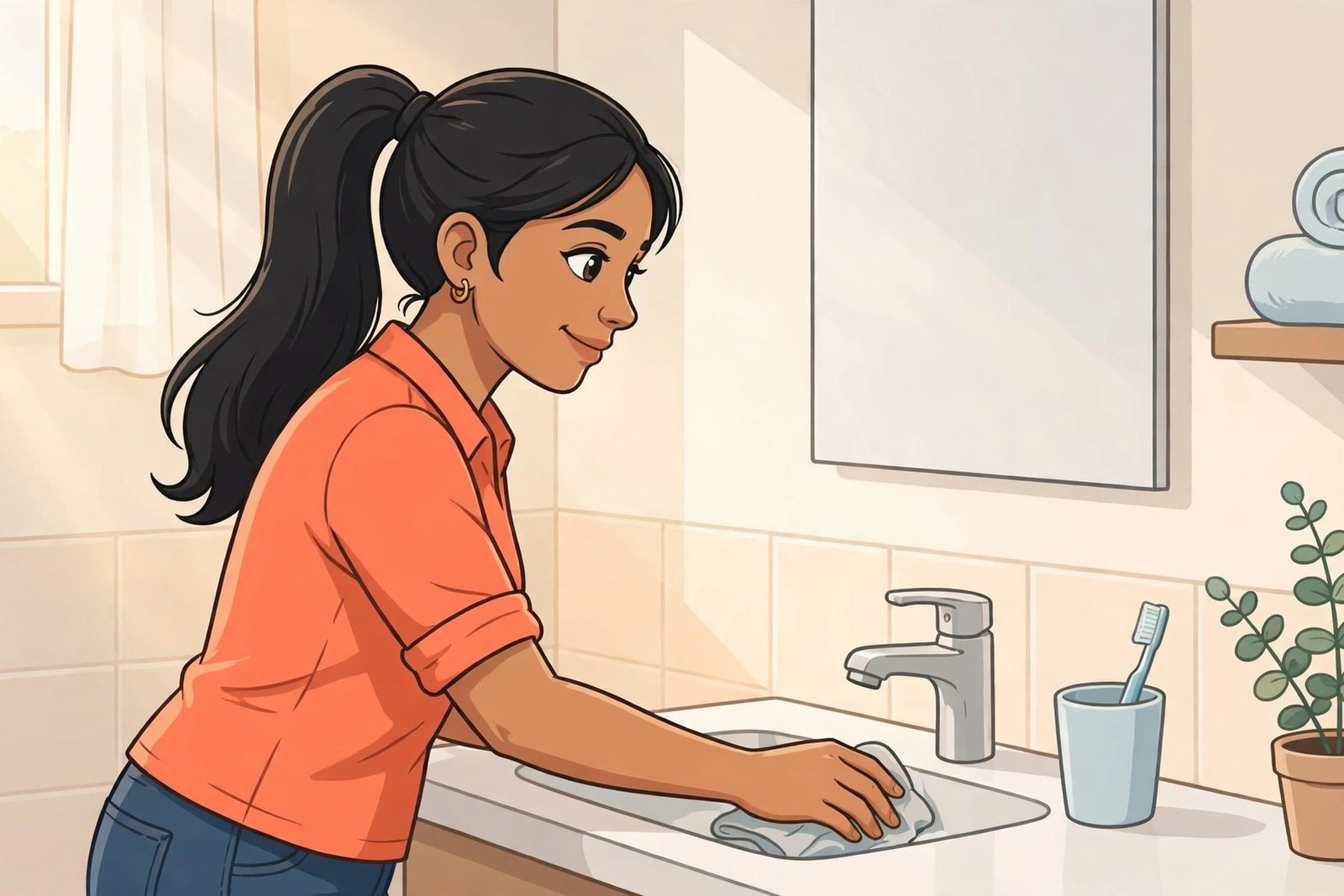
In a shared home, cleaning has witnesses. In a solo home, mess accumulates in silence until one Sunday you look up and the flat feels like a storage unit with a bed in it. The fix is not a heroic monthly deep clean. It’s spreading the work so thin it almost disappears: one small job per day, ten to fifteen minutes, matched to a day and done. Bathroom on Tuesday. Floors on Thursday. Kitchen surfaces a little every day, because kitchens forgive nothing.
Tie each job to something that already happens. Wipe the bathroom sink right after your morning wash, while you’re standing there. Take the recycling down when you leave for your walk. Run the laundry on the same evening each week, folded during a show you like anyway. Chores chained to habits don’t need motivation. They ride on rails you already built. A written weekly grid on the fridge, seven days, one line each, turns “the flat is a mess” into “today is sheets day,” and sheets day is doable at almost any energy level.
Lower the standard to “reset,” not “spotless.” A solo flat needs to return to a calm base state, not pass an inspection. Ten minutes of reset beats an hour of resentment. And here’s the part nobody warns you about: a home that’s basically in order changes how evenings feel. The couch is a nicer place to land. Inviting a friend over stops requiring a three day warning. When women picture how can i create a routine when i live alone, they rarely picture cleaning. Yet this thin layer of upkeep is what makes every other part of the routine pleasant instead of theoretical.
Let one slot stay empty on purpose. A rest day for the house, usually the weekend’s best day, where nothing is scheduled and mess can wait until Monday’s line on the grid. A cleaning rhythm with a day off is a rhythm you can keep for years. A cleaning rhythm without one becomes a second job with no pay, and second jobs get quit. Yours is designed to be kept.
And here’s a gentle truth under all of it: nobody is coming to check. That’s not sad. That’s the deal you chose, and it cuts both ways. The flat stays calm because you kept it calm, in fifteen minute pieces nobody saw. When you look at how can i create a routine when i live alone, it helps to accept that you’re both the tenant and the caretaker here, and the caretaker deserves a light workload.
Structure the Weekend Before It Drifts

Weekends are where solo routines go to dissolve. No work to outline the day, no one suggesting plans, and suddenly it’s Sunday night and the weekend feels both empty and gone. The fix that surprised me most, while learning how can i create a routine when i live alone, was embarrassingly small: decide two landmarks before Friday ends. The answer isn’t to schedule Saturday like a workday. It’s to give the weekend two or three soft landmarks: one outing, one pleasure, one reset. A market trip and coffee out. A long walk or a class. An hour on Sunday that sets up the week: a shop, a soup on the stove, clothes ready for Monday.
Plan the outing the way you’d plan it with a friend, because your own company counts. Put it in the calendar with a time. Vague intentions to “get out this weekend” lose to the couch almost every time; a booked class or a friend expecting you does not. If money is tight, the landmarks can be free: a library hour, a park loop, a free museum slot. What matters is leaving the flat on purpose at least once a day. A weekend spent entirely indoors makes Monday feel like a rescue instead of a start.
Guard one piece of the weekend as pure pleasure with no output at all. A slow breakfast. A film in the middle of the day. Lying on the floor with music, doing nothing, on purpose. Solo living gives you a rare gift: rest nobody can interrupt. A routine that forgets pleasure becomes a chore system, and chore systems get abandoned by February. Pleasure is not the reward for the routine. It’s part of the design.
Sunday night deserves one kind ritual of its own. Fifteen minutes: look at the week, lay out Monday’s clothes, check the fridge against the backbone menu, write one line about what you’re looking forward to. It closes the weekend instead of letting it leak into a grey Monday morning. Women who ask how can i create a routine when i live alone often blame weekdays, but the week is won or lost right here, in how the weekend ends and hands over to Monday.
Protect Your Social Time Like an Appointment

A routine that only contains work, chores, and rest is a routine for a machine. Solo living needs people woven into the structure on purpose, because in a shared home, contact happens by accident and in a solo home it mostly doesn’t. So schedule it like it matters, because it does: one standing call, one plan with a friend most weeks, one low effort touch on the quiet days. A voice note counts. Coffee with a neighbor counts. Contact is a load bearing wall in this house.
The habits research points the same way. Cottonwood Psychology’s guide to daily habits for living alone includes planning at least one human interaction a day among its core habits, and notes that people who live alone tend to do better when they stay socially and physically active. Small daily contact, not a huge social life: a chat with the barista, a message in the group thread, a quick call on a walk. Your routine should carry a line for people the way it carries a line for laundry.
Protect it the way you protect work meetings. When a plan with a friend is in the calendar, “too tired” has to argue with something solid, and some evenings you’ll go tired and come home glad. Other evenings the honest answer is rest, and that’s fine too; the point is the decision gets made on purpose, not by drift. Drift is the enemy this whole guide is aimed at. When my social life ran on drift, weeks passed without a real conversation and I couldn’t have said why.
And let the routine serve the life, never replace it. If a friend suggests something spontaneous on your cleaning evening, go. The bathroom will keep. A solo routine exists so your days have shape when nothing is happening; when something is happening, the routine steps aside and holds your place until you come back. That’s the sign it’s working. When a woman asks me how can i create a routine when i live alone, this balance is the part I repeat twice: structure for the empty days, freedom for the full ones.
A Routine That Bends Instead of Breaking

Every routine meets a bad week: a deadline, a cold, a family thing, a stretch of grey days where even the kettle feels heavy. Perfection based routines die there. They demand all seven anchors, miss two, and collapse into “I’ve ruined it, why bother.” Build yours to bend instead: decide in advance what the minimum version looks like. On a bad week, the routine shrinks to three things: steady wake time, one real meal, clothes changed after work. That’s it. The skeleton holds, and a skeleton is enough to rebuild on when energy returns.
Give yourself a restart ritual for after disruptions, because travel, holidays, and busy seasons will knock the rhythm flat a few times a year. The restart is small and kind: Sunday night, lay out Monday’s clothes, set the alarm, stock breakfast. One anchored Monday is all it takes to feel the rhythm again. Women who keep routines for years aren’t women who never break them. They’re women who restart without a courtroom in their head about it.
Track almost nothing. If you must track, track one thing you enjoy seeing, like a small mark on the calendar for each day the morning anchor happened. Heavy tracking turns care into homework and homework gets dropped. The real test of how can i create a routine when i live alone is not a streak. It’s whether an ordinary Tuesday three months from now runs a little smoother than it does today, with less deciding and less drift.
And keep editing. A routine is a draft, not a contract. The anchor that worked in winter may need moving in summer. A job change rewrites the middle of the day. Every few months, ask what’s earning its place and what’s just guilt with a time slot. Cut one thing without ceremony. Add one thing you’ve been wishing happened on its own. That willingness to revise is, honestly, most of how can i create a routine when i live alone over the long run: you keep fitting the structure to the woman you currently are.
So start this week, small. One anchor: the morning. Next week, the shutdown. Let the rest arrive one layer at a time. A month from now, your days will have hinges, your meals will happen, and your flat will feel less like a place you drift through and more like a life you run on purpose. That’s the whole promise, and it’s a modest one on purpose. Learning how can i create a routine when i live alone is just learning to be, for yourself, the gentle structure a shared home used to hand you for free.
Frequently Asked Questions
How strict does my routine need to be?
Loose enough to survive a bad day. Aim for anchors at roughly the same times, not a minute by minute schedule. If your morning anchor happens at seven most days and eight on a rough one, it’s working. The routine exists to carry you, not to grade you. Flexibility inside fixed points is the entire design. Think of the times as neighborhoods, not addresses, and you’ll stop breaking rules you never actually needed.
What if my work schedule changes every week?
Then anchor what doesn’t change. Shift workers can’t fix clock times, so fix sequences instead: whatever hour you wake, the same first three actions follow; whatever hour work ends, the same shutdown steps close it. That’s how can i create a routine when i live alone with rotating hours: order instead of o’clock. Your body learns sequences just as well as times.
I keep breaking my routine after a few days. What am I doing wrong?
Usually, the routine is too big, not your willpower too small. A ten step morning survives exactly until the first tired day. Cut it to two or three steps you could do half asleep, run that for two weeks, then add one piece. Small and kept beats grand and abandoned, every single time. You’re not building a new personality here. You’re building a floor that your tired days can stand on.
Should weekends follow the same routine?
Follow the same bones at a slower speed. Keep the wake window within about an hour, keep the morning anchor, then let the day stay loose with two or three soft landmarks: an outing, a pleasure, a short reset for the week. Pure drift makes Sunday night heavy. Pure schedule makes the weekend a second job. Landmarks are the middle path.
How long does it take for a solo routine to feel natural?
Give it a month of gentle reps. Most women feel the first anchors settle within two or three weeks; the full rhythm takes a season to feel like “just how my days go.” That’s the honest timeline for how can i create a routine when i live alone: not a weekend project, a slow fitting. And if you want the one sentence version of how can i create a routine when i live alone, it’s this: small anchors, kindly kept, restarted without drama.