

It happens in the shower. It happens on the bus. It happens at 11 p.m. when you should be falling asleep. Your brain starts a conversation that doesn’t exist. You say your part perfectly. The other person says theirs. Sometimes you’re finally winning that argument from Tuesday. Sometimes you’re practicing a talk you need to have next week. And then you catch yourself and think: why do i imagine conversations that will never happen, and is my brain okay?
First, the calm answer. Your brain is okay. Imagined conversations are one of the most common things a human mind does, and teen minds do it at championship level. You aren’t strange, and you aren’t wasting your brain. You’re using one of its oldest tools: rehearsal by imagination.
One note, so we aim well. This guide is about the silent kind: whole talks that play inside your head, with no sound coming out of your mouth. If your version comes out loud, in your real voice, in your room, that’s a close cousin of this habit. Cousins, not twins. Today we stay inside the head, where the talks are quiet and endless.
So if you keep asking why do i imagine conversations that will never happen, like your mind has a glitch, stay with us. We’ll look at what your brain is actually doing in those moments, why it loves these fake talks so much, when they truly help you, and how to quiet the loop when it starts stealing your sleep. There’s more sense in this habit than you’ve been told.
The Short Answer

Here is the short version. Your brain is a simulator. It runs scenes before they happen, and reruns scenes after they happen, to help you prepare, learn, and feel ready. Imagined conversations are simply what that simulator sounds like when it works on people and words. So when you ask why do i imagine conversations that will never happen, the honest answer is: because your mind is practicing life in the only safe place it has, which is inside your head.
Some of these talks are rehearsals for the future. You picture telling your friend the truth, asking a teacher a question, or setting a boundary with someone. Some are replays of the past, where your brain edits what you said and hands you the perfect line, hours too late. Both kinds are normal. Both kinds have jobs to do.
And most of them will truly never happen, and that’s fine. A rehearsal doesn’t need a real performance to be useful. Fire drills aren’t wasted just because the building doesn’t burn. Your brain isn’t trying to predict the future like a fortune teller. It’s warming up, cooling down, and sorting feelings, all at once.
So, why do i imagine conversations that will never happen so often, sometimes for an hour? Usually because something in your life feels unsaid, unfinished, or important. The loop is a signpost, not a sickness. Read the sign, use what helps, and let the rest fade. The last part of this guide will show you how, including the signs that mean the loop deserves a talk with a trusted adult. And if you’ve ever felt a little embarrassed catching yourself mid imaginary talk, join the club. It has billions of members, and most of them are asking why do i imagine conversations that will never happen right alongside you.
What Is Happening When Your Mind Starts a Fake Conversation

Let us slow the moment down, because seeing the machinery makes it much less scary. A fake conversation usually starts with a spark. A name pops up. A memory stings a little. A plan for tomorrow feels shaky. Your brain, trying to help, opens a scene: the person, the place, the first line. And because brains are good at voices, the scene quickly gets dialogue.
Notice something interesting. In these talks, you play both parts. You write your lines and theirs. That’s why the other person in your head is always a bit too predictable, too cruel, or too kind. They’re running on your guesses, not on their real thoughts. This matters later, when a fake talk leaves you sure you know what someone thinks of you. You don’t. You know what your worry thinks of you. Different source, very different reliability.
Your brain does this with more than people. It rehearses tests, games, trips, and worst cases of every shape. Conversations just feel more personal, because words are where our pride and our feelings live. A fake football match in your head is daydreaming. A fake talk with your best friend feels like evidence about your whole social life. Same tool, heavier costume. That heaviness is exactly why the question why do i imagine conversations that will never happen feels so personal at 1 a.m., even though the habit itself is plain and common.
So when the question why do i imagine conversations that will never happen shows up in the middle of one, here is a calmer way to hear it. Your mind noticed something unfinished and opened a workshop to work on it. Workshops aren’t verdicts. Nothing about the habit says you’re dramatic, fake, or too in your head. It says you’re a person whose brain prepares with stories. That’s most people. The rest of this guide is about making the workshop a good place to visit, instead of a room you get stuck in. And if you’re still quietly wondering why do i imagine conversations that will never happen more than your friends seem to, hold that thought.
We’ll come back to it, because the answer is kinder than you expect.
Rehearsing the Future: Your Brain’s Dress Rehearsal

The most useful kind of imagined talk points forward. You’ve something real coming: a talk with a friend who hurt you, a question for a teacher, a no you need to say, an apology you owe. Before the day arrives, your brain stages the scene so you can try lines, hear how they sound, and find the version that feels like you.
This isn’t overthinking by default. This is preparation, the same kind athletes use when they picture the race before running it. A girl who has pictured herself calmly saying “I need to tell you something, and it’s hard for me” will usually say it better than a girl meeting the sentence for the first time with shaking hands. The future talk in your head is a dress rehearsal. The real talk gets your second performance, and second performances are almost always steadier.
Rehearsals also help you find your real feelings before the moment. Halfway through an imagined talk, you might discover you aren’t actually angry. You’re hurt. Or you don’t want an apology; you want the friendship to feel fair again. Learning that in private, early, is a gift. It stops you from saying the loud wrong thing in the real moment and wishing you could rewind.
There’s a limit, and it’s easy to spot once you know it. One or two run throughs prepare you. The twentieth run through is no longer practice. It’s worry wearing a practice costume, trying every possible disaster line the other person could say. Your brain can’t rehearse their side anyway, because their side belongs to a real person with a real day you can’t see. Rehearse your opening, your main point, and your calm. Then close the theatre and let real life improvise the rest. That closing time is the difference between a rehearsal and a rut, and it answers half of why do i imagine conversations that will never happen on the nights the talks point forward.
So if you catch yourself mid rehearsal and ask why do i imagine conversations that will never happen, check which kind you’re in. If it’s a first or second run of a real upcoming talk, you’re watching your brain do solid, healthy work. Smile at it. Take the good lines. Leave the theatre on time.
Replaying the Past: The Comeback That Arrives Too Late
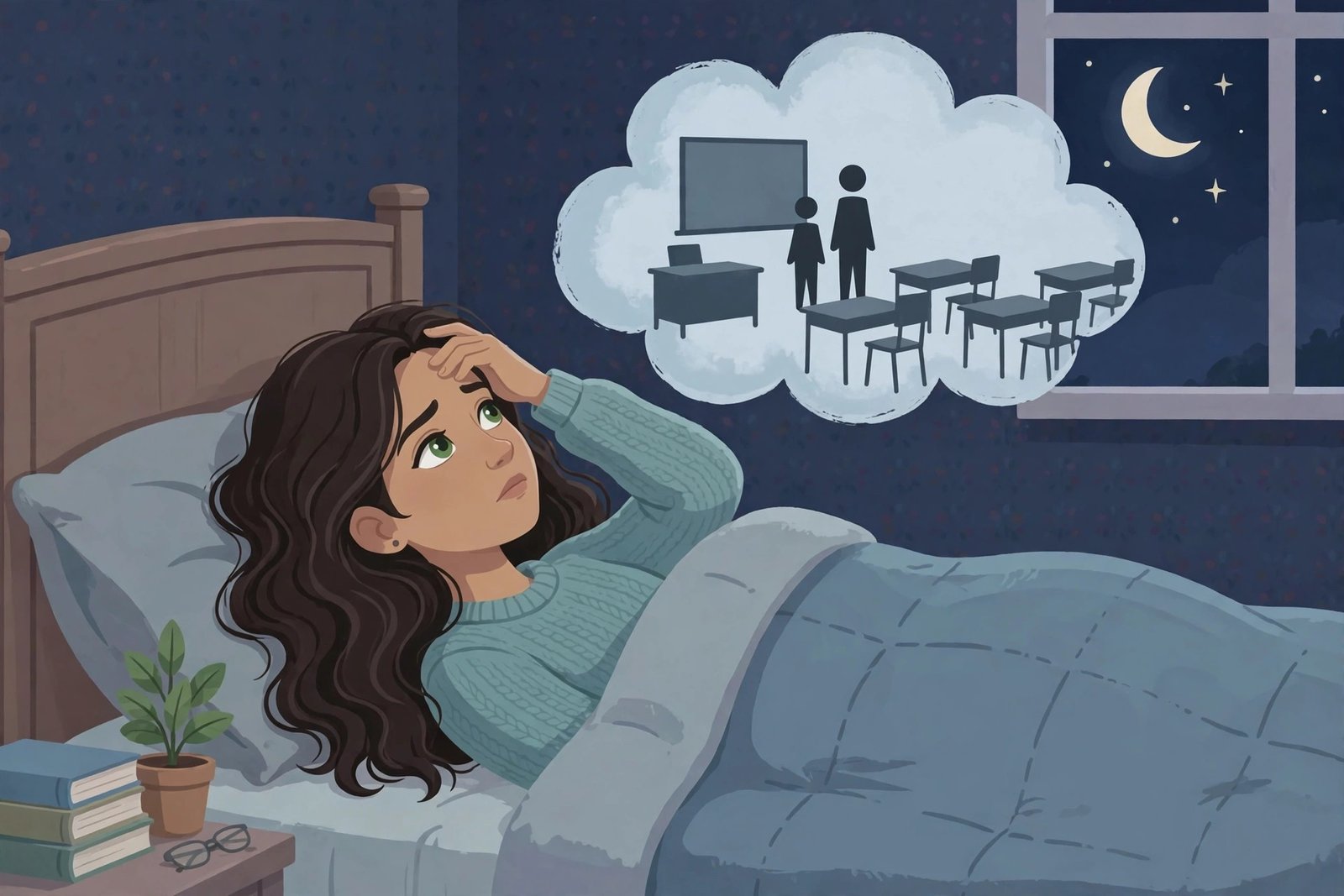
The second kind of imagined talk points backward, and it has a famous star: the perfect comeback that arrives at midnight for an argument that ended at lunch. In the replay, you’re brilliant. You say the exact right words, in the exact right tone, and the room goes quiet. In real life, you said “oh” and walked away. The gap between those two versions is where the replay lives.
Why does your brain bother? Because replays are how it learns. It’s studying the scene for next time: what stung, what you missed, what you wish you had said. A replay or two after a hard moment is a brain doing homework. The sting fades, the lesson stays, and future you gets slightly better lines because past you did the review.
The trouble starts when the replay won’t end. The same scene, the same lines, forty times, each pass making you hotter, sadder, or more awake. That’s no longer homework. That’s a loop, and loops mostly teach one thing: how to feel bad on schedule. If your evenings are full of replays of what a classmate said, our guide on how to stop overthinking what others think of you was written for exactly that spiral, and it pairs well with this one.
A trick that helps many girls: when you notice the replay starting, ask it one question. “What’s the lesson?” Answer it in one sentence, on purpose. “Next time, I’ll say I need a minute instead of going silent.” Then the homework is done, and you can tell your brain, kindly, that class is over. It’ll wander back a few times. Brains are stubborn students. But a named lesson gives the loop an exit door, and exits are what loops usually lack.
And if the comeback still arrives at midnight, try not to hate it. It means you care about how you show up for people, and that you’re still learning to speak for yourself. That’s a good heart doing late homework. Just don’t let it keep you up all night. Even good students need sleep more than they need one more pass at Tuesday.
One more thing replays love to do: they invite guests. A replay about your friend invites a sequel with your teacher, then one with your mom, until the whole cast of your life has performed by midnight. When the guest list grows like that, the theme is rarely the people. It’s the feeling underneath, usually the wish to be understood or forgiven. Naming that wish can end the season. Girls who lie there asking why do i imagine conversations that will never happen, with a different star each hour, are often asking one question in many costumes: does anyone really get me?
Once that real question is named, the fake talks quiet down, because the brain finally heard the actual request. If you’ve nights like that, you aren’t broken. You’re a girl asking why do i imagine conversations that will never happen when what she truly wants is one real talk where she feels heard.
Why Your Brain Loves These Imaginary Talks

Step back and the pattern gets almost sweet. Your brain runs these talks because it’s trying to protect three things you care about: your bonds, your pride, and your safety. Watch how each fake conversation guards one of them.
Bond talks protect your people. You imagine fixing things with a friend, saying the kind thing, being understood at last. Your brain is caring for the relationship in advance, like watering a plant before a trip. Pride talks protect your dignity. In them, you finally explain yourself clearly, and the person who doubted you gets it. Those are your self respect doing push ups. And safety talks protect your future. They scan for trouble: what if she is mad, what if he says no, what if I freeze. Worry, rehearsing with a flashlight.
This is also why the habit gets louder in teen years. Your social world is bigger, faster, and more public than it was at ten. Every day holds more talks that matter, more talks that went sideways, and more talks you can’t control. A brain with more material runs more scenes. Girls who ask why do i imagine conversations that will never happen are often girls with rich social lives and caring hearts, not girls with broken minds. The volume of talks matches the volume of caring.
There’s a cousin habit worth naming, because it proves the same point. Some girls’ brains loop on one person all day: what he said, what it meant, when he’ll text. If that sounds familiar, our guide on is it normal to think about your crush all day looks at that loop closely. Different topic, same machinery. A caring brain, running scenes and signals on repeat. Once you see the machinery, the question why do i imagine conversations that will never happen loses its scary echo. It isn’t “what’s wrong with me.” It’s “my brain cares a lot and rehearses a lot.” Those are workable facts, and kind ones.
When Imagined Conversations Actually Help You

Let us give the habit its credit, because it earns more than it gets. Used well, imagined talks are a free coach, a free rehearsal room, and a free feelings translator, all living in your head.
They help you speak better in real life. Lines you’ve tried in your head come out smoother. Points you sorted in private stay sorted under pressure. Many girls notice that the talk they rehearsed goes nothing like the script, and still goes better because of the script. Preparation bends toward you even when reality improvises.
They help you understand yourself. An imagined talk is a mirror with dialogue. Listen to what your head version of you keeps saying, and you’ll learn what you actually want: an apology, a boundary, more honesty, more rest, less pretending. Girls often solve why do i imagine conversations that will never happen about one person by noticing the same wish inside every scene. The wish is the message. The talk was just the envelope.
They help you be kinder, too. In your head, you can try the gentle version of a hard sentence before the sharp one escapes in real life. You can hear how a reply would land, and choose the one you’ll still be proud of next week. Plenty of real friendships have been quietly saved by an imaginary talk that ate the cruel line first.
And they help you create. Writers, actors, and debaters all live in imagined dialogue on purpose. If your brain writes whole scenes in the shower, it’s showing you a real skill with the volume up. The goal is never to shut the theatre down. The goal is to own the schedule: you decide when the show runs, and you get to leave when it stops helping. When a girl asks why do i imagine conversations that will never happen like it’s purely a flaw, she is missing this whole shelf of gifts. It’s a tool. Tools just need handles.
When the Loop Steals Your Sleep and Your Focus

Now the honest turn. A tool can still wear you out, and this one has a favourite time to do it: bedtime. The day ends, the room goes quiet, and the theatre opens for its longest show. Talks from today replay. Talks for tomorrow rehearse. Sleep clocks out and watches from the hallway. This is the hour when why do i imagine conversations that will never happen stops sounding like a curiosity and starts sounding like a complaint, because you’re tired and the show won’t end.
Loops also steal focus in daylight. You’re in class, but part of your mind is in a talk with your friend that will never happen, at a lunch table that doesn’t exist. The teacher’s words slide past. Your notes have gaps shaped exactly like daydreams. If that’s happening a lot, the habit is no longer serving you. It’s billing you.
Here is a simple way to tell which side of the line you’re on. Helpful talks end. They give you a line, a lesson, or a calmer heart, and then they close. Loops don’t end. They circle the same scene with the same feelings, and you come out of them more tired, more sure everyone is mad at you, and less able to sleep or study. Same theatre. Very different show. Learning to spot the difference is most of the answer to why do i imagine conversations that will never happen too much, as opposed to just enough.
Notice, too, what loops love to feed on: uncertainty. You don’t know what she meant. You don’t know if he is upset. Your brain hates a blank, so it fills the blank with dialogue, and the dialogue is rarely kind, because worry writes it. A girl deep in loops who asks why do i imagine conversations that will never happen is often not short on imagination. She is short on one real answer that only a real talk, or a little time, can give her.
If the loop is stealing sleep most nights or focus most days, that’s your sign to use the closing tools in the next section on purpose, not once in a while. And if the tools aren’t enough, that isn’t failure. That’s information, and the next section covers what to do with it.
Simple Ways to Quiet the Loop and When to Tell an Adult

Good news: loops respond to small, boring, repeatable tricks. You don’t need to win an argument with your brain. You just need to give it an off ramp.
First, park it on paper. Before bed, write the unfinished talk in three lines: what happened, what you wish you had said, what you’ll actually do. Brains loop on open files. Writing is how you show your brain the file has a place to live outside your pillow. Many girls find the show shortens the very first night they try this.
Second, shrink the rehearsal. If a real talk is coming, give your brain a kind limit: two run throughs, then done. Say it out loud if you need to: “We practiced. We’re ready enough.” Brains respect a clear closing time better than a vague wish to stop. Girls who set that limit stop asking why do i imagine conversations that will never happen with quite so much dread, because the talks finally have an ending time, like everything else in a school day.
Third, feed the moment something else. Loops grow in idle, tired, phone lit minutes. A shower with music, a chapter of a book, a slow breathing pattern: these aren’t magic. They’re simply other tenants for the room in your head, and a room with music in it hosts fewer courtroom dramas.
And here is the when to tell an adult part, said plainly. If imagined talks are tangled with dread most days, if you’re avoiding people or places because of what your head says about them, or if low mood, worry, or poor sleep are settling in for weeks, bring in a parent, a school counsellor, or another trusted adult. The TeensHealth guide to anxiety is a calm place to read more: it explains how worry that won’t quit, and keeps getting in the way of school, sleep, and fun, deserves real support. Telling an adult isn’t a confession that you’re broken. It’s how you hand part of the load to someone with stronger arms.
Most girls will never need that step for this habit. For them, the answer to why do i imagine conversations that will never happen stays simple and kind: a caring brain, rehearsing and replaying, that sometimes needs a closing time. Learn to run the theatre, and the same mind that kept you up becomes the mind that talks you through hard days. That isn’t a glitch to fix. That’s a skill to steer.
Frequently Asked Questions
Is it normal to have the same imagined conversation many times?
Yes, especially when the real one never got finished. Your brain returns to scenes that feel open: the apology you never got to give, the question you never asked, the moment you froze. Each return is your mind knocking on the same door, hoping it opens. It fades once real life ends the story, or once you write the lesson down. If you catch yourself asking why do i imagine conversations that will never happen about one scene on repeat, look for the unfinished piece inside it.
Why do the perfect replies only come hours later?
Because your brain needed the pressure to leave the room first. In the real moment, feelings run the show: surprise, embarrassment, the wish to keep the peace. Your clever lines were there, just standing behind all that noise. Later, in the quiet, the noise leaves and the lines step forward, polished and smug. Almost everyone on Earth knows this exact frustration. It doesn’t mean you failed the moment. It means you’re human, with a brain that edits after it performs, like every writer ever.
Can these imagined talks tell me what someone really thinks of me?
No, and this is the most useful no in this guide. The other person in your head is played by you, using your guesses, your mood, and your fears as the script. After a bad day, the head version of your friend gets cruel lines she would never say. After a good day, she gets kind ones. That’s weather, not reporting. If you truly need to know what someone thinks, only a real, calm talk can tell you. Imagined ones can only tell you what you fear or hope.
How do I stop an imagined conversation when I need to sleep?
Give your brain a closing routine instead of a fight. Write the scene in three lines in a notebook by your bed: what happened, what you wish you had said, what happens tomorrow. Then pick a boring, pleasant scene on purpose, like picturing your walk to school in slow detail, and return to it each time the talk restarts. It takes a few nights to train, and it does train. Fighting the thoughts makes them louder. Filing them makes them quieter.
When should I worry about this habit or tell someone?
Tell a trusted adult if the talks come with dread most days, if you lose sleep most nights, avoid friends or school, or feel low and unlike yourself for weeks. Also tell someone if the voices ever stop feeling like your own thoughts, or scare you. That’s rare, and it deserves quick support. And when why do i imagine conversations that will never happen floats up in the dark, answer like you’d a friend: because your brain cares, rehearses, and sometimes needs help closing the theatre.
Pingback: I Pretend to Understand a Conversation: What Now? - The Honest Truth