

This post contains affiliate links. If you buy through them, Mxralis may earn a small commission at no extra cost to you. See our Affiliate Disclosure.
If your bathroom shelf holds a cleanser, two serums, a moisturizer and an SPF, you already own a routine. The real question is whether those products are helping each other or quietly cancelling each other out. Order matters more than most people realize: spread a thick cream on before a watery serum and the serum never really reaches your skin. It just sits on top, pills under makeup, and goes to waste.
Learning how to layer skincare products in the right order is simpler than it sounds. One rule carries you most of the way: go from thinnest to thickest, water-based before oil-based, and keep SPF for last every morning. Follow the steps below and the products you already own will absorb better, work harder, and stop rolling into little crumbs on your face.
Steps
1. Start with a clean, gentle cleanse
Cleansing first gives every layer that follows a clean surface to absorb into. In the morning, lukewarm water alone or a mild cleanser is enough, since your skin only needs to shed overnight oil and leftover night cream. In the evening, take more care: remove SPF and makeup properly so nothing is trapped under your serums. Keep the water lukewarm rather than hot, which can leave skin tight and reactive. Massage the cleanser in for about a minute, rinse, then pat dry with a soft towel. Leave your skin slightly damp rather than bone dry, because the next layers spread and sink in far better on skin that still holds a little water.

2. Apply toner or essence while skin is still damp
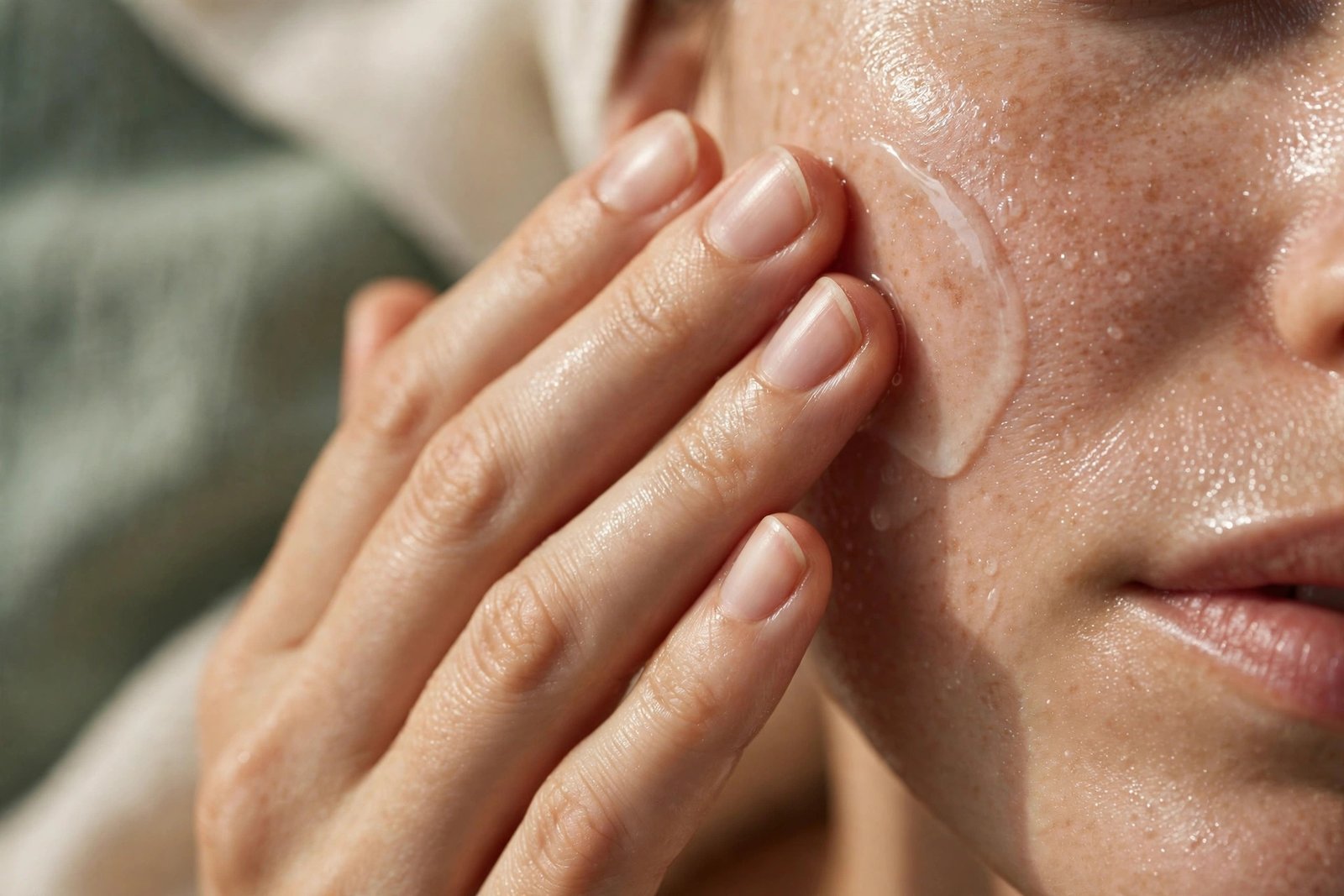
A toner or essence applied to damp skin helps every layer after it spread more evenly and absorb more fully. Think of this step as priming a sponge: slightly wet skin drinks product in, while dry skin lets it evaporate on the surface. Pour a little into your palms and press it over your face instead of rubbing with a cotton pad, which wastes product and can tug at skin. Cover your forehead, cheeks, nose and chin, and do not forget your neck. If your toner is an exfoliating one with acids, you do not need it twice a day; a hydrating toner can be used morning and night. Give it a few seconds to settle before moving on.
3. Layer treatment serums from thinnest to thickest
Serums carry the concentrated ingredients, so they go on before anything heavy has a chance to block them. Start with the most watery texture and end with the thickest or most oily. A hydrating serum usually comes first, followed by a targeted treatment for dark spots, fine lines or breakouts. Use a few drops for your whole face; more product does not mean more results, it just means more pilling. Press serums in with your fingertips rather than rubbing hard. If you use two serums, keep the total routine realistic so you will actually repeat it daily. One well-chosen serum used consistently beats three that you abandon after a week.

4. Press eye cream on before your face cream
Eye cream goes on before face moisturizer so the delicate eye area gets its own targeted layer first. The skin around your eyes is thinner and drier than the rest of your face, and a rich face cream dragged across it can be too heavy. Take a pea-sized amount for both eyes, warm it between your ring fingers, and tap gently along the orbital bone, from the inner corner outward. Avoid pulling or stretching the skin, and keep the product a little distance from your lash line so it does not migrate into your eyes. This step takes twenty seconds and makes concealer sit far more smoothly later.

5. Seal everything in with moisturizer
Moisturizer is the blanket that keeps the water and active ingredients underneath from evaporating off your skin. Without it, much of your careful layering simply dries out into the air. Choose the texture by your skin type: a light gel cream for oily skin, a richer cream for dry skin, something in between for combination skin. Use about a pea-to-dime amount, dot it over your face, and smooth it upward and outward. Bring it down your neck as well, since your neck shows dryness just as quickly. At night you can choose a slightly richer cream than in the morning, because it has hours to work undisturbed.
6. Finish with SPF every morning
SPF is always the final skincare step of the morning, because it needs to sit on top as an even, unbroken shield. Anything applied over sunscreen can disturb the film it forms, which is why serums and creams all go underneath. Use a generous amount for your face and neck; most people apply far less than they think. Smooth it on evenly, let it settle for a few minutes, and only then start makeup. At night, skip this step entirely: your last layer becomes your night moisturizer, or, for very dry skin, a few drops of facial oil pressed over the top as a final seal.
7. Give each layer a moment to settle
Waiting even thirty to sixty seconds between layers prevents pilling and lets each product set before the next one arrives. You do not need a stopwatch or a ten-minute gap; the time it takes to brush your teeth or choose an outfit between steps is plenty. Press products in with warm palms instead of rubbing vigorously, which moves product around instead of into the skin. If you do get pilling, it usually means too much product, two formulas that dislike each other, or layers applied too fast. Reduce the amount first before blaming the product. A calm, unhurried order will fix most layering problems on its own.
Tips
- When in doubt, follow the texture rule: thinnest to thickest, and you will rarely go wrong.
- Introduce one new active product at a time, and patch test it first, so you can tell what your skin loves and what it does not.
- If your skin is sensitive, keep strong exfoliating acids and retinol in different routines, for example acids in the morning and retinol at night, or on alternate evenings.
- Write your order on a small note inside your cabinet door for the first week; by the second week it becomes automatic.
Once the order is second nature, your routine stops being a shelf of products and becomes a system that actually delivers. If you want to see this layering in action, our 10-minute morning routine shows the exact same order at a realistic weekday pace, and our guide to the night routine that fixes your sleep and your skin shows how the evening version winds down without the SPF.