
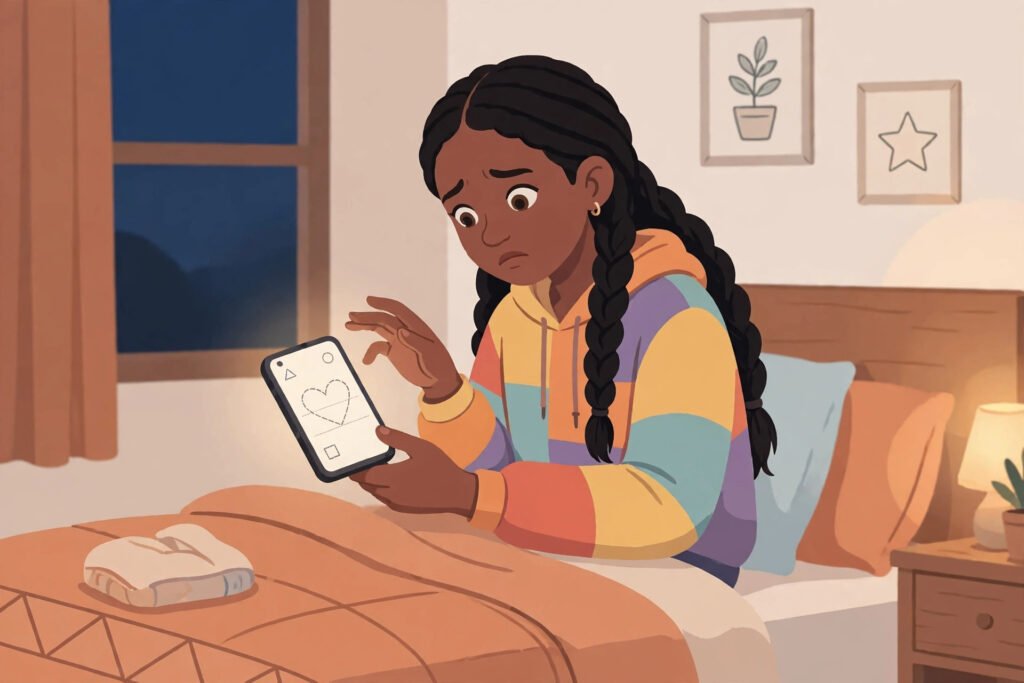
You post a photo you love. Ten minutes pass. Three likes. You check again at lunch. Still three. By dinner, the photo feels ugly to you, even though you loved it this morning. You delete it. Not because you stopped liking it. Because other people didn’t like it loud enough.
Or it’s smaller than that. You ask your friend “does this look okay?” four times before a party. You laugh at a joke you don’t find funny. You agree with an opinion in class, then hear your real opinion whisper, too late, from the back of your mind. All day, in tiny ways, you keep asking the room to vote on you.
If you recognize yourself here, you’re not vain. You’re not fake. You’re a normal human with a normal need that’s running a bit too loud. And one question keeps circling. How can i stop seeking other people’s approval, and start trusting my own voice first?
Here’s the good news. You don’t have to delete the wish to be liked. You couldn’t if you tried, and you don’t need to. The wish isn’t the problem. The problem is who’s in charge. This guide shows you how can i stop seeking other people’s approval becomes a daily practice. Notice your own opinion first. Enjoy praise without needing it. Make choices you can stand behind, even in a quiet room.
By the end, you’ll know the signs the habit is running your day. You’ll have small drills to build self trust. And you’ll know when the hunger for approval gets heavy enough that you deserve real support from an adult.
The Short Answer

Here’s the short answer. You can’t switch off the wish to be liked, and you don’t have to. You demote it. Your opinion gets the first vote. Other people’s votes come after, as extra info, not as the verdict. That’s the heart of how can i stop seeking other people’s approval. Approval becomes a nice bonus, not your oxygen.
Start tiny. Before you ask anyone, ask yourself. Do I like this song, this outfit, this plan? Say your answer in your head, out loud if you can. It feels awkward at first. Then it feels like finding a voice you forgot you had. How can i stop seeking other people’s approval if my own opinion feels silent? You train it like a muscle, with small reps, on low stakes choices, every day.
And when praise comes, enjoy it. Smile. Say thanks. Just don’t build your whole mood on it. Likes go up and down like weather. Your worth can’t ride that roller coaster. So how can i stop seeking other people’s approval for good? Put your voice first, let theirs be second, and practice until the order feels natural.
Wanting to Be Liked Is Human, Not a Flaw

Let’s clear something up first. Wanting to be liked is not a weakness. It’s wiring. Humans survived in groups for thousands of years. Being accepted by the group meant safety, food, and care. Being shut out meant real danger. Your brain still runs that old program. Approval feels like safety because, for most of human history, it was.
Teen brains feel this even more strongly. In these years, your brain is built to tune in to friends. Their faces, their laughs, their silence. It all lands louder than it will at thirty. That’s not drama. That’s development. You’re not broken for caring what your friends think. You’re right on schedule.
So the goal isn’t to stop caring. A girl who truly didn’t care about anyone’s view would miss real feedback and real connection. The goal is balance. Their view informs you. It doesn’t run you. There’s a wide, healthy space between “I never listen to anyone” and “I can’t move until everyone claps.”
Here’s a kinder way to see yourself. You’re not an approval addict. You’re a girl whose volume knob for other people’s opinions got turned up too high. Knobs can turn back down. That’s exactly how can i stop seeking other people’s approval works in practice. Not a new personality. A new setting.
And one more thing. Needing some approval doesn’t make your achievements fake. Your good grade still counts if you smiled when the teacher praised it. Your goal in the game still counts if you loved the cheers. Joy in praise is human. It’s only a trap when praise becomes the price you pay yourself to feel okay. Keep that line in sight, and how can i stop seeking other people’s approval gets much less scary.
You can even see the seed of it in small kids. A toddler holds up a drawing and scans your face before she decides if it’s good. That scan isn’t taught by bad people. It’s just human. The work of the teen years isn’t to kill the scan. It’s to add a step before it. Her own look at the drawing, with her own eyes, before she checks yours. That step is small, and it changes everything that comes after.
How the Approval Habit Quietly Runs Your Day

The habit rarely looks dramatic. It doesn’t announce itself. It runs your day in small, quiet moves that feel like nothing. You pick the outfit that got compliments last time, not the one you love. You order what your friend orders. You say “same” in the group chat before you even know your own take.
Watch a normal school day through this lens. Morning: you change your shirt twice, picturing the hallway jury. Class: you know an answer, but you stay silent because a wrong answer might look dumb. Lunch: you laugh along at a joke about a younger kid, and your stomach twists. Afternoon: you check your story views six times. Night: you reread a text you sent, hunting for a tone that might have annoyed someone.
None of these moments ruins a life. But stacked together, they teach your brain a sad lesson. Other people’s reactions matter more than your own signals. Your signals go quiet. Then you need even more approval, because it’s the only voice left in the room. That’s the loop. Seeing the loop is the first crack in it.
If your head spins for hours after small moments like these, you’re not alone in that either. Our guide on how to stop overthinking what others think of you walks through the replay habit and how to calm it. The two habits feed each other. The more you seek approval, the more you replay. The more you replay, the more you seek.
Try a one day audit. No judgment, just notes. Every time you check a like count, change a choice for an audience, or ask “is this okay?” out loud, make a tiny mark in your notes app. Most girls are shocked by their own number. Shock is useful here. You can’t change a habit you can’t see, and asking how can i stop seeking other people’s approval starts with seeing your own day clearly.
And be gentle with what you find. A high number doesn’t make you pathetic. It makes you honest. Every mark on that list is a spot where a small new choice can grow. That’s hopeful, not shameful. Girls who ask how can i stop seeking other people’s approval and then look at their day without flinching are already halfway out of the loop.
Start Noticing Your Own Opinion First

Here’s the core skill. Before you collect anyone else’s view, catch your own. It sounds simple. It’s not, if your brain is trained to poll the room first. Your opinion often shows up as a fast, quiet signal. A small yes in your chest. A tiny no in your stomach. It arrives before words. You just have to pause long enough to hear it.
Use the ten second rule. When a choice appears, give yourself ten seconds before you look at anyone’s face. Ten seconds to ask, what do I actually want here? At first, the answer may feel blank. That’s okay. Blank is what an untrained muscle feels like. Keep asking. The signal gets clearer with reps, like a radio tuning in.
Start with the smallest choices on earth. Which snack. Which song in the car. Which notebook cover. Pick by your gut, not by what photographs well. Say it out loud when you can. “I want the blue one.” Tiny sentence. Big training. Each one tells your brain that your voice counts as data.
Then move up a level. Opinions. Your friend group debates a movie, a singer, a school rule. Before you nod along, find your real take. You don’t always have to say it. Knowing it is the rep. Saying it sometimes is the bonus rep. Girls learning how can i stop seeking other people’s approval often find this step changes everything. The room stops being a jury. It becomes a conversation you’re part of.
One warning. Your own opinion won’t always be the popular one, and that will sting at times. A sting isn’t a stop sign. It’s the feeling of a muscle working. Athletes don’t quit because a workout burns. They know the burn means growth. Same here. The discomfort of holding your own view, kindly and calmly, is the workout itself.
And when you truly have no opinion? That happens too, and it’s fine. Not every choice matters. The skill isn’t having a take on everything. It’s knowing the difference between “I don’t care” and “I care but I’m scared to say it.” That difference is the whole map of how can i stop seeking other people’s approval, drawn in one line.
Compliments: Nice to Hear, Dangerous to Need

Compliments are lovely. A real one can warm your whole day. “Your presentation was great.” “That color suits you.” “You’re a kind friend.” Nothing in this guide asks you to swat praise away or act cool about it. Smile. Say thanks. Let it land. Enjoying a compliment is healthy. Needing one is where the trouble starts.
Here’s the difference. Enjoying means the compliment adds to a day that was already okay. Needing means your day waits for a verdict. Without praise, you feel flat, unsure, a bit lost. With it, you fly. Then it fades, and you need more. That’s not confidence. That’s a drip feed. And drip feeds always run dry at the worst moment, like the night before a big day.
Watch for the hidden tax of needing praise. You start picking safe wins. The easy class. The outfit that’s already approved. The opinion everyone holds. Risky choices might fail, and failure brings silence, or worse, jokes. So your life shrinks to the size of what’s guaranteed to earn claps. That’s a small life for a girl with a big future.
This is also where approval seeking can slide into peer pressure. The teen health experts at Nemours KidsHealth explain in their guide on peer pressure how groups send quiet signals about how to dress, talk, and act in order to win acceptance and approval. When your need for that approval runs high, those signals stop feeling like pressure. They feel like instructions. Naming that link is a big step in how can i stop seeking other people’s approval, because it shows you the habit isn’t just in your head. It’s in the room too.
A healthier way to hold praise: treat it like weather, not like climate. Weather changes daily. Climate is the deep pattern. A compliment is weather. Nice sun today. Your climate is what you know about yourself on a plain Tuesday with no comments at all. Build the climate. Let the weather be a bonus.
Try this small practice. When a compliment lands, enjoy it for ten seconds, then add one of your own. Not out loud. In your head. “She liked my essay. And I know I worked hard on the second draft.” Your voice joins theirs. Over time, your voice gets the last word. That’s how can i stop seeking other people’s approval grows teeth. Praise becomes dessert. Your own view becomes the meal.
Being Chosen Is Not the Same as Being Valued

Few feelings sting like not being chosen. The team list without your name. The group chat you hear about on Monday. The party you weren’t invited to. Your brain reads it as a verdict on your worth. Chosen equals worthy. Not chosen equals not enough. That math feels true. It isn’t.
Being chosen is often about fit, timing, and other people’s needs. A coach picks height for a position. A host has six chairs, not seven moods about you. A group forms around one shared class, not around a ranking of humans. Plenty of choosing has almost nothing to do with your value. It just doesn’t feel that way from the outside.
Being valued is quieter and deeper. Valued means people know the real you and keep showing up. They text back. They save you a seat. They remember your hard week and ask about it later. A girl can be chosen by a popular group and valued by no one in it. She performs, she smiles, she goes home empty. Chosen is a photo. Valued is a home.
So when the sting hits, ask a better question. Not “why didn’t they pick me?” but “who actually knows me and treats me well?” That list may be short. Short is fine. Two people who value you beat twenty who merely chose you for a roster, a photo, or a plus one. Build there. That’s where how can i stop seeking other people’s approval gets practical. You stop chasing every door and start watering the rooms where you’re already welcome.
And give it time. Being valued grows slowly, through small honest moments. You share a real opinion. You admit a bad day. You let people see the unedited you, a little at a time. The ones who stay for that version are your people. The performance can retire. Girls who learn how can i stop seeking other people’s approval often say this part feels like exhaling. You don’t have to earn your seat every single day.
Here’s a small story that shows the difference. Two girls try out for the same dance crew. One gets picked. The other doesn’t. By chosen math, one wins and one loses. But watch what happens next. The picked girl spends every practice scared of losing her spot. The other girl joins a smaller crew where the coach knows her name, her style, and her bad days. By spring, guess who’s happier and steadier? Being valued feeds you weekly. Being chosen feeds you once, on the day of the list. When a no stings, run the spring test. Ask where the weekly feeding actually is. That’s how can i stop seeking other people’s approval turns into a compass.
It points you, again and again, toward the rooms where you’re known, not just the rooms where you’re picked.
Small Ways to Trust Your Own Choices

Self trust isn’t built by one big brave moment. It’s built by tiny kept promises. You say you’ll study for twenty minutes, and you do. You pick the club you actually like, and you go. You wear the shoes you love, and you survive the day. Each kept promise is a brick. Enough bricks become a floor you can stand on.
Start a proof list. Notes app, paper, whatever sticks. When you make a choice from your own gut and it goes fine, write it down. “Wore the yellow sweater. Felt good all day.” “Said I liked the unpopular singer. Nobody died.” On shaky days, read the list. It’s hard to argue with your own evidence. Feelings shout. Evidence sits there, calm and true.
Delay the poll. When you want to ask the group chat “should I?”, wait one hour. Live with your own answer for that hour. Most of the time, the urge to poll fades, and your answer still stands. You’ve just proven you can hold a choice without a jury. Do that a few times a week and watch your spine grow.
It also helps to spend time where likes don’t exist. Offline hobbies. A sport where your body gives the feedback. Drawing in a notebook nobody sees. Our guide on how to feel confident without chasing likes goes deeper on that offline confidence, and it pairs well with this one. A life with some unposted corners reminds you that a moment can be good before anyone rates it.
Expect wobbles. Some days you’ll poll everyone and delete a photo and feel fifteen steps behind. That’s not failure. That’s a habit in the middle of changing. Habits bend before they break. Note the wobble, be kind to yourself, and take the next small rep. Trust built slowly is trust that lasts. That’s the quiet engine of how can i stop seeking other people’s approval. Not a personality transplant. A hundred small kept promises.
And let your future self help. Before a hard choice, ask, what will I think of this tomorrow morning? Tomorrow you is wise. She doesn’t care about the hallway jury. She cares that you slept well and kept your word to yourself. Borrowing her eyes, even for ten seconds, is a rep too. Girls deep into how can i stop seeking other people’s approval use that trick daily, and it keeps working because it never really gets old.
When Approval Hunger Hurts Too Much

For most girls, this habit is annoying but manageable. Sometimes, though, it grows teeth. Your whole mood hangs on replies. Silence from a friend ruins a full day. You change your beliefs with every group you’re in. You say yes to things that scare you, just to stay liked. You check counts so often that homework and sleep start to crack.
Those are signs the hunger is hurting you, not just nudging you. And they’re signs you deserve support, not shame. This isn’t a character flaw. It’s a pattern that got too strong, often after a lonely patch, a friendship breakup, or a rough year. Patterns that strong rarely loosen alone. That’s not weakness. That’s just how deep patterns work.
Tell an adult you trust. A parent, a school counselor, an aunt, a coach. You don’t need a dramatic speech. Try this. “I care so much about what people think that it’s making me anxious most days. I want help with it.” That’s enough. A good adult will take it from there. Counselors hear this exact sentence all the time, and they have real tools for it.
If the hunger comes with panic, tears most days, or a wish to disappear from school life, please speak up sooner, not later. Help works best early. And asking for help is not another bid for approval. It’s you, valuing yourself enough to act. In a way, it’s the strongest proof that how can i stop seeking other people’s approval is already working in you. You chose your own wellbeing over your image. That’s the whole skill, right there.
You were never meant to be voted into worth. You’re a person, not a post. Some days the room will clap. Some days it won’t notice. Either way, the girl in the mirror gets the first and last word. Practice giving her that word, kindly and daily, and watch how steady you become.
None of this means you stop listening to people you love. A mom who knows you well, a friend who tells you the truth even when it’s awkward, those voices are gold. The habit to break isn’t listening. It’s obeying every voice at once, including strangers, silent followers, and a like count at midnight. Filter the voices. Keep the gold. Let the noise pass by.
Frequently Asked Questions
Is it bad to enjoy compliments?
Not at all. Enjoying praise is healthy and human. Smile, say thanks, let it warm you. The trouble starts when you need praise to feel okay at all. Then a quiet day feels like failure, and a kind word becomes a lifeline instead of a bonus. Learning how can i stop seeking other people’s approval doesn’t mean refusing compliments. It means building a steady base of self trust, so praise is dessert, not the meal. Enjoy the dessert. Just eat the meal too.
How do I know if I seek approval too much?
Check your patterns, not your worth. Do you change outfits, opinions, or plans just to match the room? Does one unanswered text or a low like count ruin your day? Do you ask “is this okay?” many times a day, even for tiny things? If yes shows up a lot, your approval volume is high. That’s useful data, not a verdict on you. Girls who ask how can i stop seeking other people’s approval usually spot themselves in that list, and spotting it is step one.
What do I do when nobody reacts to my post?
First, breathe. A quiet post is not a verdict. People scroll fast, apps bury posts, and friends get busy with their own days. Ask yourself one honest question. Did I like this photo before I posted it? If yes, let it stay. Deleting teaches your brain that the room owns your joy. Leave it up, close the app, and go do something that feeds you offline. The urge to check fades faster than you think, and each time you ride it out, you get steadier.
Can I stop caring what people think at all?
No, and you don’t need to. Caring a little keeps you kind, tuned in, and socially smart. The goal was never zero care. It’s the right order. Your voice first, theirs second. Think of other people’s views as weather reports. Useful info, worth a glance, but you still choose your own clothes. When girls ask how can i stop seeking other people’s approval, they often fear becoming cold. You won’t. You’ll become steady, which is warmer in the long run.
What is the first small step I can take today?
Pick one tiny choice and make it alone. The snack you actually want. The song you actually love. The answer you actually believe. Don’t announce it. Don’t poll the chat. Just choose, and notice that the world keeps spinning. Then write it down as proof. One rep feels small. A week of reps feels like a shift. That’s the honest answer to how can i stop seeking other people’s approval. Not a leap. A staircase, climbed one honest choice at a time.