

You get a 92 on the test. Your eyes skip every right answer and land on the missed ones. You sing in the school show, hit almost every note, and the one flat note is the only sound you hear on the bus home. Your friend laughs hard at someone else’s joke, and a small voice says, see, you’re the boring one.
Notice something. The scenes share nothing. A test, a song, a laugh in the hallway. But the feeling that follows you into all of them is the same. I’m not good enough. Not smart enough, not talented enough, not fun enough. The word after “not” changes. The verdict doesn’t.
If that verdict lives in your head most days, you’re not lazy and you’re not dramatic. You’re a girl with a harsh inner voice, and it’s louder than the facts. And one question keeps circling. How can i be confident when i never feel good enough, no matter what I do?
Here’s the honest start. That feeling isn’t a measurement of you. It’s a habit of your mind, and habits can change. This guide breaks down how can i be confident when i never feel good enough into real steps. Where the voice came from. Why it lies. How to collect proof against it. And how to talk to yourself in a way that builds you instead of grading you.
None of this asks you to become arrogant or to fake a smile. Confidence here means something quieter. Trusting that you’re enough to try, to stay in the room, and to speak, even while your hands shake a little.
The Short Answer

Here’s the short answer. Confidence doesn’t come from finally feeling perfect. It comes from deciding the verdict is wrong and acting anyway, in small ways, until your brain collects new evidence. That’s the core of how can i be confident when i never feel good enough. You don’t argue with the feeling once and win. You out practice it.
The never good enough feeling is a voice, not a fact. Voices can be retrained. Every time you finish a hard thing, speak up once, or treat yourself fairly after a mistake, you hand your brain a new record. Records stack. Stacks become belief. How can i be confident when i never feel good enough if the voice never fully shuts up? You build a second voice, kinder and better informed, and you let it talk more often.
Start small and start today. One finished task. One fair sentence to yourself. One thing you do even though the verdict growls. That’s not a poster slogan. That’s the actual mechanism. So how can i be confident when i never feel good enough for real? Small proof, fair words, repeated days. The feeling fades as the evidence grows, and it does grow.
The Never Good Enough Feeling Is a Thought, Not a Fact
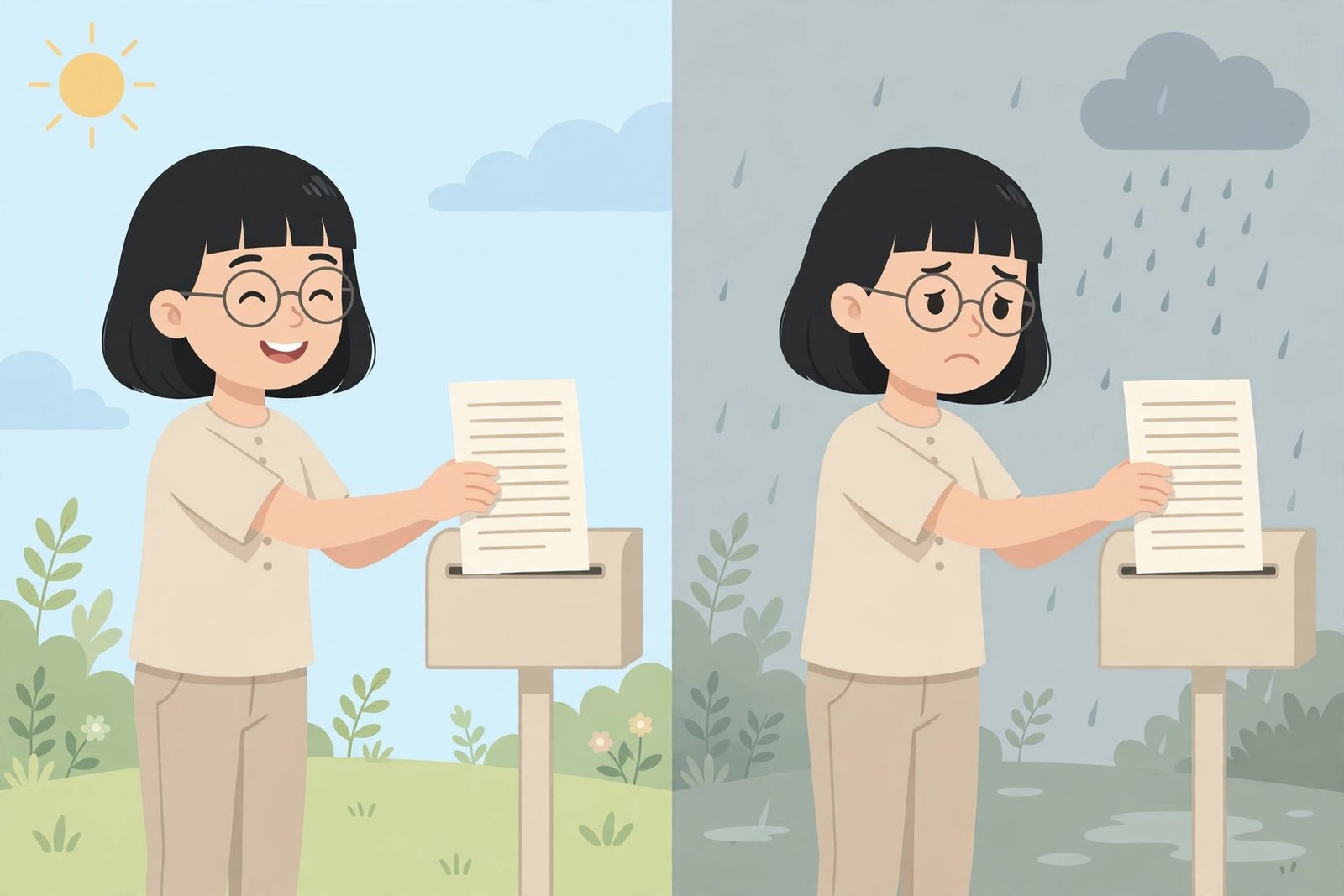
Read that heading again, because your brain will argue with it. The feeling feels like a fact. It arrives with the weight of a test score or a scale. It sounds like a report about you. But a feeling is weather, not climate data. It tells you about your mood and your habits of thought. It does not measure your worth, your talent, or your future.
Here’s a quick proof you can test yourself. Hand in the same essay on a good day and a bad day in your head, and watch the grade your inner voice gives it change. The essay didn’t change. Your sleep, your stress, and your mood did. A real measurement doesn’t swing with your breakfast. A mood does. When the verdict swings, it was never a verdict. It was weather wearing a judge’s robe.
The voice also grades with a rigged scale. It counts every miss at full weight and files every hit under “luck,” “easy,” or “she was just being nice.” Run any life through that scale and it fails. A top athlete could take your inner test and flunk it. The scale is broken, not the girl being weighed. Seeing the rigging is the first crack in it.
Give the feeling a name when it shows up. Not “the truth.” Call it the never good enough feeling, like you’d name a rainy front moving through. Naming it puts a small, saving distance between you and it. You stop being the storm. You become the girl watching weather she doesn’t have to obey. Girls who practice that distance start to see how can i be confident when i never feel good enough isn’t a riddle about worth. It’s a skill question about which voice gets the mic.
And be fair to yourself about one thing. This feeling is incredibly common in these years, even among girls who look sure of themselves from the outside. The class star has it before results day. The team captain has it in the locker room. You’re not behind some curtain of broken girls. You’re in a huge, quiet crowd, and most of them think they’re the only one. You’re not. That’s worth remembering on the days the voice says you’re uniquely hopeless. It lies about that too. It lies about almost everything, which is exactly why how can i be confident when i never feel good enough begins with not believing the loudest voice in the room.
Where That Harsh Inner Voice Comes From

Voices aren’t born. They’re built, mostly out of things you heard and patterns you absorbed before you could question them. If praise was rare and correction was loud in your early years, your brain learned a style. Scan for flaws first. It’s trying to protect you from disappointing people. It just never learned when to stop scanning.
The health experts at Nemours KidsHealth explain this well in their guide on how teens can improve their self-esteem. The people in your life shape how you feel about yourself. When adults focus on what’s good in you, you learn to feel proud. When scolding outweighs praise, it gets hard to feel good. And they name the voice in your own head as a key player. Thoughts like “I’m such a loser” quietly tear self-esteem down, word by word.
Old teasing can build the voice too. A nickname from grade five. A sibling’s joke about your grades, your laugh, your anything. Kids drop those lines and forget them. The girl who heard them sometimes carries them for years, in her own voice, long after the room changed. If a sentence in your head sounds like a specific person, that’s a clue. It might be an echo, not an opinion you chose.
Being praised only for being “smart” or “perfect” can backfire too. If love felt tied to flawless results, mistakes stop feeling like information. They feel like danger. So the voice gets strict, hoping strictness keeps you safe and loved. It means well. It’s just using a painful tool for the job.
Knowing where the voice came from changes how you hear it. It’s not the voice of truth. It’s the voice of old rooms, old fears, and other people’s moods, recorded and replayed. You can respect your past without letting it narrate your future. That shift in hearing is where how can i be confident when i never feel good enough starts to get an answer. You stop asking how to silence a judge. You start asking how to retire a recording.
And here’s a hopeful detail. If the voice was built, it can be rebuilt. The same brain that learned to scan for flaws can learn to scan for proof, effort, and growth. It won’t flip in a week. Brains change by reps, not by speeches. But every section after this one is a set of reps. Reading about where the voice came from is rep zero. The real training starts now, and it starts with the word the voice hates most. Enough. Specifically, learning how can i be confident when i never feel good enough means learning what enough actually is.
Good Enough Is Not the Same as Perfect

The voice’s favorite trick is moving the goalposts. You aim for a good grade, get it, and hear, “Well, it wasn’t the top grade.” You finish the drawing, and it says, “Real artists would do better.” Any win gets redefined as not the real win. Play that game for years and of course you feel behind. The finish line runs away for a living.
Perfect is a photo. It’s frozen, filtered, and impossible to live inside. Good enough is a life. It says, I did my best with the time, energy, and knowledge I had today. Some days your best is a 92. Some days your best is handing something in at all, during a hard week, with a headache and no sleep. Both can be good enough. The voice only accepts the photo. You get to accept the life.
Try grading like a kind teacher instead of a courtroom. A kind teacher looks for what improved, names one thing to work on, and sends you off believing the next try matters. She doesn’t circle one error in red and declare the whole student a failure. You already know how to spot that fairness when it flows toward friends. The practice is letting it flow toward you.
There’s a sentence worth memorizing for report card days, audition days, all the verdict days. Done well beats perfect and unfinished. A finished, imperfect essay teaches you more than the flawless one that stayed in your head because it never felt safe to write. The voice would rather you attempt nothing than risk a B plus. That preference is the trap. Every attempt it blocks is proof you’ll never get to collect.
Let good enough have a floor you define in calm moments. For homework, good enough might be: complete, checked once, handed in on time. For a song: practiced, sung all the way through, one shaky note allowed. Floors end the moving goalposts. When the day meets your floor, the day counts, whatever the voice says. This is how can i be confident when i never feel good enough gets practical. You stop chasing a horizon and start standing on ground you chose.
And notice what happens to your energy. Girls who live by the photo spend their fuel on hiding flaws. Girls who live by a floor spend it on growing. Same girl, same talent, whole different year. Confidence isn’t the prize for becoming perfect. It’s what grows when you stop demanding perfect as the entry fee for feeling okay. That is how can i be confident when i never feel good enough turns from a wish into a working rule.
Collect Small Proof That You Are Doing Okay

Your brain believes records more than pep talks. A poster that says “you’re amazing” feels nice for a minute and fades by lunch. A list of real things you did, in your own handwriting, is harder to argue with. So start collecting. Not trophies. Proof. The small, boring, true kind.
Keep a proof list where you’ll actually see it. A notes app page works. Every day or two, add one line. Finished the hard chapter. Helped Mia understand the homework. Showed up to practice when I wanted to hide. Spoke once in class. None of these will trend anywhere. All of them are evidence that you function, you contribute, and you finish things. On verdict days, read the list before you let the voice open its case.
Make the proof specific. Vague lines like “did okay today” slide off the brain. Details stick. “Stayed calm when the experiment failed and started it again.” “Sent the message I was scared to send.” Specific lines are hard to file under luck. They have your name and your effort written all over them, which is exactly what a rigged scale hates.
There’s a bigger confidence picture here too. Real confidence grows from what you do and record, not from applause. If you want more on building that kind of steady base, our guide on how to feel confident without chasing likes is a good next read. It pairs with this one, because applause fades by dinner, but a proof list is still true at midnight.
Share the collecting with a friend if you can. Trade one proof line each at the end of the day, by text, no ranking allowed. Hers will remind you that normal girls collect small wins too. Yours will get witnessed, and witnessed proof weighs more. Some days your line will be tiny. “Got out of bed on the hard morning.” Tiny counts. Tiny is still proof, and proof is the whole game of how can i be confident when i never feel good enough.
Give it a month before you judge it. Brains don’t update on three entries. They update on thirty. By then, the list starts answering the voice before you do. The voice says you never finish anything. The list shows twelve finishes. You don’t have to win the argument with feelings. You win it with a record. That’s how can i be confident when i never feel good enough stops being a debate you lose nightly. It becomes a file you keep, and the file keeps growing.
Talk to Yourself Like You Would Talk to a Friend

Run this experiment in your head. Your best friend gets a 78 on a quiz she studied for. She sits by you, eyes wet, and says she’s stupid. What do you say? You don’t agree. You don’t hand her a list of her flaws. You say, “Hey. One quiz. You were tired, the questions were weird, and you’re not stupid. We’ll review it together.”
Now compare that voice to the one you use on yourself at the same score. Slower? No. Harsher. Faster. Crueler. Most girls run two courts. A fair one for friends, and a rigged one for themselves. The practice in this section is simple to say and life changing to do. One court. Same rules. Same kindness standard, both directions.
Start by catching the sentence. The voice talks fast, so slow it down by writing it. “I ruin everything I try.” Seeing it on paper shrinks it. Then rewrite it the friend way, keeping it true. Not fake sunshine. True. “I messed up one part of one try. Other parts went fine. I can fix the weak part next round.” True sentences are the only kind your brain will actually accept, so keep them honest and specific.
Watch for the voice’s favorite words. Always. Never. Everyone. Nobody. “I always choke.” “Nobody likes my ideas.” Those words are the rigging showing. Real life rarely deals in always and nobody. Swap in accurate words. “I choked on Tuesday’s presentation and did fine on Friday’s.” Accuracy sounds less dramatic. It’s also the truth, and the truth is the only ground confidence can stand on.
Tone matters as much as words. The friend voice is warm, a bit funny, on your side. Practice borrowing it out loud if you can, in your room, in the shower. It feels silly for a week. Then it starts feeling like yours. Girls deep in this work say the same thing. The kind voice doesn’t arrive as a gift. It arrives as a habit, built sentence by sentence, exactly like the harsh one was. That’s the hopeful symmetry inside how can i be confident when i never feel good enough. What was built against you can be built for you.
One more tool. Give the harsh voice a name and a look, something a bit ridiculous. A cranky old referee with a broken whistle. When it blows the whistle on your whole worth over one mistake, you can smile and say, that’s just Ref again. Humor shrinks the voice’s authority. It becomes a character you manage, not a god you obey. And every day you manage it kindly, you practice how can i be confident when i never feel good enough in the most direct way there is. You become the adult in your own head, and she’s on your side.
School, Talents, Friendships: The Feeling Wears Many Costumes

One reason this feeling is so hard to beat is that it changes costumes. Beat it in math, and it shows up at choir. Settle it at choir, and it appears at lunch, whispering that you’re the dull friend. You start to think you’re failing everywhere. You’re not. It’s one voice with a wardrobe, and spotting the wardrobe is half the win.
At school, it wears the grade costume. It treats every score as a final ruling on your intelligence. But grades measure one performance, on one day, on one slice of a subject. They don’t measure your curiosity, your effort across a year, or what you’ll know by June. A girl is not a number with hair. When the costume shows up at report time, name it. “That’s the verdict voice in its school outfit.” Naming shrinks it.
In talents, it wears the comparison free costume, the pure inner one. You draw, you dance, you code, you bake. No rival needed. The voice just holds your work next to an ideal in its head and sighs. Notice it never compares you to other beginners at your level, learning at your speed. It compares your draft to a master’s final. Any beginner flunks that test. Judge your work against your work from three months ago. That’s the only fair match, and it’s usually a kinder story.
In friendships, it wears the personality costume. Too quiet. Too much. Not funny enough, not interesting enough. It treats friendship like an audition you keep failing. But your friends didn’t cast you. They chose you across ordinary days, group chats, and boring Tuesdays. They have data the voice ignores. This is also where the feeling borrows outside judges. If you often hear verdicts in other people’s imagined voices, our guide on why am I so afraid of being judged by others pairs well with this one. The imagined jury and the inner judge are close cousins, and calming one helps calm the other.
Here’s the practice for all three costumes. When the feeling hits, ask two questions. Which costume is this? And what would count as proof here, real proof, not vibes? A finished problem set. A cleaner second verse. A friend who texted first. Answer with evidence, and the costume loses its power. Costumes impress. Evidence convinces. Collect enough evidence across enough arenas, and how can i be confident when i never feel good enough starts answering itself, in school, on stage, and at the lunch table.
And when all three costumes attack in one week, be extra gentle. That’s not a sign you’re worse than everyone. That’s a sign you’re tired, stretched, or carrying something heavy offstage. Rest is a strategy too. A rested brain grades fairer. Even one early night can turn the judge’s volume down by half, and you’ll wonder why yesterday felt so final. It wasn’t final. It was fatigue in a costume, and now you can spot those too. Fair grading, rest, and proof are the soil where how can i be confident when i never feel good enough grows.
When Feeling Not Good Enough Means You Should Tell an Adult

Most days, this feeling is a loud but manageable companion. The tools above can turn its volume down, week by week. But sometimes the feeling stops being a voice and becomes the whole weather. It greets you every morning. It kills your interest in things you used to love. It follows you into sleep, into meals, into every room, and self talk stops touching it.
Those are signs to bring in an adult, sooner rather than later. A parent, a school counselor, a trusted teacher, a family doctor. Not because you’re broken. Because a feeling that heavy deserves more hands than just yours. Counselors hear this exact sentence from teens constantly. You won’t be their first case or their strangest. You’ll be a normal girl asking for tools, which is a brave and sensible thing to do.
You don’t need a perfect speech. Try this shape. “Most days I feel like I’m not good enough at anything, and it’s getting heavy. I’ve tried being kinder to myself, and I think I need more help.” That’s enough to start. A good adult will ask questions and help you find the next step. If the first adult shrugs it off, tell another one. Keep going until someone hears you properly. That’s not being dramatic. That’s being persistent about your own wellbeing.
Asking for help fits the whole spirit of this guide, by the way. It isn’t the opposite of confidence. It’s confidence in action. A girl who values herself gets support the way she’d get a brace for a sprained ankle, without shame, because she plans to keep walking. If you’re wondering how can i be confident when i never feel good enough and the honest answer feels like “I can’t do this part alone,” that’s not failure. That’s information, and acting on it is the strongest move in this article.
You deserve to walk through your days without a rigged judge narrating. The verdict was never true. It was a habit, an echo, a costume collection. And habits can be retrained, echoes can fade, and costumes can be retired, one small proof and one fair sentence at a time. Start today. Your future self is already grateful. Kind reps, repeated in your favor, are how can i be confident when i never feel good enough turns from a daily question into a fair description of you.
Frequently Asked Questions
Why do I feel not good enough even when I do well?
Because the feeling isn’t wired to your results. It’s wired to a habit. Your inner voice grades with a rigged scale. Wins get filed under luck. Misses get circled in red and kept for months. So your head’s scoreboard shows loss after loss while your real record holds plenty of wins. The fix isn’t one huge achievement. It’s fair grading and small proof, collected daily. That’s how can i be confident when i never feel good enough on your good days too.
What’s the difference between good enough and perfect?
Perfect is a frozen photo. Flawless, filtered, impossible to live inside. Good enough is a standard you set on a calm day. Honest effort, checked once, handed in. With perfect, every result feels like failure, because real life never matches a photo. With a clear floor, results can count, and counted results grow confidence. That swap, photo for floor, sits at the center of how can i be confident when i never feel good enough.
What do I say to myself after a bad grade?
Start with facts, not verdicts. “I got a 74 on one quiz, in one subject, on a tired week.” That’s true. “I’m stupid” is the voice in its school costume, not a fact. Then use the friend sentence. “One quiz isn’t my whole brain. I can review the two topics I missed.” Then take one small step, like ten minutes of review, and log it as proof. Facts, fairness, one action. That order is how can i be confident when i never feel good enough after a rough result.
Why does the feeling show up with my friends too?
Because the voice owns many costumes, and friendship is one of its favorites. There, it stops grading your work and starts grading your personality. Too quiet, too much, not fun enough. It’s the same rigged scale, aimed at a new target. The giveaway is that it ignores evidence. Your friends keep choosing you, texting you, saving you seats. That’s real data. When the friendship costume talks, answer with data. The costumes lose their scare with practice.
What’s one small step I can take today?
Start a proof list, and add one true line before bed. Something you finished, handled, or survived today. “Finished the essay even though it felt bad.” One line feels tiny. It isn’t. It’s the first exhibit in a new record, and records are what brains trust. Add a line most days, then read them all on the next verdict day. That small habit is how can i be confident when i never feel good enough. Not a leap. A list, growing one honest line at a time.